
“Stranger Things” Season 5 (Netflix)
Yoon Haein: Netflix’s flagship series “Stranger Things” is set in the 1980s in Hawkins, a fictional town in the U.S. state of Indiana. The story begins when eleven-year-old Will Byers goes missing one day. As his friends Mike, Dustin, and Lucas search for him, they meet a girl with supernatural powers named Eleven (El). Through El, they learn that Will was taken into the Upside Down. Meanwhile, Will’s mother, Joyce, and Hawkins police chief Hopper also search for Will, and they come face to face with one strange phenomenon after another. Over the past four seasons, the show has carefully unfolded what the Upside Down is, why El became someone with supernatural powers, and who Vecna, the final villain who took Will into the Upside Down, really is.
There are plenty of keywords that explain why “Stranger Things” is so popular and fun. There is a setup that feels straight out of Dungeons & Dragons (D&D), the visual thrills of creature-feature horror, the chemistry among a wide range of memorable characters, and a world that vividly recreates 1980s culture while paying homage to cult classics. On top of that, there is another kind of drama that hits just as hard: the joy of a coming-of-age story seen through kids. Since Season 1 premiered in 2016, nine years have passed, and the child actors who were in their early teens are now adults. Over five seasons, the characters in the story have also grown up in their own ways, becoming more mature as they learn to understand themselves. For example, in the previous season, El loses her powers and regains them as she fully confronts the past memories she had erased. What brings Max back to the real world, when she was left standing on the edge of life by past sadness and trauma, is the memories and bond she shares with her friends, captured by the song she loved, “Running Up That Hill.” At the end of Episode 4 in Season 5, when Will feels confused about what he can do and why he is different from others, Robin’s line feels like the message that runs through the entire show: “The problem was always me. I only looked for answers in other people, but all the answers were inside me.” Becoming an adult means getting to know yourself. The kids of Hawkins are slowly becoming adults in exactly that way.
Of course, Hawkins is still in danger. In Season 5, Max is still in a coma in the hospital, and Will sometimes senses the Upside Down’s ominous energy. The military is stationed in Hawkins, and access in and out of town is controlled. Still, the main characters each do what they have to do. Robin and Steve host a local radio show, quietly spreading information that could help them sneak into the Upside Down. El keeps training again and again, avoiding the military’s pursuit while trying to become stronger than before. With everyone’s help, Hopper infiltrates the Upside Down and continues the search for Vecna. Will Hawkins find peace again? Starting with Volume 1, released on November 26, “Stranger Things” Season 5 will roll out Volume 2 on December 26 and the finale episode on January 1, 2026, teasing the last battle with Vecna.
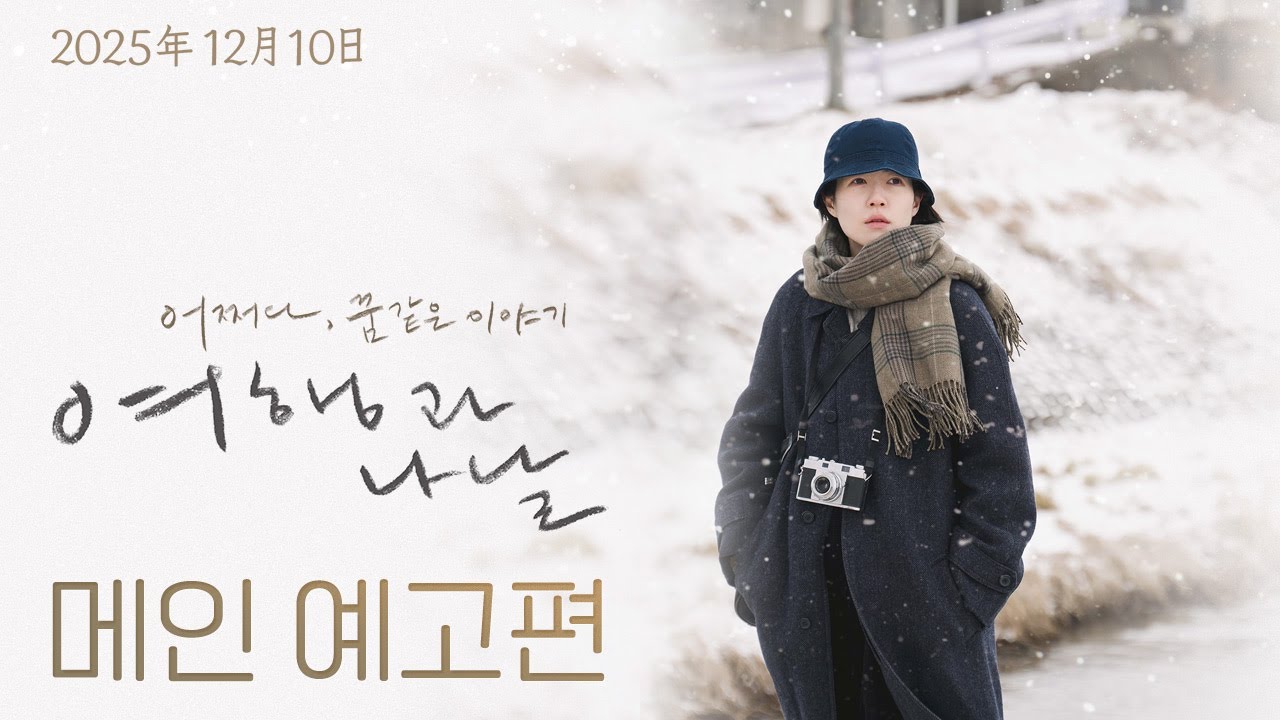
“Two Seasons, Two Strangers”
Bae Dongmi(CINE21 Reporter): Korean writer Lee (played by Shim Eun-kyung), who lives in Japan, is having a hard time finishing her screenplay, and watching her sit alone at her desk, penciling in each Korean character one by one, you cannot help but worry she might never finish it. It does not even exist on the page in Japanese, which makes you feel for her all over again as you wonder how she will translate it when the time comes. Then, just as that concern settles in, the film begins to play out the story she is writing on the screen. Instead of winter, the writer’s season, it opens onto a midsummer beach. A young man named Natsuo (played by Mansaku Takada) kills time through a dull afternoon in a coastal city where his mother grew up, until he meets Nagisa (played by Yuumi Kawai), a woman his age who is beautiful and strangely hard to read. They have only just met, but as they spend hours walking together and talking about this and that, Natsuo suddenly blurts out the depression he has been holding inside. The two trade even cynical remarks without hesitation, yet they stay by each other’s side until sunset, quietly comforting one another. They promise to meet the next day again and go for a swim. But a massive typhoon comes between them. By morning, the wind is howling, rain is pouring in sheets, and waves are crashing higher and higher. Will Natsuo and Nagisa be able to meet again? If they do, will it be safe to swim? Just as those questions start to rise, the film slips back into winter and returns to Lee’s story. Still unable to get the screenplay to move forward, Lee suddenly heads to Japan’s far north without even booking a place to stay, stepping into a region blanketed in fresh snow. “Two Seasons, Two Strangers” brings winter and summer into collision and draws its two story lines through two very different visual landscapes.
Director Sho Miyake won the Golden Leopard, the top prize at the Locarno Film Festival, for this film. In interviews, he has said he especially wanted to capture the wind made by atmospheric flow. Wind cannot be seen directly, so the film shows it through what it moves: trembling leaves, hair flying everywhere, fabric lifting and fluttering. Even just watching those signs, the audience is drawn into a curious, hard-to-name feeling. “Two Seasons, Two Strangers” also brings to mind film theorist Siegfried Kracauer’s description of cinema’s distinctive aesthetics as “leaves rippling in the wind.” More than any other art form, film can record the world as physical reality with a kind of honesty. Because of the medium’s distinctive qualities, directors cannot help but want to capture how fleeting life is, and viewers feel it too: the beauty of those images quietly hints at how quickly life passes, when what a director once recorded comes alive again as light on the screen. The film is built on simple pairings: wind and a fluttering skirt, winter and writing, summer and swimming. Miyake lays out these links between seasons and people without dressing them up, and that restraint is exactly what makes the film feel beautiful. No matter how hard modern life pushes us to outrun it, we cannot step outside weather, place, and season. Time keeps moving, steadily and plainly, and we live inside it. Sometimes we travel anyway, simply because familiarity starts to feel dull and we want to feel the unfamiliar again. “Two Seasons, Two Strangers” stays true to cinema’s distinctive aesthetics and still feels closest to the rhythm of everyday life.

Nas & DJ Premier – “NY State Of Mind PT. 3”
Kang Ilkwon (Music Critic): A living legend, a hip hop icon, a rapper’s rapper and a producer’s producer. More than that, they are hip hop itself. That is what Nas and DJ Premier represent. Ever since Premier’s work on Nas’s “Illmatic,” the 1994 record that stands as a hip-hop bible, fans and artists have been waiting for a full album from the two. Now it has finally happened. Their collaborative studio album, “Light-Years,” arrives with 15 songs. It lands 31 years after “Illmatic,” and 19 years after word of a joint project first surfaced in 2006. The title is spot on. A light year is a unit of distance, but here it also reads as a metaphor for time passed. The album keeps its distance from today’s hip hop. It barely nods to trends, and there is almost no sign of market chasing in its sound or subject matter.
Nas has always rapped with a feel for time’s layers. Even when he speaks in the present, he calls back the past; even when he looks back, he hints at what is next. Premier’s beats, meanwhile, preserve the past and document the present, built from chopped samples and hard drums. Across decades, the two masters have turned their way of reading New York into music. On “Light-Years,” the most striking track is “NY State Of Mind PT. 3,” the third installment of “NY State Of Mind,” the signature cut from “Illmatic” and an emblem of 1990s East Coast hip-hop.
What matters is that the New York in “PT. 3” is no longer the city at the height of hip-hop. Here, Nas replaces youthful rage and tension with a steadier gaze, watching the city through years that have piled up. In step with that shift, the tight edge of “PT. 1” settles into something calmer, and Premier’s production, once charged with a crouched predator energy, turns solemn. When he lifts vocals from Billy Joel’s “New York State of Mind” (1976) and layers them in, you feel that classic sampling touch and the pull of nostalgia. Then the second verse reaches its final line, built to mirror the structure of the 1994 original, and you cannot help but get lost in the feeling.
Back in the so-called golden age of hip hop, they were already in the same constellation. After years on their own paths, meeting again right here reminds you of what hip hop began with and where it first took root.