It doesn’t matter that HUH YUNJIN’s traveling the world on tour—she’s always going to find time to flip through her books. The LE SSERAFIM member says metaphors help her broaden her horizons, calling reading both a mirror and a window. Read on to hear how the idol keeps striving toward self-improvement and how books have been a constant in her life as she works to make her dreams come true.
Were you into books when you were younger, too?
I was totally into stories as a whole.
I loved hearing stories, reading them, and even making up my own.
I used to have fun making up stories just by myself or with my younger sibling or my friends. We moved to the US not long after I was born, so my mom and dad worked really hard to make sure we spoke Korean as much as possible at home.
We had almost 100 children’s books for that reason. I can still see the bookshelf in our study completely packed with them.
My parents always read to me when I was little.
Do you have a method for deciding which language to read a book in?
Not really, but I’ve noticed that books feel a little different depending on whether I read them in English or Korean.
When I feel like I need emotional healing, I tend to read in Korean. It just hits me different somehow. I mostly read in Korean when I’m reading poetry or fiction. For something nonfiction, like an essay, I tend to read them in English.
Since English was the first language I was exposed to, it feels a bit more raw and straightforward to me.
What does it mean to you to be able to read in two different languages?
Honestly, I wasn’t very good at Korean at first, and it took me forever to read anything, so I never thought I’d actually be able to finish an entire book.
I remember borrowing a book from an older trainee and trying to read a book in Korean for the first time.
It took absolutely forever.
I think language really shapes your personality, so just being able to read in Korean really broadened my identity.
Even though I’m the same person whether I’m speaking in English or Korean, I feel like I have a slightly different persona for each one.
When I’m speaking in English, it feels like the part of me that uses Korean isn’t tapped into. That’s why just being able to read in both languages makes me feel like a more complete version of myself.
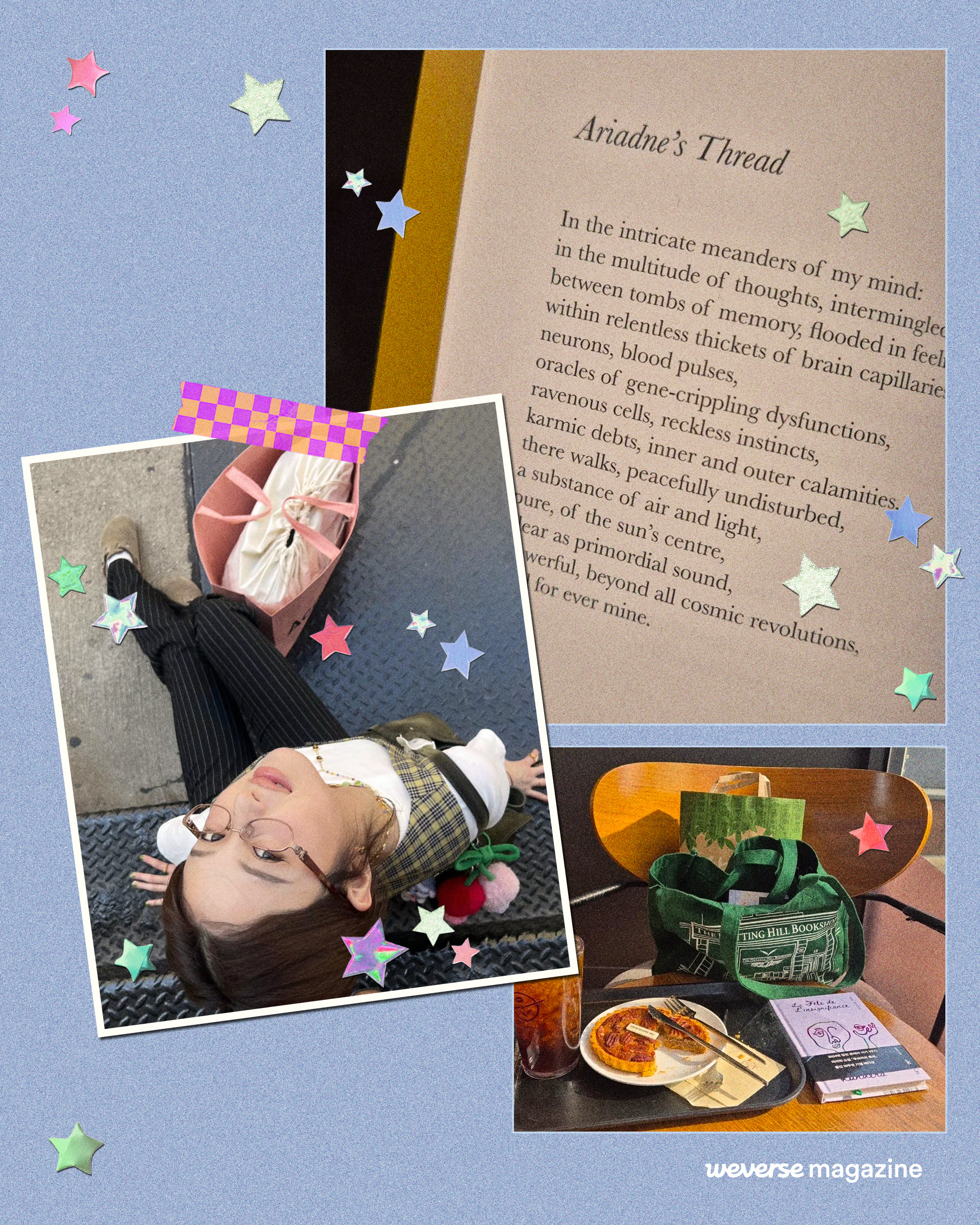
We sometimes get to see you on camera reading books in the car.
I actually focus better when I’m in a car.
Something about going somewhere helps me concentrate, so I read a lot on planes, too.
That’s how I ended up reading so much during the tour.
On mornings where I’d head out to work first thing in the morning, if I felt like it was time to wake my brain up, I’d start reading.
Do you find reading relaxing?
It’s relaxing and it’s brain food.
It’s like … people’s tastes aren’t just there, you know?
You only get to know your own taste in things by putting in the effort to curate things, and reading’s the same way.
It’s a hobby, but you have to keep at it to get something out of it, I think. I wouldn’t really say it’s purely relaxing—because I’m ambitious, and because I read to learn more.
And you never find it hard to put in that kind of effort?
I learned from an early age that … I’m the kind of person who needs to keep filling herself up with stuff.
I actually give so much output that I feel like I need to continuously fill myself with input, so I want to read more and more.
You know that feeling when you really don’t want to do anything and just want to take it easy, but deep down inside, you know it’s good for you?
I think of it like exercising my brain. My heart and my head. (laughs)
It sounds like you really enjoy spending your time reading.
Definitely. I love it.
It can be a challenge sometimes when I’m sleepy, but then there’s times when I’m so absorbed in it that I fly right through it.
I love that feeling—that flow state. It makes me really happy.
Did that happen with any of the books you read lately?
I read “The Old Man and the Sea” by Ernest Hemingway.
It was amazing.
It’s super short, so I finished it in about two hours. I love how stories feel like both a mirror and a window.
When I say mirror, I mean when reading a book feels like it’s about me—something I can relate to. At the same time, stories act as windows, opening up the imagination.
Like, “Oh, I never thought about it that way,” or, “Wow, that’s a completely different way to look at the world.” That’s what stories do—they use the power of metaphor to broaden my world and my perspective of it.
Sometimes they even show you things that are hard to deal with.
When I read “The Old Man and the Sea,” it really hit me—no matter how much suffering and hardship humans go through, they’re unbreakable beings.
There’s no such thing as defeat. I absolutely loved it.
Do you move on relatively quickly after engrossing yourself in a book, or do you lean more towards sitting with the feeling afterwards?
Haha. I sit with the feelings.
That’s why I’m always talking about books with FEARNOT and with my friends and family.
If I read something that leaves a deep impression or really moves me, I love to just call someone up and go, “This happened, then that happened, and I see the world this way now, and I think I’m gonna start living like this from now on!”
I’ve had long conversations like that with the rest of the group, too.
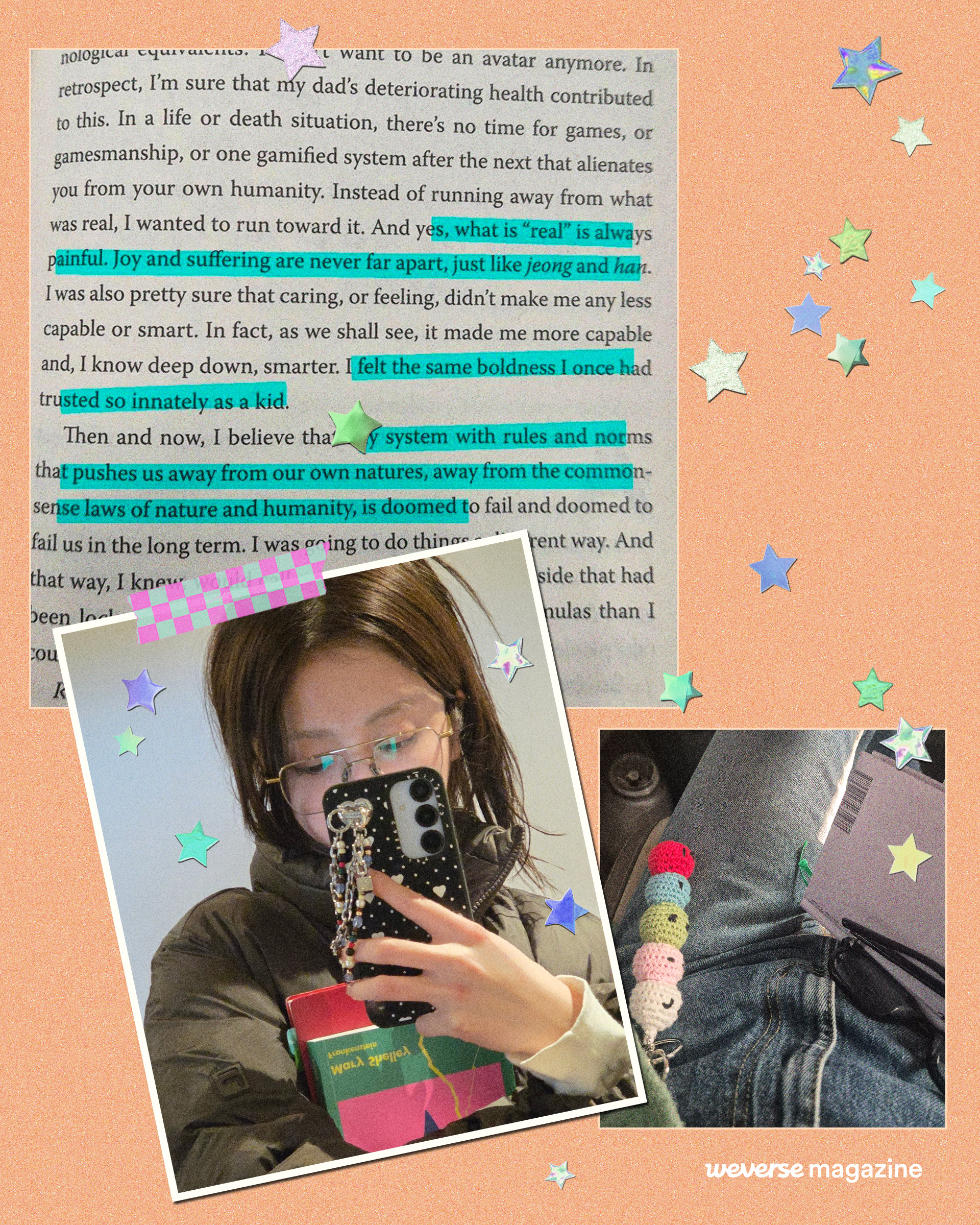
Do you buy multiple books in one go?
I’ll go to buy just one, but I end up coming away with practically a huge stack a lot of the time. (laughs)
It’s not like I ever intentionally go into it thinking, “I better buy a bunch!” It’s more like I pick one out, then another, like, “Oh, this looks interesting. This one too.”
It’s particularly bad if I visit a physical bookstore. (laughs) I can’t drag myself out of there. So I only allow myself to go twice a year.
Are you particularly passionate about holding onto books?
I write all over my books, so throwing them away and losing that would feel like such a waste—a waste of money, too.
And, I mean, books are just so pretty to look at. I enjoy stacking them up.
I like to keep them around for decoration when I’m done reading them, too.
I’m curious about your bookshelf.
Do you take any kind of special approach to organizing your books?
I’ve been trying to organize my books since I have so many of them now.
I tried to organize them by genre … but I gave up. (laughs) It was way too complicated.
For now, I’ve just separated them into English and Korean books. One of my friends suggested I organize them by size, so I tried it, but it looked pretty bad, so I just went back to doing things my way.
I like it when they’re all jumbled up.
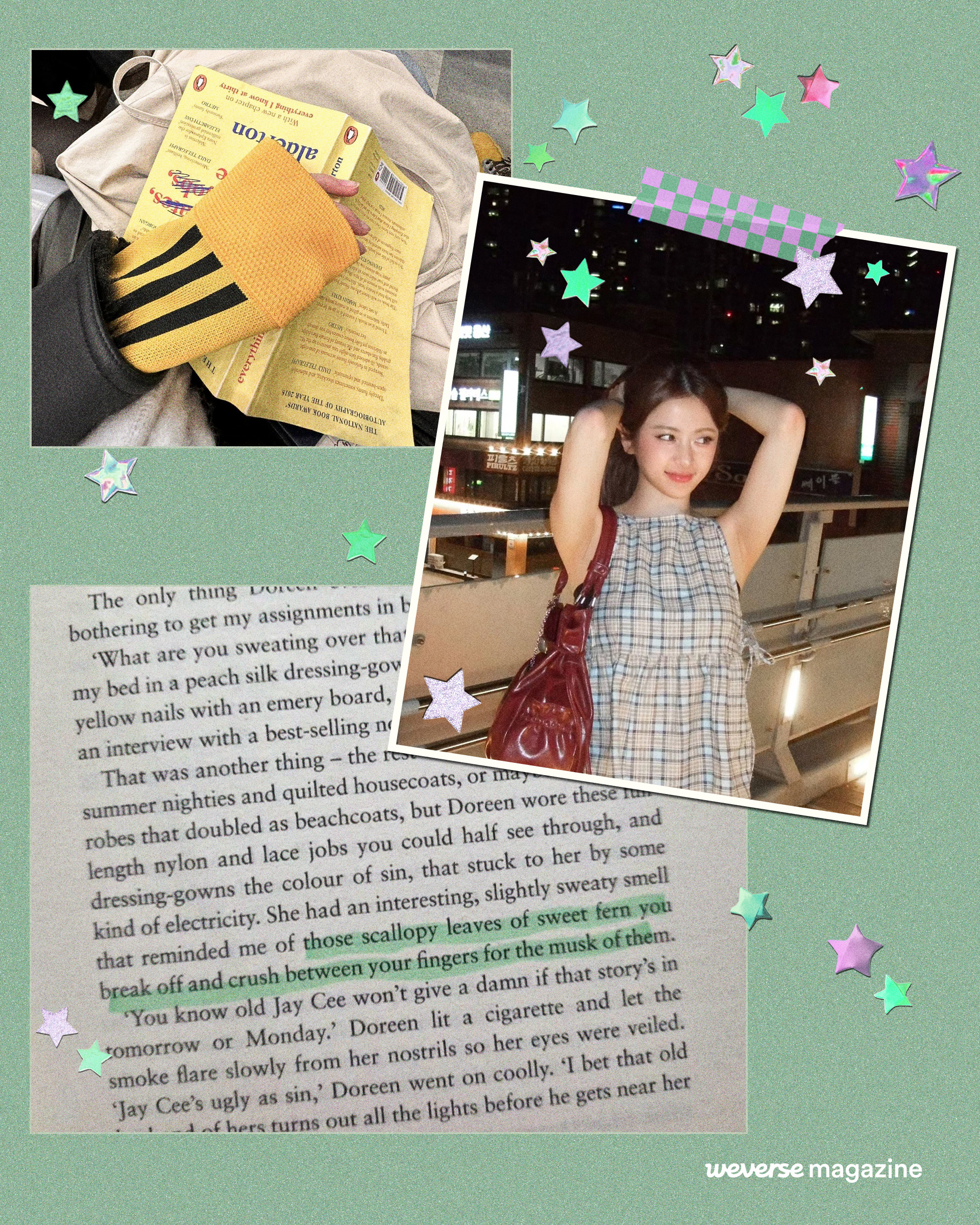
Do you have any habits around reading?
I always carry stickers with me.
I forget a lot of good lines, so I use stickers to make sure I can remember them. Every color means something different.
Pink means, “This really resonated with me.” Blue means, “This is so sad.” Orange means, “This is seriously shocking.”
Also, I can’t close a book until I finish the chapter I’m on. If I have to go somewhere soon or the timing’s too tight, I try just not to read at all. I feel bothered if I just leave a chapter unfinished like that.
And I always check the page number of the last page in a book before I start reading it.
In a previous interview with “Weverse Magazine,” you mentioned that your mom sent you an e-reader.
Have you been using it?
I used it once and that was it.
Sorry, Mom. (laughs) I just love analog.
I can’t give up the feeling of physically flipping through the pages. Paper books are 100% better.
When it comes to videos or movies, or even music, it feels like, “Here, watch this. Listen to this.” But with books, I get to turn the pages at my own pace. It feels like an empowering medium, and I like that about it.
Do you ever read the same book more than once?
If I really love a book, I’ll read it multiple times.
“The Old Man and the Sea” is one of those books that’s great no matter how many times I read it. I’m on my third read or so now, and it’s absolutely fantastic.
And it feels different every time I read it.
You know how you can listen to a song and get one thing out of it, but then listen to it again later and it feels completely different? Books are the same way.
I remember bawling my eyes out when I read “The Giving Tree” as a kid. I thought the tree was so sad. I kept thinking, “Why does it just give and give like this? The guy doesn’t even appreciate it.”
But when I reread it recently, I found myself wanting to be the tree—like, how great would it be to have someone in your life you love so much that you’d give them anything?
Do you still read mostly essays?
These days, I really love the breathing room that only fiction has—the things that go unsaid and leave room for your imagination.
Maybe it’s because I talk a lot.
I want to hold back a bit. (laughs)
But essays are great because they feel like a conversation. And sometimes the straightforwardness of an essay hits even harder.
Do you have a favorite book?
There’s this book by bell hooks called “All About Love.” That remains my all-time favorite.
It’s so hard for someone like me to even pick a favorite. (laughs)
But this book taught me about the importance of community and how to create a culture where love can exist. And it made me reflect a lot on my work with LE SSERAFIM.
I feel like if I hadn’t read this book when I did, it would’ve taken me a lot longer. It means a lot to me for several reasons, including because of when I first read it. I have a lot of cherished memories tied up in “All About Love,” having talked with the other group members so much about it.
What makes a book a good book in your eyes?
One that humbles me. One that makes me see you can look at things in ways you never even realized.
Sometimes I even feel guilty while reading—like when I come to understand a friend’s perspective after we had a fight, or when I find myself empathizing with an opinion one of the group members has but that I couldn’t understand before. I like books that make me reflect on myself like that.
Some people say literature can be comforting.
I think literature’s comforting, too.
It makes us more human.
That’s why I think society needs more of it. I hope reading experiences an explosion in popularity.
I mean, without literature, life’s just so lonely. It helps build empathy (laughs) and it broadens our perspective of the world.
Do you have a writer who you’re always looking forward to new work from?
Definitely Han Kang.
Last year, my manager gave me her book “We Do Not Part” as a gift. I found so much solace while reading it.
I still remember one line: “like a snail coming out of its shell to push along a knife’s edge.” I couldn’t stop crying after reading that.
That’s the magic of a novel.
If you could meet Han Kang, what would you ask her?
Oh my god!
What would I ask …
I’d want to know what she thinks our society and people today need, from her perspective as a writer. There’s so many things I’d want to ask, but if I had to pick just one, it’d probably be that. It’s something I’m grappling with too.
What are you grappling with, exactly?
Umm … I’m grappling with how I can use where I’m at to foster a sense of unity.
I believe literature can be a way to inspire unity, connection, and empathy.
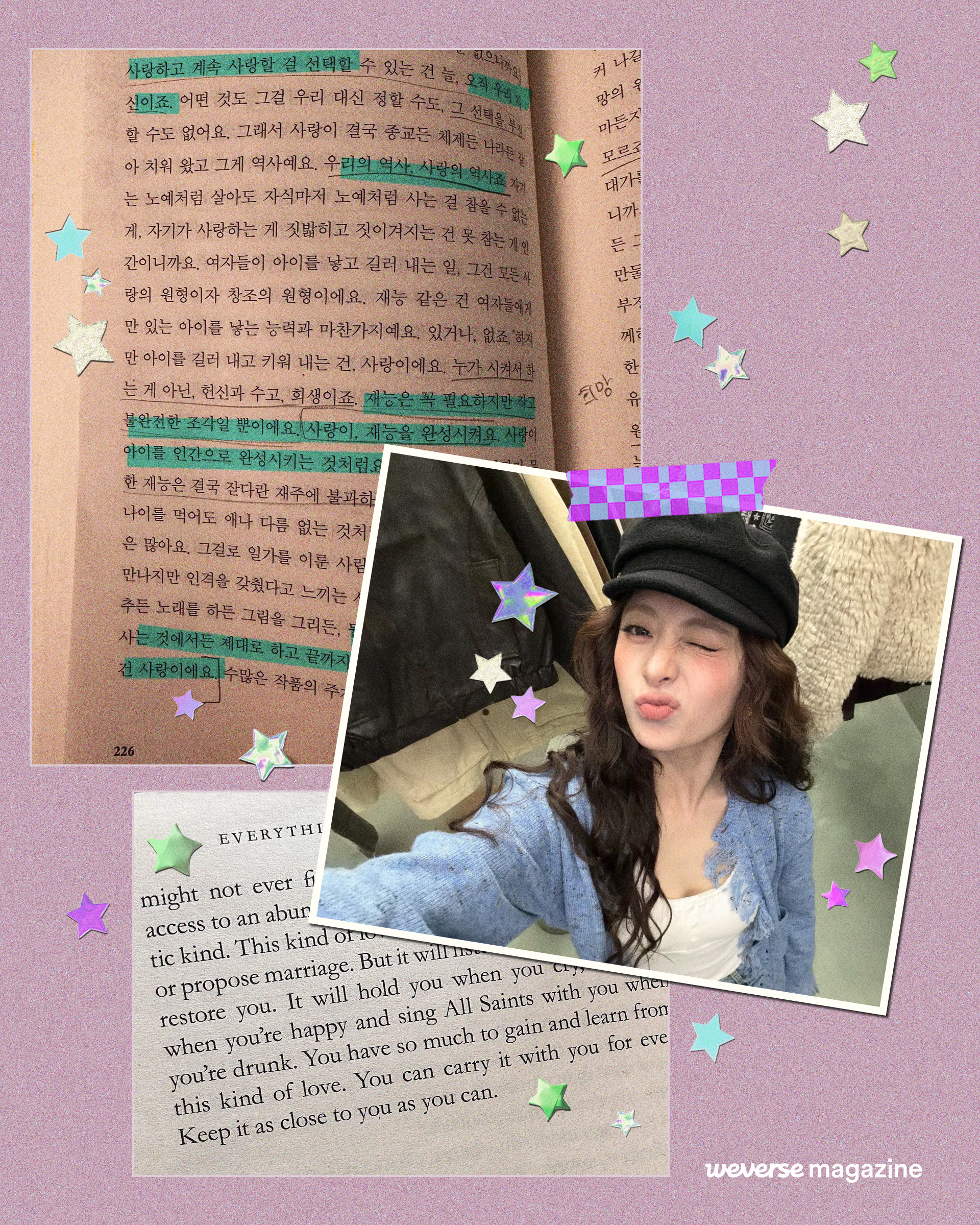
Do you ever read books to find inspiration for your craft?
It’s really fascinating, but somehow I always end up reading books that connect with our next album.
After “EASY” and right before we started promoting “CRAZY,” I read “Gwangin” (“Madman”) by Lee Hyugjin. The main character was literally a madman. (laughs) I was reading it, thinking, “CRAZY—he’s seriously CRAZY, this guy.”
The book showed what someone can do when they’re completely consumed by something.
I thought about it when we were doing “CRAZY” and then later during “HOT.” There’s also a poem by Louise Glück called “Telescope,” which is where the song “Crazier” off “CRAZY” was spun off from.
What does writing lyrics mean to you?
I mean, it’s a ton of fun. I’m never happier than when I’m writing lyrics.
Even if only some of my ideas make it into the song, just the process of immersing myself into that world and putting words to music is incredible.
Simply put, I write lyrics purely out of love. On a deeper level, I think it’s personally the most fitting way for me to capture a part of myself and keep it there. I mean, I can draw, write, and make videos too, but lyrics feel like the most candid option for me.
In another “Weverse Magazine” interview, you mentioned that you read books because you want to know more and learn things, and that you want to be responsible and broaden your worldview to be a good person.
Is that the same reason you keep reading today?
What an adorable answer. (laughs)
Yes, that’s still the case, but now I think I read because I want to face the parts of myself I don’t like.
I want to stay humble, regain the parts of myself I’ve lost, and remind myself, “Oh, right, this is who I am.” I was recently reminded how, no matter how much you learn, you can’t truly grow on your own, and that you grow by talking with others about the things you learn and feel.
That’s another reason I keep reading—because I want to talk with other people about the things I’ve learned.
Now that your first world tour is almost over, what would you say it’s meant to you?
I feel like it’s been a really important source of momentum for us. It’s like we were kind of floating along before, but now this tour let us plant our feet firmly on solid ground again.
It’s like, “This is the beginning! We’re always beginning, but now, it’s really beginning.” It feels like it gave us the momentum to come together and work hard hand in hand.
It applies to us as a group and also to what we’re building together with FEARNOT.
When you spoke to “Weverse Magazine” about your debut, you said that one of your dreams was to do a world tour with LE SSERAFIM.
Now that you’ve made such a major dream come true, is there something new you’re dreaming of?
Oh my god. I want to go to number one.
I don’t mean on the chart—the kind of number one where you achieve something and grow from it, and you can just tell that you’ve reached the top.
That’s the kind of number one I want. I’m just not sure what kind of number one that is, exactly.