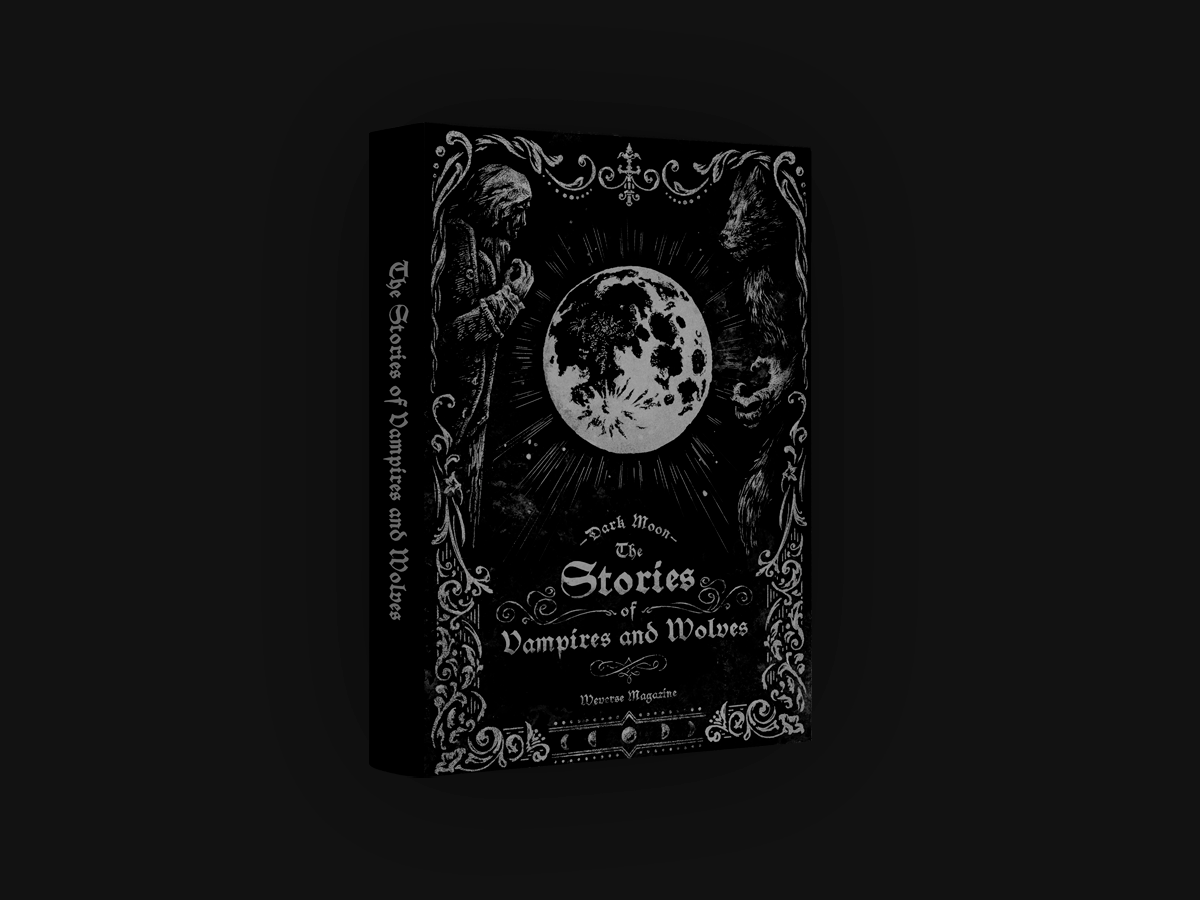
To celebrate the fourth anniversary of HYBE and ENHYPEN’s collaborative original series “DARK MOON,” as well as the release of the anime adaptation of “DARK MOON: THE BLOOD ALTAR,” we reached out to four of the voice actors who brought the characters to life for a written interview. Yuto Uemura, Shugo Nakamura, Jin Ogasawara, and Hiroto Shimizu—who voice Jakah, Jino, Solon, and Jaan, respectively—gave us the lowdown on their approaches to the characters when it came to acting and recording their lines, plus shared a little more about themselves. Below, we break down their responses under seven helpful headings.
[Note: An interview with Shunichi Toki (Shion), Chiaki Kobayashi (Noa), and Kikunosuke Toya (Heli) will be released on February 13th.]
Seven insights from Yuto Uemura (voice of Jakah)
Introduction
Yuto Uemura: I’m Yuto Uemura. I started my acting career early on as a kid with the Himawari Theatre Group. I found out how fun it can be to act using only your voice through numerous projects, and voice acting is now my main focus.
Being cast as Jakah
Yuto Uemura: I was cast for the show through a Self-tape audition. I tested for something like four different characters, but the one I ended up being cast as was Jakah. I related to the character enough that I thought he might be the easiest for me to play, so I was happy when I got the part.
Jakah according to Yuto Uemura
Yuto Uemura: All the vampires are really close with each other and share a tight bond where they’re tied together by fate. Their vibe is really similar to ENHYPEN, who “DARK MOON” is a collaboration with, so the characters felt super vivid to me. I feel like Jakah’s kindness and sharp edge were born out of the easygoing atmosphere that the group of friends all made together. This is a bit off topic, but when I met ENHYPEN at the screening, they were so cool. And when I saw how sweet and gentle JUNGWON was, I went, “Oh, just like Jakah!” And that’s when it clicked. (laughs)
A particularly memorable scene
Yuto Uemura: When I was recording lines, I heard it was the whole vibe of my voice that got me cast. I thought a lot about how to use that to show what makes Jakah Jakah in such a diverse group of characters. For example, I’d consciously shift the nuance of my performance depending on the scene, like changing my voice to be softer when he’s hanging out with everyone and having fun and more intense for serious scenes. I personally really love the scene where they’re in a fight and calling out to each other telepathically. The sense of urgency and unity in that scene really stuck with me.
Voice acting behind the scenes
Yuto Uemura: It suddenly hit me while playing Jakah how different my own attitude and demeanor felt while recording. I was meeting a lot of new people, and on top of that, I suddenly realized I was actually the most established actor within the group. I thought about the best way I could support this cast of new actors, including Hiroto Shimizu in his first ever starring role. I calmly took in the atmosphere in full and came to enjoy the new challenge. I kind of felt like that mindset was really similar to how Jakah himself would think, and it was one of those moments where I felt genuinely honored just to be a part of the cast.
Finer details of the role
Yuto Uemura: I read the webtoon in advance, and whenever recording I was given pages from the original for the episodes we were working on, so I had no problem getting a clear image of the scenes in my head. The challenge of humans, vampires, and werewolves coexisting, the mix of overlapping feelings between them, the eeriness and beauty that comes from that … It was all so captivating, and I think the anime makes those parts of the story feel even more three-dimensional. Naturally there were some changes to dialog and particular details in the direction, but the core of the story stayed rock solid, so playing Jakah, I could really keep an image of the original in my head and faithfully work that into my performance. And honestly, even in the scenes where no one’s talking, the characters are still living their lives. When I picture what’s going on below the surface, it becomes clear why the next line needs to be said and how it naturally turns into a conversation. This series feels particularly dialog-driven, so I tried to always be actively listening not only to what Jakah was feeling when speaking but how everyone else was feeling, too. I think it was easy for me to take up the baton and keep going with it since every single person in the cast treated their characters with so much care.
“Fall seven times, get up eight”
Yuto Uemura: The reason I hold the proverb “fall seven times, get up eight” in such high regard is because the more I act, the more I realize that being an actor means you’re studying every single day. As an actor, there are days when things go your way and you feel confident, and then there are days when you hit a wall—and what’s expected from you can change from day to day. I think you have to constantly update yourself and change directions when you’re an actor. With all that going on, I feel like what matters most is staying flexible in how you think, being grateful for the people who work alongside you, and never losing the love of acting. The reason I don’t see the cycle of falling down and getting back up as strictly painful is because I’m with stalwart comrades who keep me putting in the effort to be able to say “this was fun!” at the end of the day. It helps me not to give up, and to get back up, too. I think I’m at a point now that I can stand my ground on my own somewhat, but seeing how I used to find the strength to get back up from more seasoned actors than myself, I want to keep up the personal development so that next time I can be the one reaching out and pulling someone else up.
Seven insights from Shugo Nakamura (voice of Jino)
Introduction
Shugo Nakamura: I’m Shugo Nakamura, and I’m both a voice actor and a singer.
Being cast as Jino
Shugo Nakamura: I recorded my voice at the studio and sent in a tape for my audition. When I saw Jino’s facial expressions and lines, I just knew he was perfect for me!
Jino according to Shugo Nakamura
Shugo Nakamura: I think Jino is someone who values harmony among the people he’s with above all else, so if there’s someone who threatens that harmony, he wouldn’t show them any mercy. Why he ended up that way … Well, this is mostly just my own headcanon, but it might be because he was persecuted as a monster in the past. If it was hard for him to trust others easily, then it totally makes sense that he’d have developed such a strong sense of camaraderie.
A particularly memorable scene
Shugo Nakamura: There’s a scene in episode three where Jino’s fighting using his fire power, then grabs hold of an enemy vampire and says, “Who sent you? Spit it out! What’s your game?!” When his friends are in danger, he switches out his usual gentle vibe for this eliminate-threats-at-all-costs mode. It was pretty terrifying to see, so when we did the actual recording, I really focused on capturing that tension in my tone of voice.
Finer details of the role
Shugo Nakamura: I tried to keep the corners of my mouth slightly curled and speak as directly and honestly as possible, being considerate of whoever Jino was talking to. Even with his Tsukkomi lines, I was careful not to let them sound too harsh. Since there are going to be more fight scenes later on, I paid special attention to the sense of urgency in those performances. Jino’s desire to protect Sooha and his friends keeps getting stronger as the story goes on. Once, when I was just talking with the director, she told me, “Jino’s character seems so much clearer now that you’ve given him a voice,” and as a voice actor, it doesn’t get more rewarding than that.
Jino from the perspective of an actor and a singer
Shugo Nakamura: Jino’s character is made in collaboration with JAKE, and he’s such a cool and kind character that I really love him. “DARK MOON” as a whole is a collaboration with ENHYPEN, and I was really impressed by how well their image is woven into the story. The fact that a collaborative project with idols has been adapted into another medium is already amazing, but ENHYPEN also performs both the opening and ending theme songs, so I’m sure ENGENE must be really happy about that too.
What it means to be Shugo Nakamura
Shugo Nakamura: Never compromise on what I love, stay open to new things, and keep challenging myself—that’s who I am these days. Whether I make the most of my potential or let it go to waste is ultimately up to me. I want to keep seeing and experiencing as many different things as I can.
Seven insights from Jin Ogasawara (voice of Solon)
Introduction
Jin Ogasawara: I’m Jin Ogasawara, the voice actor for Solon. I don’t think I have an unusually special career compared to others, but while working as a voice actor, I ended up becoming the singer in a band. It was special getting to experience things as a solo artist through that flow of events.
Being cast as Solon
Jin Ogasawara: I auditioned for it! The fact that this whole thing started from something as unique as a collaboration with real-life idols struck me as really impressive, and I remember reading through the dialog for characters I didn’t even audition for because they were just that interesting. Since the original is real idols and characters, I was thinking about how this added layer of voice actors could be fitted into the connection between real-life idols and their characters that their fans are already so attached to more easily. The funnest part about it was getting to take on a challenge that you really can’t anywhere else. And this is just my personal take, but I felt like Solon really fit with my own way of approaching things exactly as they are, which made him even more intriguing to me.
Solon according to Jin Ogasawara
Jin Ogasawara: I see Solon as someone whose conservative nature means his affection for his friends and his wariness of others are closely related and have an effect on one another. He’s not the type to go out and try to expand his worldview or circle of friends, but that doesn’t mean he’s always hostile toward other people either. He’s conservative, but at the same time he isn’t so thoughtless that he acts with the intention to hurt people, which makes him a pretty tricky guy to take on. Still, he’s a good guy, though. (laughs) And I don’t really think there’s much about Solon that suggests he’s this transient, empty, barely-there character. He’s stubborn, but that stubbornness comes from a solid sense of self, and deep down, he’s definitely flexible enough to understand and accept things when they’re truly important. When he’ll really be able to grow is probably when he can properly face the root of that flexible part of him.
A particularly memorable scene
Jin Ogasawara: Where Sooha’s crying and says, “I’m not saying hi—I’m keeping this conversation short,” and I snap back, “Say hi! Take as long as you want!”—that back-and-forth was so cute. (laughs) [Fuka] Izumi, who plays Sooha, has such an amazing approach that I kind of felt like I was just riding the wave she set into motion. Even so, I didn’t want that scene to end up being too much like empty comfort, so I tried to play it in a way where Solon himself still feels a bit out of place about it, but he shows his instinctive considerate self.
Finer details of the role
Jin Ogasawara: Solon’s fairly reserved when he’s dealing with people outside the group, but when he’s interacting with his friends, he’s much more open with his emotions. He often ends up in the tsukkomi role too, stepping in to straighten things out. I didn’t want to forcibly turn it into a comedy just by cranking up Solon’s tsukkomi voice, though. Even without adding in that thoughtfulness, I think those vampires would be happy enough just talking the way they always have given how long they’ve been together. Any unnecessary flourishes could actually get in the way of how close they feel. If I had to sum it up, the most important thing about playing Solon was keeping it natural.
The voice actor and the singer
Jin Ogasawara: I don’t really think there’s a huge difference between the two, but I am sure what I’ve gained as a voice actor and what I’ve gained as a singer keep influencing each other and changing shape. It’s hard to explain in concrete terms, but who I am when I express myself acting in a big group, and who I am when I stand in a small group or alone with singing as my main mode of expression—those are two things I used to separate in my head but have slowly blended together over time. I think maybe it might be sufficient enough now to just label myself an “expresser.”
“Liking something is the biggest motivation”
Jin Ogasawara: I recently started doing my own stream, and that made me realize how much I love talking, making people laugh, and being right in the middle of all that fun. And I started to think that maybe that’s actually the biggest reason I ended up making acting my job in the first place. That feeling of liking something can help you rush toward your goals, but sometimes it’s also a kind of deadly poison that can stop you in your tracks, so in order to be able to live with that feeling, I think it’s important to look closely at each ingredient on the label inside your own heart.
Seven insights from Hiroto Shimizu (voice of Jaan)
Introduction
Hiroto Shimizu: I made my debut as an actor, and started voice acting last year. “DARK MOON” is my very first anime!
Being cast as Jaan
Hiroto Shimizu: I got the part by auditioning for it. I had absolutely no idea what I was doing or how I was supposed to do it, even while recording the tape. But when I read the background and the original, I couldn’t believe how the plot just barreled along, and I remember thinking, “I have to be a part of this!”
Jaan according to Hiroto Shimizu
Hiroto Shimizu: I think this applies not just to Jaan but to all seven of the vampire leads: To me, their personalities and individuality feel like the real core of the story later on. I have to be careful not to spoil anything by getting too into details, but I’m sure Jaan’s bold personality has been a part of him for a long time. I also feel like his playful side and how much he cares for his friends was probably shaped by time the seven of them spent together in the past.
A particularly memorable scene
Hiroto Shimizu: There’s more than a few mellower scenes as the story goes on. One of those that really stuck with me is when they’re all in this really tough situation and Jaan steps up and says, “It’s fine, leave it to me.” Even though he himself is hurt, him having the kind of nature to get up and say something like that really moved me. I remember feeling like that was when my image of who Jaan is became a little more fleshed out.
Voice acting behind the scenes
Hiroto Shimizu: I drink a lot of water, so I brought this huge, three-liter stainless steel water bottle with me to work. I’ll never forget how they’d all say “that water bottle is massive” every time I took it out to take a sip. I plan to keep using it for the rest of my life. (laughs)
How Hiroto Shimizu would draw Jaan
Hiroto Shimizu: I never actually tried drawing Jaan, but if I did, I’d definitely draw him with that distinctive way he wears his bangs back and, most importantly, with solid arms and fists to make him like a martial artist. Some of my own preferences might have gotten mixed in in there. (laughs) I’d love to be able to capture that sense of strength in his arms. I also think the hobbies I’ve had up to this point and the creative stuff I’ve posted on social media really helped me bring out how different Jaan is when he’s being his usual tenacious self versus when he acts all goofy. He somehow looks like he could probably handle anything with ease, but I feel like there’s something about him that might make him choke when it really counts, and I feel like I managed to express that too.
Voicing an anime character for the first time
Hiroto Shimizu: Even though it was my first time, the crew there and all the seasoned voice actors I worked with were really, really, really nice to me, and thanks to them, every time I recorded with those good nerves driving me, it felt like I was coming out of my shell. Now that I’ve finished recording everything, I can say this was an absolutely priceless first experience—something I wouldn’t trade for the world.