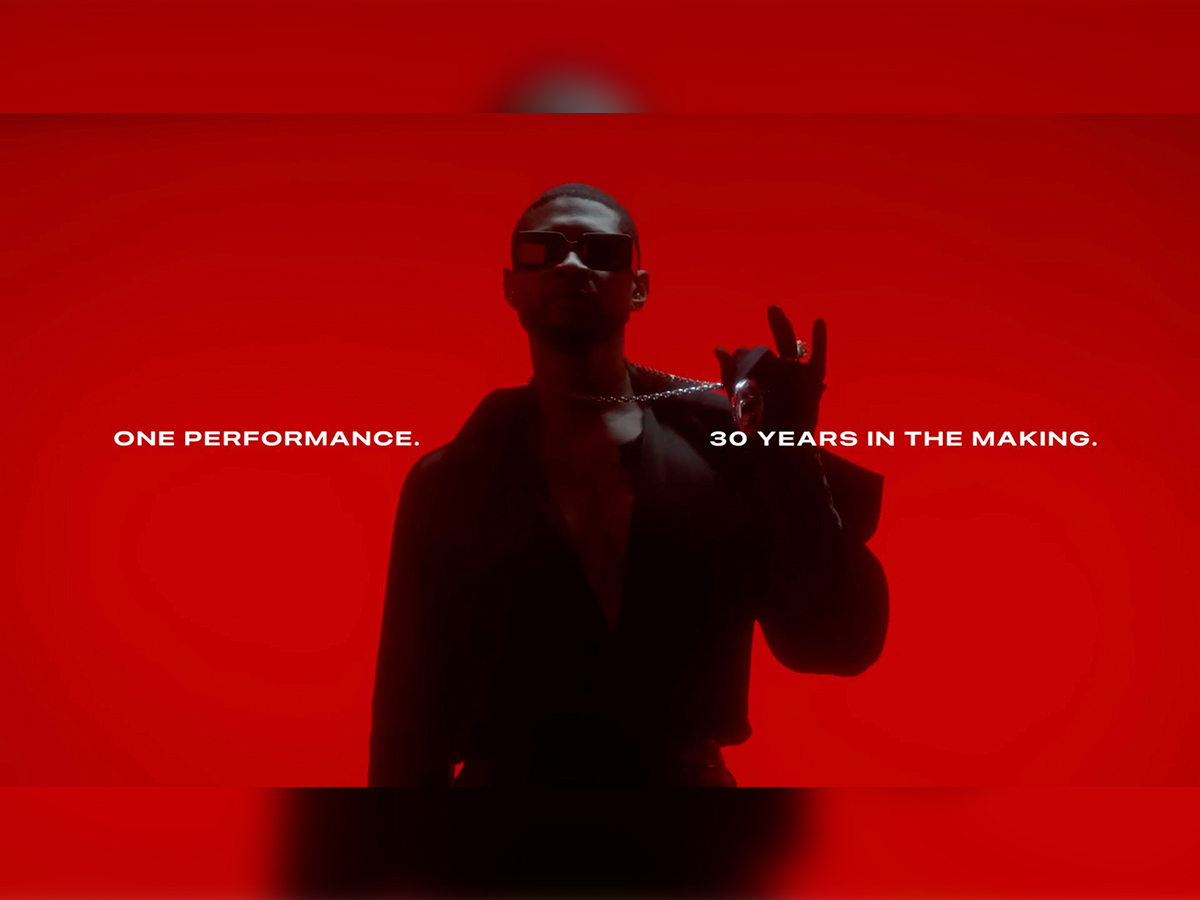
On February 8, as the halftime show at the 60th Super Bowl began, more than 100 million viewers around the world suddenly found themselves looking at Puerto Rico’s sugarcane fields. What followed was a sequence of quintessential Puerto Rican imagery: farmers wearing traditional straw hats called pava, old men playing dominoes, carts selling all kinds of food including the iconic icy dessert piragua. And then the party kicked into full gear. It was a long, boisterous, but very family-oriented party—the kind embodied by a wedding and the expected symbol of a drowsy child. Bad Bunny—Benito Antonio Martínez Ocasio, as he declared at the start of the show—took raw Latin American euphoria and transplanted it with full confidence onto the premier stage of the most American of sports. Every word he spoke and every song he performed was in Spanish. There were no subtitles, either.
To better understand Bunny’s performance, it’s best to look back at Kendrick Lamar’s show for last year’s Super Bowl. Lamar was enjoying a fresh peak in his career—critically, commercially, and by a measure of sheer cultural impact. While one song in particular was monopolizing the public’s attention, he also invoked the historical debt of the “40 acres and a mule” that were promised but never provided to freed slaves. Samuel L. Jackson proclaimed this as “the Great American Game,” yet the show also called that same problematic game out for its systematic discrimination against Black people. In the fusion of entertainment with a historical message, sights like Serena Williams doing the Crip Walk made it clear that Lamar was foregrounding his pride in his identity and culture, even if it might be deemed socially inappropriate.
Bunny seems to have been working from Lamar’s template. You might expect the ongoing immigration issues in the US to have been the show stealer, but unlike the anger and condemnation that drove last year’s show, Bunny made the creative choice to put his compatriots’ everyday lives on display. Latin American culture has long been trimmed down to fit Western tastes for the mainstream US pop music market, where it’s been consumed as exotic song and dance. Bunny broke away from those familiar tropes and added a kind of local flavor to the biggest stage in the world—one that feels at once unfamiliar and yet perfectly natural.
His entire performance unfolded around his La Casita (“the little house”) set modeled after a traditional Puerto Rican home. When Bunny jumps down from the roof, the house transforms into a social club. Handing Bunny a drink is Toñita, owner of the Caribbean Social Club in Brooklyn, New York, the last remaining Puerto Rican social club there and still in operation after more than 50 years. All these indigenous cultural elements weren’t cobbled together for this show alone—Bunny wore a pava as high fashion at the recent Met Gala, La Casita has been a centerpiece of all his recent concerts, and his song “NUEVAYoL,” as the title alludes to, is about New York, with lyrics referencing Toñita and her club.
At the halftime show, Bunny shouted out just one thing in English: “God bless America!” For the singer, “America” isn’t a single nation. Bunny called out the names of Chile, Argentina, and other Latin American countries, then moved his way up through the US and Canada, finally naming his homeland, Puerto Rico. The football from the opening of the show reappeared, and Bunny put the message written on it front and center: “Together, we are America.” It wasn’t political provocation, but historical correction. When the name America arose in the early 16th century, it came from the Italian explorer Amerigo Vespucci and, importantly, referred to the entire landmass stretching from the Arctic Circle down to Tierra del Fuego at the southernmost tip. Over time, though, the word narrowed to mean the US alone, and the rest of the landmass south of it, not only geographically but also culturally, became separately known as Latin America.
That’s what makes it so significant that Bad Bunny, of all people, is the one standing center stage. He rose to global superstardom in the streaming age on the strength of his Latin audience alone, and became the first artist to win the Grammy for Album of the Year with a Spanish-language album. In 1968, Puerto Rican José Feliciano performed a Latin jazz version of “The Star-Spangled Banner” that was met with backlash. In 2013, Marc Anthony, born to Puerto Rican immigrants, sang “God Bless America” at the MLB All-Star Game and was attacked with racist comments online. For artists like Jennifer Lopez, Shakira, and Ricky Martin, singing in English was unavoidable in a market dominated by physical albums and radio. Lopez and Shakira headlined the Super Bowl halftime show in 2020, but they did so with a careful balance of English and Spanish. This year, however, Ricky Martin joined the halftime show to sing “LO QUE LE PASÓ A HAWAii,” a song that pushes back against gentrification. It goes to show just how much the world has changed in the more than 20 years since Martin was “Livin’ la Vida Loca.”
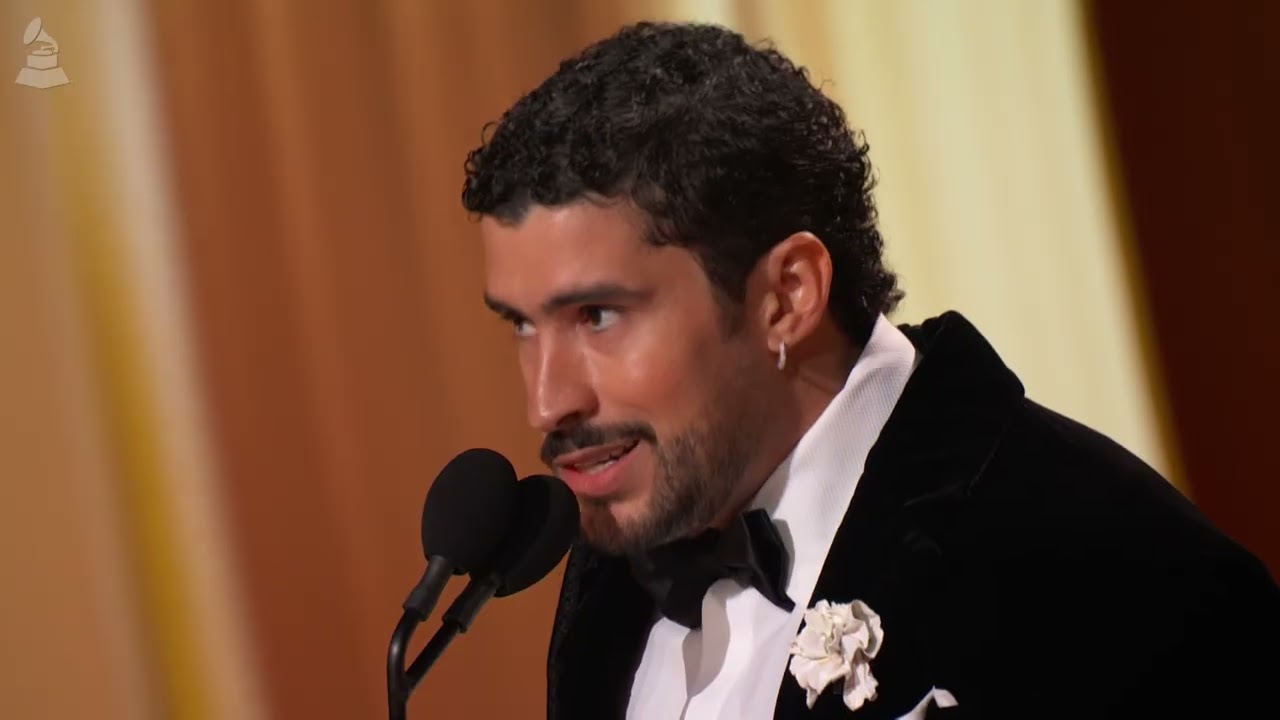
Bunny had every right to stand on that stage and say, on behalf of all the generations that came before him, “Seguimos aquí” (“We’re still here”). It follows in the same vein as his Grammy acceptance speech, when he said, “We are humans, and we are Americans.” He doesn’t seek anyone’s permission, and he doesn’t contort himself to fit in. He doesn’t blow up or spew hate, either. The last line to flash across the big screen at the end of the show sums it all up perfectly: “The only thing more powerful than hate is love.”
Roc Nation, the Jay-Z company that oversees the halftime shows, has moved beyond simply locking in ratings with big names, setting its sights on shaping the very culture itself. There’s a big difference between putting up with controversy and conflict and just chasing buzz—in other words, “not shocking for shock’s sake—but culturally powerful.” On top of that, the NFL wants to push American football beyond US borders. Every year, the league is adding more regular-season games in Latin America and Europe, with the former a particular priority. There are more than 40 million NFL fans in Mexico and Brazil each—the largest fan bases outside the US.
None of this takes away from the cultural authenticity or explosive impact of the work. All the planning and careful calculation just creates an opening for an artist who’s earned it. On the Monday immediately following the performance, Bunny’s music racked up 98 million streams in a single day across the US, nearly a personal best. On the “Billboard” Hot 100 reflecting that same week (dated February 21), 18 of his songs charted, including four of them in the Top 10 and his hit “DtMF” at No. 1—his first chart-topper where he’s given top billing. It was the first song sung predominantly in Spanish to reach No. 1 since “Despacito” in 2017. Numbers like those are impossible to reach on the back of repeat listens from existing fans alone. Not everyone had to understand the lyrics for his message to get through. A great performance is a great performance and always has the power to move people. And Bad Bunny made it happen.