
I heard you had a pretty hip hop-heavy childhood thanks to your dad.
My dad was always telling me about music he loved, ever since I was little.
He’d play me lots of stuff from the first wave of American rappers, and he’d put on music from old Japanese dance shows and explain how some music styles grew out of dancing.
The song that stuck with me the most was “Jump Around” by House of Pain.
I absolutely loved it.
We’d listen to it in the car on every trip, and I actually used the beat once when I was a trainee and working on my monthly evaluation.
I sent my dad the video afterward and he thought it was the cutest thing. (laughs)
Did you and your dad keep talking about music after you became a trainee?
Yes, once I became a trainee and started making music myself, my dad would say things like, “Don’t just make the same kind of thing—try branching out a bit,” and he’d play me a lot of older stuff.
We talked a lot about all different genres too.
What got you dreaming of becoming a rapper?
Watching “Show Me the Money” and “High School Rapper” was when I first really felt the appeal of Korean hip hop.
Since I’d mostly been listening to whatever my dad told me about, I was mainly listening to hip hop from other countries and wasn’t really familiar with Korean hip hop until around sixth grade.
But then I watched “High School Rapper,” and as a grade schooler, seeing kids come out in their uniforms and rap just looked so cool to me.
That was probably when I subconsciously decided that I had to start rapping.
pH-1’s performance of “Orange” on “Show Me the Money 777” was another one I thought was just incredible.
What was it like when you first started writing raps?
When I first started out, I had no idea how to write lyrics, so I’d just pick a topic and go from there.
For example, if the topic was school, I’d think of words like “backpack” and “teacher.”
I’d just write down whatever came to me, even if it didn’t really make sense.
Like, “Slipped on my backpack and went to school / Ran into my teacher.” (laughs)
I started out practicing over boom bap beats, mostly House of Pain, and I remember at the end of middle school using the beat from “Freak” one time—one of the competition songs from “Show Me the Money” season nine.
Did you ever let anybody hear it?
Nah, I didn’t do it in front of anyone.
I was sort of embarrassed, so I only ever practiced for my parents. (laughs)
I’d do it like I was in a talent show or something, and they’d tell me to have more confidence.
What made you decide to audition for the 11th season of “Show Me the Money”?
There’s actually a bit of a backstory there.
I wanted to audition for the previous season in my last year of middle school, but I couldn’t even apply because I never got my parents to sign the consent form.
But I kept at my rapping anyway and my parents were supportive and said, “Let’s get you on the show—it’ll be good experience,” so I went ahead and applied for season 11.
I figured that whatever happened, just putting myself out there would be a huge experience and probably a chance to grow, so I signed up just thinking, “Let’s see what happens.”
I auditioned in front of R.Tee, and with more cameras pointed at me than I’d ever seen in my life, I could literally feel the heat rising off my body.
I was in my school uniform for summer and practically melting.
Becoming a trainee must have meant picking up a lot of new skills beyond just rapping.
I didn’t really know much about the idol world before I was chosen, and it was my first time living with a group of people, so I figured trainee life might be tough.
Rap I’d been doing since I was little, so I could work on that on my own, but finding my own style in vocals and dance, with help from the people around me—that part was a little rough.
Still, having the other members around made it fun.
Every time we’d talk about music together, I’d think, “We really get each other.”
It was a ton of fun whenever we’d talk about how we wanted to work together moving forward, with all the ideas flying around.
The time seemed to fly by, too.
What was it like making music with the group during your trainee days?
“All Good” came about when WOOJIN said, “Hey, let’s try making something like this.
I think it’d be really cool if we made it together.”
The idea was that he would do this laid-back singing rap, and then I’d come in and flip the energy with something harder and faster.
The beat actually switches in the middle too.
Then there’s “Thinking,” which was originally a solo track of mine that was all rap from start to finish.
But there was this period where LOUIS was just so happy to always be hanging out with me in my room.
He’d just hang around going, “Man, this is awesome,” and that’s when I asked him to get in on it with me.
Once he came on board, we got the vocal hook.
It was a good reminder about how everybody brings their own take to a song and you get totally different styles out of it.
And the line “maeil nuna saenggak-na” [“Every day thinking ’bout you”] was something I just threw in as a joke, but LOUIS actually kept it in. (laughs)
You’ve referred to the group as your “brothas” in your lyrics. You must be pretty close.
I’m an only child, so I always desperately wanted siblings growing up, and being in a group gave me friends that were like brothers.
The group members have become every bit as important to me as family.
I don’t lie in my lyrics—that’s just how much I love them.
“RYUL STYLE” shows up in your lyrics more than once. What exactly does that mean?
It’s kind of my personal motto.
It’s like the line in “Thinking” that goes, “Push it to the very end, RYUL STYLE.”
My motto’s all about pushing things to the very end.
There was a time when I lacked confidence, but debuting and putting myself out there made me realize I needed to stop hiding and own who I am.
So it’s about showing the world exactly who I am.
Just like you repeat your motto when you rap, do you express yourself through the music you make?
Yes, when I’m working on my own, I tend to write a lot about myself—who I am, the things I want to do, how I’m going to do amazing things. (laughs)
When I get good feedback on something I’ve made, I feel proud, like, “Okay, I won them over.”
Honestly, I used to be so embarrassed that I’d just let my creations pile up no matter how hard I’d worked.
I think I wanted to hide because the head of our label is an artist himself and I figured he’d see through all my shortcomings right away.
But once I gave them something, then another, I wanted to get some feedback right away, and that made me push myself even harder so I could get better feedback.
Now that I’ve debuted, I’m out there for the world to see, so there’s no choice but to go at it with confidence.
I’ve come to realize that when you’re telling your own story, being unconfident’s not an option.
It’s your music, after all.
That brings to mind “Trust Myself,” which you wrote based on your time on the TVING show “RAP:PUBLIC.”
“Trust Myself” is exactly like the title says—you have to trust in yourself enough to get results, so don’t let yourself get self-defeated.
If you present yourself as unconfident, that’s how people will remember you.
I was actually the youngest contestant on “RAP:PUBLIC.”
I had the least experience of anyone there, and being around rappers I looked up to like idols, I think I really froze up.
There was a lot I wished I’d done differently, so I worked that message into the rap—believe in yourself and go at it with confidence.
What kind of impact did the real-world experience you got from “RAP:PUBLIC” have on you?
I think that show’s a big reason my rap skills have improved as much as they have.
The quality of my lyrics got a lot better, and I feel like I learned how to actually put my thoughts into words.
Having to rap live pushed me to improve my delivery, tone, and stage presence too.
More than anything, I grew as a person.
I was on the show until the ninth episode, but I didn’t exactly make a strong impression at the time.
But that experience is part of why I now want to introduce myself to people exactly as I am—no filter.
You mentioned in an “Esquire” interview that you can sometimes write lyrics in under 30 minutes, so maybe that experience has something to do with it. What’s your secret?
I’ve been working at it steadily since I was 16, and now I’ve got over a hundred unfinished tracks, all in different genres.
I almost always jot down keywords as soon as they come to me, even if it isn’t a complete thought.
Putting those ideas together is part of what helps things come together fast.
Once something clicks for me, I go straight into it.
I think I’m just naturally quick to put things into action. (laughs)
I think I’ve built up enough of a feel for beats that I can tell what kind of vibe it has and work faster now.
What is it about hip hop that’s driven you to make over a hundred tracks?
I don’t know … it’s just such a cool genre, the way you can express yourself honestly through your lyrics and onstage.
Every rapper has their own personality and flavor and carves out their own path—that’s what I love about hip hop.
There’s no one way to do it, so it has a different feel depending on who’s doing it.
You said in an interview with “Billboard Korea” that Jack Harlow is one of your role models.
Jack Harlow’s been in the game since he was really young.
Watching how his style and image have evolved year after year has been a real source of inspiration.
I also pay close attention to how he uses flow and rhyme when he raps—so I can try practicing something similar later.
He’s especially good at writing sweet love songs, like “Hello Miss Johnson.”
It made me want to try writing something like that when I was working on “FaceTime.”
Hip hop has so many subgenres. What do you find yourself listening to most?
Jerk’s having a moment right now and I’ve been getting into it, but trap is what I always come back to.
There’s such a range of moods within trap.
There’s stuff you can just vibe to easily, like “Saucin’,” and then there’s songs with more of a unique feel, like “Moonwalkin’.”
There’s also this more emotional, comforting side to trap that I reach for when I need it, so I keep coming back to it depending on my mood.
For the fans, I’d recommend “Thats What They All Say” by Jack Harlow.
It’s got some really big names featured on it and it covers a huge range of musical styles.
Are you into the fashion side of hip hop too?
So into it.
These days I think shoes are what really make or break an outfit.
I look up what shoes my favorite artists are wearing and what they wear with them, and if I’ve got something similar, I’ll try to put together a look piece by piece.
I pay a lot of attention to color combinations too, and if the pants are long, I’ll wear higher shoes to compensate.
I mostly look to A$AP Rocky and Travis Scott for inspiration, and when I want something more casual, I draw from Tyler, the Creator’s style.
I want to show fans a style that’s effortlessly cool but not too flashy.
What kind of feel do you want your hip hop to have?
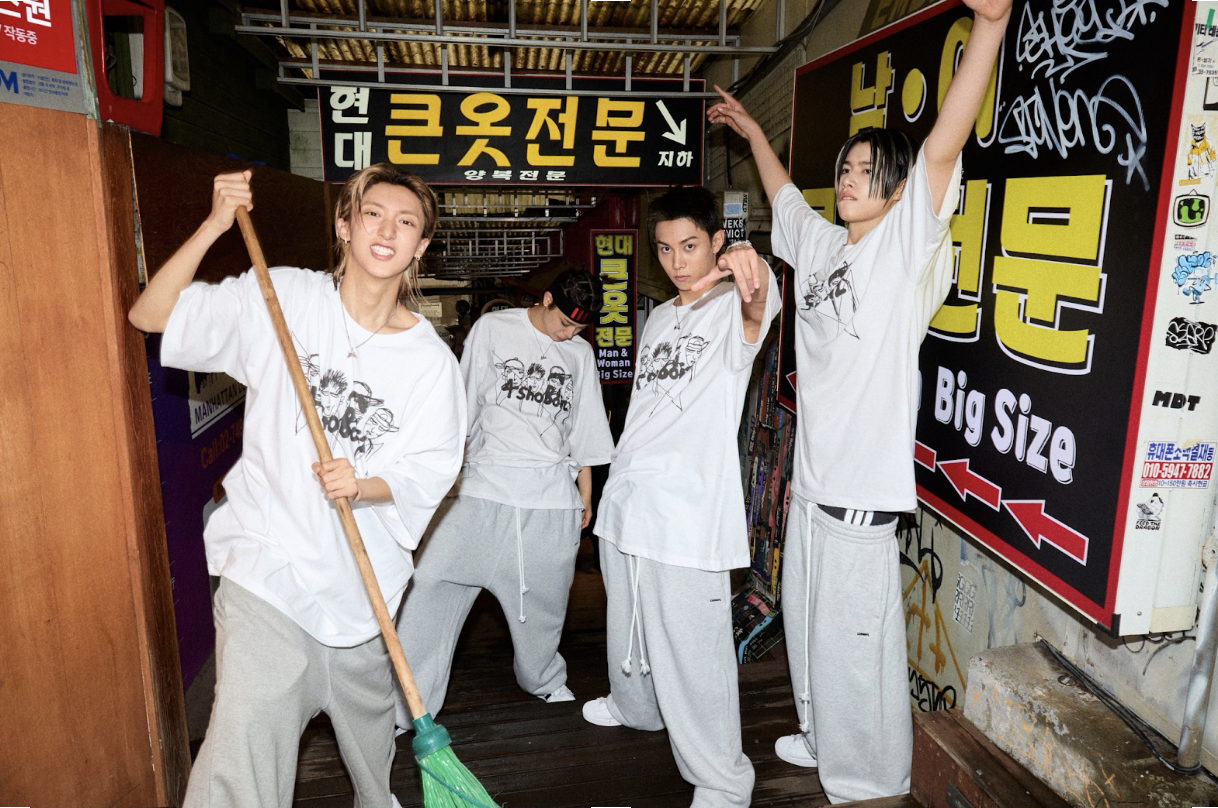
I’m a straight up goofball, really, but when I’m rapping I’m just … genuinely cool, I think. (laughs)
Isn’t that part of the appeal—the way I come across differently when I’m just talking like this versus when I’m rapping?
I’m the one who sets the mood, so even though I’m one of the oldest in the group, it’s still hard for me to get too serious.
I want us to have fun together, so I try to keep things light.
But when it comes to the music, I want to be cooler and more serious.
As the only rapper in the group, I feel like my role is to change up the mood of a song.
I find songs are more fun to listen to when the rap comes in and breaks up the melodic flow.
If I were to compare myself to a food within LNGSHOT, I’d say I’m the refreshing danmuji of the group. (laughs)
How has hip hop changed or shaped you as a person?
I think hip hop has helped me mature and be more of an adult.
Once music is out there, it’s out there for good, you know?
I think of it as a solid asset as well as a log of where my head was at and how I was feeling at the time.
And through all of that, hip hop is what’s helped me grow.
Is there anything you’d like to say to the fans who’ll be coming along for the ride?
The fans have had such a huge influence on me.
Without them I probably wouldn’t have been able to write most of the songs we have coming out.
Thanks to you guys, that means a lot of different kinds of songs coming your way, so get hyped. (laughs)
I’ll make sure all the love they’ve shown me wasn’t for nothing.
Just watch me become as cool as Jay Park!