The seven members of BTS stand with Gwanghwamun Gate at their backs. This opening of “BTS THE COMEBACK LIVE | ARIRANG,” broadcast live on Netflix on March 21, lays out the direction of the group’s latest album, “ARIRANG,” in an instant. The boys who got their start in Korea emerge on the same path once walked by kings of the Joseon Dynasty. A group of 50 backup dancers from all different backgrounds but all wearing black split to either side, clearing a way for the idols. From that point on, BTS’s path no longer keeps them in one place—it stretches outward as it takes them on a journey the whole world shares in together. No doubt “BTS THE COMEBACK LIVE | ARIRANG” was streamed live on Netflix with a similar idea in mind.
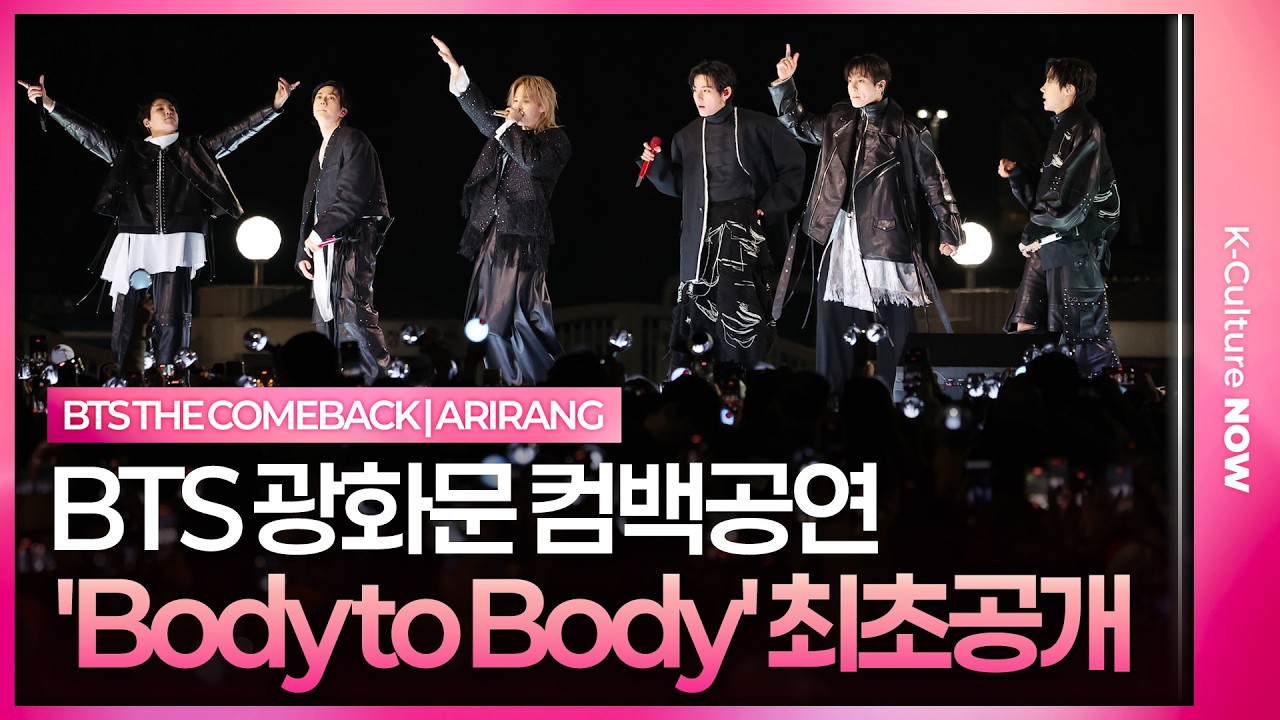
It’s also why it felt incredibly apt that “Body to Body,” the opening track off “ARIRANG,” opened the show. The song sends a message about breaking down barriers and uniting people through music while incorporating the traditional Korean folk song “Arirang.” A screen shaped like a door stood in the center of the stage as the group’s performance of “Body to Body” began, a fog settling in the darkness behind it. But the darkness gradually lifted, revealing traditional musicians and singers from the National Gugak Center bringing the folk song to life, and a media facade bloomed across the walls leading from Gwanghwamun like ink spreading on paper. As BTS moved onto their new songs “Hooligan” and “2.0,” capturing their attitude toward the stage and the launch of their new era, the screen and the walls all flushed red together. The screen functioned as both a doorway and an alternate world throughout the show, turning the ancient gate in the background into a framed painting. Its colors and patterns continued to shift throughout the show, first into a blue sky, then a star-filled microcosmic universe, constantly pulling the audience into new worlds.
From concert opener “Body to Body” to “2.0,” the songs quite literally present the audience with BTS 2.0. “Body to Body” breaks away from K-pop’s typical synchronized group formations. Instead, the performance brings out what makes each of the BTS members unique, all while moving together as one cohesive whole. For “Hooligan,” the group worked with a large dance troupe, filling the stage edge-to-edge with awe-inspiring moves. The BTS members dance alone during “2.0,” flawlessly executing their tight group choreography over a trap beat. The energy only rose from there with BTS’s global hit “Butter,” followed by a performance of “MIC Drop,” a song that marked a major turning point in their career.

“BTS THE COMEBACK LIVE | ARIRANG” didn’t just capture where BTS is at right now—it also took that and linked it with where they’ve been. Starting with three of their latest-and-greatest tracks off “ARIRANG,” the concert then shifted to their past hits “Butter” and “MIC Drop” before returning to the present with “Aliens,” also off the new album. Released in 2017, “MIC Drop” was an opportunity for the group to prove themselves by addressing scrutiny head-on, but with “Aliens,” BTS turns their identity as outsiders into a point of pride and instead demands that listeners meet the group on their home country’s terms. That’s what makes it key that the staging for “Aliens” foregrounds the group and places attitude front and center even as it builds its mise en scène around the backup dancers’ quick, wild movements. The question in “Aliens”—“Are they for real? For real?”—may still be there, but in 2026, BTS is up onstage in Seoul’s Gwanghwamun Square, broadcasting their message to the whole world on Netflix.
“During the time we had to pause for a bit, we spent a lot of time thinking about what we should hold onto no matter what and what we need to change,” SUGA told the audience during the concert, distilling the meaning behind the group’s latest album, “ARIRANG,” and putting on a show after nearly four years away. “We’re still not completely sure, and still feel anxious at times, but I think even these emotions are a part of who we are.” Even after finding incredible success around the globe, more waves keep rolling in toward the group. The boys expressed their acceptance of that reality into soft waving movements during a placid performance of the new album’s lead single, “SWIM.” The current swelled into a longing for freedom in “Like Animals,” and then settled into an atmosphere of mutual feelings in “NORMAL,” when the group members came to the front of the stage to be closer to the crowd. The entire show was designed to highlight BTS’s messages in one continuous, flowing movement, from whipping the audience into an excited frenzy with high-intensity song and dance, to the focus on deeper emotions starting with “SWIM.”

By the time the concert drew to a close, the Gwanghwamun stage that had opened in a dark fog transformed into a different scene altogether. The door-like screen was now filled with an image of a starry night sky, the sea of a crowd full of glowing phones joining in to turn Gwanghwamun Square into what looked like an endless expanse of outer space. The scene was a perfect mirror of how “stars shine brighter on the darkest nights” for the group’s encore performance of “Mikrokosmos.” With all those individual lights coming together to form one bright sky, the sense of solidarity that BTS had conjured up at the start of the show with “Body to Body” became tangible by the end. Their pursuit and the questions surrounding it that they aimed to express through their music became a universally shared emotion in that moment—one broadcast live around the world. And in that moment, the traditional sound of “Arirang” and the globally informed songs and dance were all framed together by a place that symbolizes Korea itself. In doing so, they put on a show that completely washed out all borders of genre and geography—all grounded in the identity of a single K-pop group. Today, BTS is writing the here and now of what that “K” stands for.
- For BTS, time flows on2026.03.25
- Jin’s ‘#RUNSEOKJIN_EP.TOUR’ report2025.09.03
- Making j-hope’s performances2025.08.04