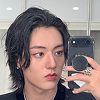
“It’s got some real kick.” When HARUTO talks about music on Weverse LIVE, it’s like he can feel it in his bones. His ability to latch onto a beat right from the intro and the “tasty” sound of a single lyric is the product of years spent refining his tastes. He wakes up in the middle of the night to record voice memos, and he keeps the other group members’ preferences in mind while working. Music is his personal diary and personal drive. We asked about the K-pop that changed HARUTO from a boy too afraid to make anything into the powerhouse he is today, with instincts locked in to the music.
I understand you’ve been a K-pop fan ever since you were young.
I learned the choreography to “Gara Gara Go!!” at a dance academy when I was little, which was my first introduction to BIGBANG.
My mom fell completely in love with that song, and I heard a lot of BIGBANG after that.
Your K-pop reaction videos on Weverse LIVE have been getting a lot of attention lately.
The world’s finally found me … I’m joking. (laughs)
I’ve been joking on stream that I must have some kind of cyber magnetism, but I think I’ve been lucky that everyone reacted positively to me consistently studying music.
Even when TREASURE isn’t actively promoting, I keep hearing things like, “I’ve really been enjoying your content lately,” and that made me feel like, “Ah, something must be clicking.”
But I try not to pay too much attention to the response I get so I don’t let myself come across as inauthentic.
How did you get started doing the K-pop reaction streams in the first place?
I always have music playing when I stream anyway, so when I saw a comment asking me to play some K-pop one time, I did it, and people liked it.
How do you choose the songs?
If it’s just for me, I’ll listen to songs that I’m personally into.
I try to put on songs that the fans can easily listen to.
There are some tracks that are experimental and fit my tastes more, but I don’t really tell people what the song’s called, even if they ask. (laughs)
But the fans just figure it out anyway and post it in the comments, which tells me the people who watch my stream have good taste.
It was impressive hearing you break down songs in such detail during your stream.
It’s not like I started studying music to do reaction videos, but I don’t think it’s enough to just stream if you don’t know anything about a genre or where it comes from.
That said, since I’ve learned a lot about music and there’s been such a good response, I think I can safely say that it blew up for a reason. (laughs)
When did you get into the habit of doing in-depth analysis of music like that?
I actually didn’t join the label as a rapper—it started when someone on staff suggested I try it.
I felt like I should put in more effort, so I got some advice and pushed my voice hard on purpose and let it recover, and I did that over and over while it was changing until my voice dropped.
Then I asked myself “Who are some rappers with deep voices?” and started listening to a bunch of songs and learning about things like different rap styles and lyrical structures. I guess it became a habit of mine, to keep analyzing songs like that.
What kind of things in particular draw you into a song when you’re listening to it?
I’m drawn to any music that you would say without question has some kick to it.
If you listen to “Bag Bad Back” by RIIZE, it’s obviously the part where the beat stops and SHOTARO goes “swoosh swoosh.”
The “dance dance meow” part in the ILLIT song “Billyeoon Goyangi (Do the Dance)” obviously gives it some kick, too.
I knew “404 (New Era)” by KiiiKiii was killer as soon as I heard the “dun dun dun” part in the intro.
I also really love Hearts2Hearts’ “STYLE.” That part at the end where they don’t sing the chorus again at the end but do something completely different is so good.
I could go on and on. (laughs) I try to do the same thing when I’m writing a song—make sure it’s clearly got some kick to it.
You’ve watched K-pop evolve from BIGBANG all the way to the fourth and fifth generations of today. As an artist, what kind of changes have you noticed lately?
Older K-pop was great how every group had their own distinct identity, and these days it feels more like they take genres that started blowing up overseas, like house or techno, and put them in a K-pop package.
I think today’s K-pop is about taking certain trends and making them more mainstream.
I guess you listen to a lot of different songs to keep up with trends since you also write music.
My melodies are heavily influenced by Korean hip hop, but for my beats I tend to follow the vibes from overseas.
One genre I listen to a lot of is nu jazz, and there’s a particular synth sound that comes up in those songs. It’s sort of cute and minimalistic, and as soon as I hear that, I save the song to a playlist before even listening to the rest of it.
I actually never used to make playlists, but I figured, I only listen to songs I like, so they all sound pretty similar. (laughs) So lately I’ve been organizing them by genre or artists I like to make things easier.
How do you go about discovering new music?
I start digging around whenever I’m bored. I get a lot of recommendations from people I know, too.
Fans ask me where I go looking, but honestly, I’ve done so much looking that now the algorithm just keeps serving things up, and when a good song pops up, I download it, so I don’t have a very helpful answer. (laughs)
Sharing my finds with fans might be pushing me to dig even deeper, though.
What do you hope to convey to your fans through that?
I do it in hopes they’ll develop their own tastes.
I think what would be ideal is if someone listens to my stream, hears something they like then start digging from there. I do that, too.
You seem to be very specific about your own taste in music.
Yes, for sure. I really want to have my own taste. (laughs)
So I just try to listen to as much of everything as I can.
I love music, and making it while listening to stuff makes me love it even more.
I came all the way here by doing what I love, so I want to keep listening to and make music that fits my tastes.
A few times on your stream, you’ve actually written a new verse to an existing song, and sometimes you post the finished product. It feels like your way of showing your admiration for them.
The three songs that made me think “listening to this makes me want to write for it” were “FaSHioN” by CORTIS, “404 (New Era)” by KiiiKiii, “Moonwalkin’” by LNGSHOT.
I thought it’d be fun to drop something in there like I was the featured artist.
You could say I do it out of pure admiration for the songs, mixed with wanting to demonstrate my passion.
You’ve said before that writing lyrics in Korean is better for you. Why is that?
It’s easier to rhyme in, and there’s so many different ways to abbreviate words that it’s just plain fun.
If I end one line with “moja,” the next line has to have an “o-a” sound too—no exceptions.
I guess that’s my own little rule about rhyming. (laughs)
Sometimes I write a mix of Japanese and Korean lyrics, and I wrote this one thing that was in Japanese but rhymed in Korean, and it felt unbelievably satisfying when it clicked.
What’s it like when you’re working with the other members of TREASURE?
I’ve been working with PARK JEONG WOO a lot lately.
He talked about how he wanted people to know what his taste in music’s like, and I thought, “Well, I know what he’s into—I should write something for him,” so I started messing around with a song.
When he heard it, he said, “No, we should do this together,” so we did.
Then, with SO JUNG HWAN—was it when we were shooting the “YELLOW” music video?—he had to head out again soon.
I couldn’t get to sleep, so I asked if anyone wanted to work on some music, and he said he did. And there’s a song that came out of that, too.
I imagine everyone in the group has their own style when it comes to working together.
We’ve spent so much time together that I know what kind of approach works for each of them.
PARK JEONG WOO, for example, I basically have to trap in a room so he can really get into it.
With SO JUNG HWAN, I usually keep the conversation going and work on giving the song some kick.
With ASAHI, it’s often a case of asking him to write a rap once the track is already finished.
How do you stay true to your own tastes when working with the others?
It used to be that, when I was working with them, I wanted it to be a time for them to do what they wanted and work through whatever they were feeling, so I’d adapt to them, but now it’s more like we’re studying music together.
I happened to be in an R&B phase when I was working with PARK JEONG WOO, so I could write good melodies.
With SO JUNG HWAN, I tried pushing my own tastes, and it turned out he’d been listening to the same kind of music.
Things just click like that sometimes. It’s been a lot of fun.
You mentioned in an interview with “Singles” that making music is how you recharge. What is it about it that gives you that feeling?
The dopamine from being able to make the kind of music I listen to, the dopamine from having the freedom to write lyrics my way.
That, and listening to it while I’m on my way somewhere. All of that lets me recharge.
It sounds less like a part of your work and more like a personal diary of the emotions you experience.
There’s something cool about being able to take what you’re thinking and feeling and channel it into a song. (laughs)
There’s a desk right next to my bed, so sometimes I even wake up in the middle of the night and just start recording.
When I listen to it again later on, I can hear exactly what I was feeling in the moment. That’s why my songs feel like a diary to me.
I get more inspiration from everyday life than from things like movies or TV. The things I’ve lived through and the emotions I feel come alive in the music, and I find that exciting.
It’s one of the reasons I love music.
So I never lie in my lyrics. No cap.
You grew up a K-pop fan, later became an artist yourself, and now you get to share your love of all kinds of music. What does K-pop mean to you at this point?
It still feels surreal that I’m actually an artist and doing this.
K-pop is the genre that turned me from a listener into a creator.
I used to be really scared to create anything. I’d work on something alone and never let anyone hear it.
K-pop is what changed that about me, so I personally hope people won’t draw a line between K-pop and other music, but think of it all as one thing.
Doing Weverse LIVE has helped me discover so much more great K-pop too.
Do you think you’ll keep streaming?
I started doing this purely out of a love of music, so I don’t think I could ever get tired of streaming.
You can’t beat someone who loves what they do, and I think that’s what this is.
I’m grateful I get to show the real me through Weverse LIVE.
I absolutely love that feature, so I’ll probably keep doing it for a long time.
What kind of artist do you aspire to be going forward?
Even now, when I perform on a stage where the artists I used to watch have performed, or when I look out and see young fans, I think, “Ah, so this is how I must have looked to those other artists.” It still gets me.
I think artists can give kids something to dream about, and that makes me want to do even more.
I want to be the kind of artist who people feel has a uniquely strong understanding of music.
I’m going to show people just how far I can go.
I want to give them something that doesn’t just sound good—it surprises you.
My instincts are always locked in.