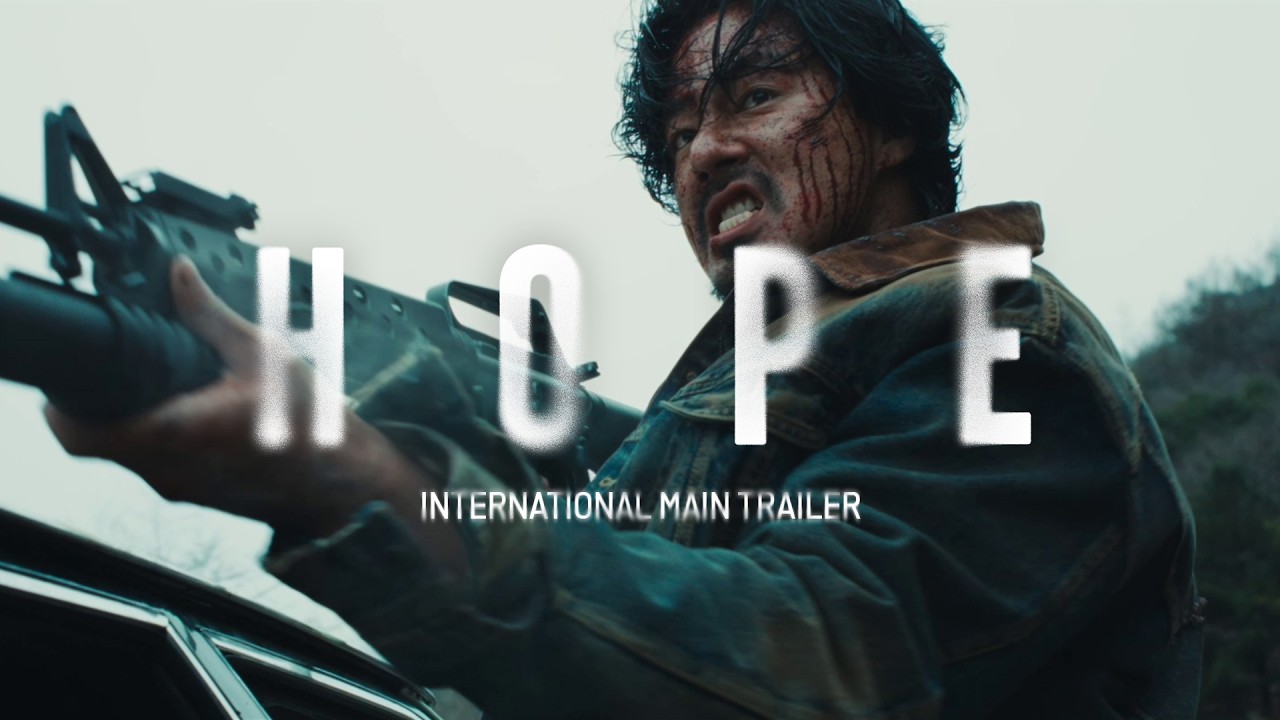
“HOPE”
*Warning: Contains spoilers.
Nam Sunwoo (“CINE 21” Reporter): It was not until the final shot of “HOPE” that I understood what its title really meant. The “hope” in question has less to do with the protagonists’ chances of surviving their encounter with a monstrous creature than with the aliens’ seeming indifference to the extinction of humanity. The more I thought about it, the more fitting it became. The pursuers are always more lively than the pursued. They know what they want; only the fugitives are ignorant of the particulars. The danger begins when the unknown becomes an object of fixation—when the feeling that understanding is almost within reach is precisely what stops you in your tracks.
Consider Beom-seok, the local police chief played by Hwang Jung-min. He raises his gun at the hulking, long-haired creature, and their eyes meet. A glance that could only have lasted an instant stretches across the screen with uncanny duration. Beom-seok hesitates to pull the trigger, as though something unspoken has passed between them. Later, he insists that the creature was crying and even rebukes the person he believes caused its sorrow. Na Hong-jin has little interest in telling us whether Beom-seok is right. The film remains committed to the physical chase between beings who regard each other as enemies. Its refusal to satisfy the audience’s hunger for meaning can feel almost mocking. Yet the recurring camera movements of the film’s opening suggest otherwise. The sunlit wreckage left in the creature’s wake remains vivid, and “HOPE”—a thriller staged in broad daylight—repeatedly draws Beom-seok out of shadowed interiors and into those bright ruins, as though whispering that whatever truth he is permitted lies there. Perhaps the film is not mocking interpretation so much as urging it on. Genre cinema, after all, excels at offering confusion absorbing enough to lose oneself in. Whether you take the bait is up to you.

“Na Yung Suk VS Junior PD”
Lee Minyoung: At a time when AI is beginning to stake its claim on creative work, can a producer’s instincts—honed over 26 years in the field—still hold their own? “Na Yung Suk VS Junior PD,” a series from channel fullmoon, turns that question into a competition. Armed with nothing but pen and paper, Na Yung Suk faces off against a junior PD backed by Google’s Gemini. Given the same guest, each develops a variety-show concept while their identities remain hidden until the results are in. The winner is decided by a combined tally of views, votes, and likes.
Once the names are stripped away, viewers immediately begin looking for the unmistakable Na Yung Suk touch. The first matchup, featuring æspa’s KARINA, proved just how irresistible that impulse could be. In “Not the Met Gala, but the Maetdol Gala,” where KARINA grinds soybeans on a traditional millstone to make kongguksu, many were convinced the concept had to be Na’s—from its quietly comforting “Three Meals a Day” sensibility to its trademark fondness for putting celebrities to work. “I’m KARINA In Real Life, But In An Alternate World, I’m 21-Year-Old Ji Min?”, by contrast, split opinion. Some found it far too attuned to contemporary trends to be Na’s work, while others argued it reflected the same affection for elaborate fictional worlds that has long defined his shows. Then came the reveal, and every assumption unraveled. Cheon Ji In, a producer with just three years of experience, and Gemini had reproduced the instincts of someone who had spent 26 years refining them. Meanwhile, the veteran’s own concept felt fresh enough to be mistaken for the newcomer’s.
The behind-the-scenes episode from the first matchup ultimately reveals something more interesting than the result itself: both concepts began with the same impulse. Cheon Ji In started by asking how to let KARINA shine as herself. Na Yung Suk began by asking what seemed to bring her the most joy. Both approaches looked beyond KARINA the idol to Yoo Ji-min the person. By the second matchup, featuring Ha & Soo (Jung Jun-ha and Park Myung-soo), viewers were no longer trying to identify the minds behind the concepts. Instead of debating who made “Introducing My Friend’s Hate Comments,” in which the duo trades hateful comments about each other for words of encouragement, or “Real-Time Tracking LIVE, Tag,” a live reimagining of iconic chase episodes from “Infinite Challenge”, they found themselves talking about the shows themselves. Once reputation is stripped away, all that remains is the work—and whether it begins by seeing the person behind the public image. Perhaps that was the destination this blind battle had been heading toward all along.
I.M.F. - “Imported Mold”
Kim Doheon (Music Critic): Imitation, modification, fabrication: a joke, perhaps, or an allusion to the 1997 Asian financial crisis. After stints in PYHA, Bamseom Pirates, and Gawthrop, Sunggun Jang named his new band I.M.F. With bassist Sungsig Min, drummer Sejeong Lee, and guitarist Seokyoung Haam, he has turned the project into a full-fledged band—one now sweating its way through Korea’s underground in pursuit of music as subversive as it is abrasive.
Released on June 19, “Imported Mold,” I.M.F.’s debut full-length, is a faithful record of that pursuit. Its promotional copy reaches for familiar genre labels—noise rock, industrial, and more—but the language feels almost too neat. “Grotesque assemblage” comes closer. The grindcore and powerviolence of Bamseom Pirates remain unmistakable, but “Dami” veers into nu-metal, “Hairytale” channels Soundgarden-style grunge, “Formicary” lunges into thrash, and “Roach” lumbers through doom sludge with the ungainly swagger of Limp Bizkit. Past and present collide in a deliberately disorienting mass. Jang’s voice further scrambles the mixture. His ritualistic muttering recalls Korn’s Jonathan Davis; his feral screams tear the lyrics loose from their written meaning until they register less as language than as sound. On Korean music portals, the posted lyrics read almost like track-by-track notes rather than words meant to be heard. The sole exception is “Taxi Driver.” Inspired by a “Hankyoreh” column by novelist Park Wan-seo, the song hurls an aggressive punk spirit against its historical moment. It also brings to mind “I’m a Taxi Driver in Paris,” a song from Lee Min-hwi’s days in Mukimukimanmansu; Lee and Jang now play together in Gawthrop.
In “Frankenstein,” the Creature curses his creator, arguing that his cruelty grew out of a life of unbearable solitude. I.M.F. travels in the opposite direction. After sustaining the project alone, Jang has built it a conventional band’s body. He and his bandmates have little use for the fashions and sensibilities framed by a smartphone screen; instead, they seize us by the collar and fling us into a cramped club rank with sweat. Soumbalgwang, Peach Truck Hijackers, Socialclub Hyangwu, Chip Post Gang, Rebar Concrete—the younger roar of extreme music, noise, garage rock, and post-punk collides violently with the local character of Korea’s indie scene. Here, the lonely gather like imported mold, finding solidarity in the loudest noise they know how to make.