For every name we’re called by others, we have a separate mask we wear. To one person, we’re the playful friend. To another, the inscrutable colleague. Each name they call us demands we wear the face and adopt the attitude that fits that relationship. The longer we go by a particular name, the more we grow into the mask, until eventually, we can’t tell whether that’s really our face in the mirror. What, then, is our real name? Strip away every name we’ve ever been called, and who are we? What makes us smile? What makes us frown? What expression crosses our face when we’re happy, and what’s the first thought that comes to mind? And what does our face show when we have to do something we don’t want to? Tear down the rigid framework built up by the names we’re called, and what spirit—in Korean, young—lies hidden within?
The album “YOUNGEST” feels like a journey toward answering that question. Young K, Kang Younghyun, Brian, and countless other names people don’t know—none of these things he’s called can provide an entirely satisfactory answer. The name Young K, in particular—the stage name he took on when he debuted—seems to have come to him as an implicit quest, and he was (and still is) a player who’s diligently worked to complete that quest. Each door he opened on that quest let Young K connect with more and more people, but for every door, he must have felt a little further from the young in Kang Younghyun—his original, true self.
The quest to find the young within tends to converge inward. That’s inevitably how it goes when you’re trying to figure out who you are. Ironically, though, the way Young K searches for young on “YOUNGEST” is more about looking outward. That doesn’t render self-exploration meaningless, though. The outward-facing search he sets off on becomes an experiment—a way of testing how far, and in what directions, he can go once he steps beyond the limits of a finite world.
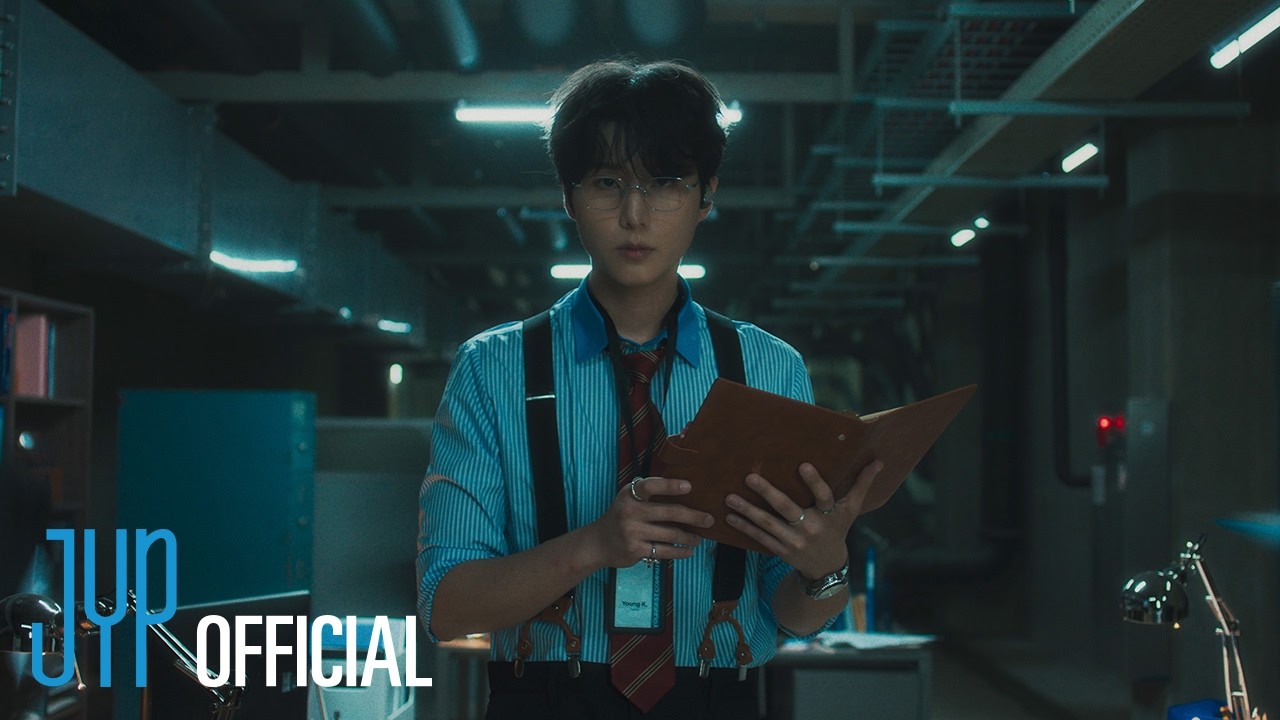
Korean homonyms: From zero—another kind of young—to spiritual young
Young K’s earlier solo albums were specifically made for Young K. Put another way, they were albums that bolstered Young K’s very existence. From the underlying message that Young K is “Eternal” so long as there’s music, to the “Letters with notes” he wrote out through song, listeners followed Young K’s journey as a musician from origin to growth. The same can be said about the involvement of producer Hong Jisang, who’s been with DAY6 right from the beginning. And even when the artist experimented with genres that were new to him, he never fully strayed from who he is as a member of DAY6 or as Young K. Even when he’s working with an R&B soul sound, it isn’t out of left field—it connects back to the musical lineage of JYP Entertainment, the label that brought Young K into the world. In other words, working with new genres isn’t beyond Young K’s boundaries, it’s just widening the radius of what that name encompasses.
But “YOUNGEST” circles back to square one, starting again at zero. He explores a wealth of genres, as if searching for answers to what it is he likes and what he excels at, eager to connect with new people along the way. There’s the sweet soul track “Hey Honey,” the hyperpop-heavy “whatever,” the future bass EDM song “Goodbye, Love,” a country track called “Heading Home,” the folksy ’90s “Gypsophila,” and the mellow jazz number “Ordinary Days.” Through a true kaleidoscope of interactions, Young K writes some absolutely inspired melodies. Starting once again from zero, he takes solid steps in every direction he possibly can, testing the waters to find whether he’ll eventually arrive at his own personal young.
What’s interesting is that even though the album’s packed with songs made through all these new collaborations, it never loses that Young K sound. “Marionette” is a prime example, its piano riff conjuring images of a puppet show that gives the track fairy-tale vibes. It’s something you’d never expect to hear from DAY6 or a Young K solo release, yet it ends up having its own distinct rock sound thanks to working with producer Woo Min Lee (aka collapsedone), who’s been working with DAY6 since the beginning. Likewise, Young K wrote “A Hundred Whys for Goodbye” (with JINJOO of DNCE) with producer BUMZU. Even though this is the first time the two have collaborated, the song has echoes of “365247,” a track off DAY6’s 2019 album “The Book of Us: Entropy.” The synthpop lead single “Shut The Door” absolutely radiates dazzling summer energy, and no season better captures who Young K is—nor is there any season he’s better at capturing.

The space between young and K
Maybe the belief that there’s one true self, a spiritual young buried at the deepest part of ourselves, is nothing more than fantasy. Maybe it does exist, but that alone can’t encompass everything that makes us who we are. Some parts of us become an eternal shadow we can never shake almost like they’re fate, while others we choose ourselves, driven by our own wants and desires—driven by the determination to create something new out of ourselves. We’re sent here and there, jostled about, through a series of freewheeling, rousing movements, coming face to face with another version of ourselves. Oddly enough, it’s when we’re headed down that path that we encounter things we never intended, totally by chance. And those things become part of what makes us who we are, too. In the end, finding ourselves isn’t about uncovering some pure and true version of self. It’s more about seeing how the paths we’ve chosen, and the things we’ve stumbled into along the way, have changed us.
When Young K starts from scratch to find his young, the first thing he checks is the direction of his compass. The needle points toward himself because there’s always room in DAY6’s music to let anyone fill in the blanks themselves. The perspective isn’t immediately defined, and so easily relatable scenes of falling in love, breakups, dreams, and frustration are sketched out in broad strokes. But on “YOUNGEST,” the speaker is clear. It’s Young K, Kang Younghyun, or Brian. Every word of the album stems from real experiences belonging to the same man all of those names belong to.
Deeply true-to-life stories drawn from intensely personal, everyday experiences are woven throughout the album. There’s “Marionette,” about being liberated from having to play a role. “Shut The Door,” inspired by gossip heard from a friend. “Yonge St.” is steeped in memories from when he went by the name Brian. “SPIKE,” written after watching the anime “Haikyu!!” There’s also “Heading Home” and how it paints a grueling day of KATUSA service during his military days. It may not feel like there’s much space for the listener to insert themselves into the songs when it’s clear who they’re about, but he’s not the sole recipient of the emotions the music imparts—feeling trapped living life behind a mask, relationship issues, wandering streets as a kid, favorite anime and videos, walking home feeling dejected after a brutal day. The intensely personal stories he tells become all of ours. That’s why the song “Anthem” rings of encouragement for both himself and for everyone listening.
In the end, “YOUNGEST” may look like a journey of self-discovery, but it’s more akin to drawing a map of who Young K is. The experiences he’s been through, and the emotions that bloomed out of them, mark coordinates on that map, and those coordinates connect to form paths branching in every direction. Those paths are how Young K comes to find, or understand, himself, and they’re also how listeners come to see who he is. On this map where fate, chance, and choice all intermingle, we walk the paths Young K has drawn as we laugh, cry, and relate. And in the end, we come to realize something—that the map resembles something that isn’t so different from our own lives.