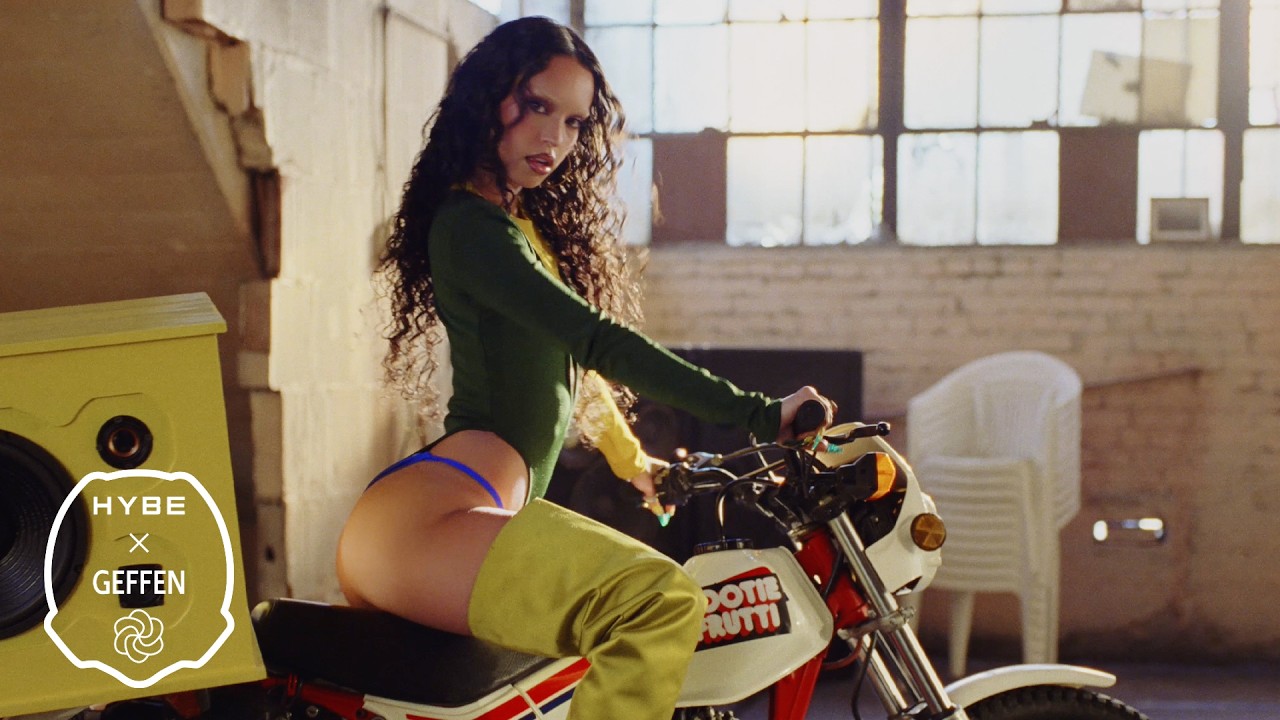
Despite its title, there is no wilderness in the three music videos KATSEYE released for “WILD.” Instead, they unfold in playgrounds and parking lots, dressing rooms and dance floors, and sweltering indoor spaces. In “PINKY UP,” Lara and Sophia ride a motorcycle as if racing across a vast desert, though they’re actually in a room swirling with dust. In “Animal,” the members are at their freest and wildest when they tear through their suits in the red room, stride forward, and break into dance. And in “Hootie Frutti,” the members and a crowd dance not in the rain, but under water pouring from indoor pipes. In “PINKY UP,” the camera takes in a teddy bear lying toppled over on a playground; giraffes strolling across a TV screen, with zebra toys beside it; and a plaster angel fixed to the wall, posed as if about to take flight. It is a world populated by things that evoke nature, the wild, and freedom, yet are manufactured or incapable of moving on their own. Within it, KATSEYE remain confined indoors even as they breathe wildness into an artificial world.
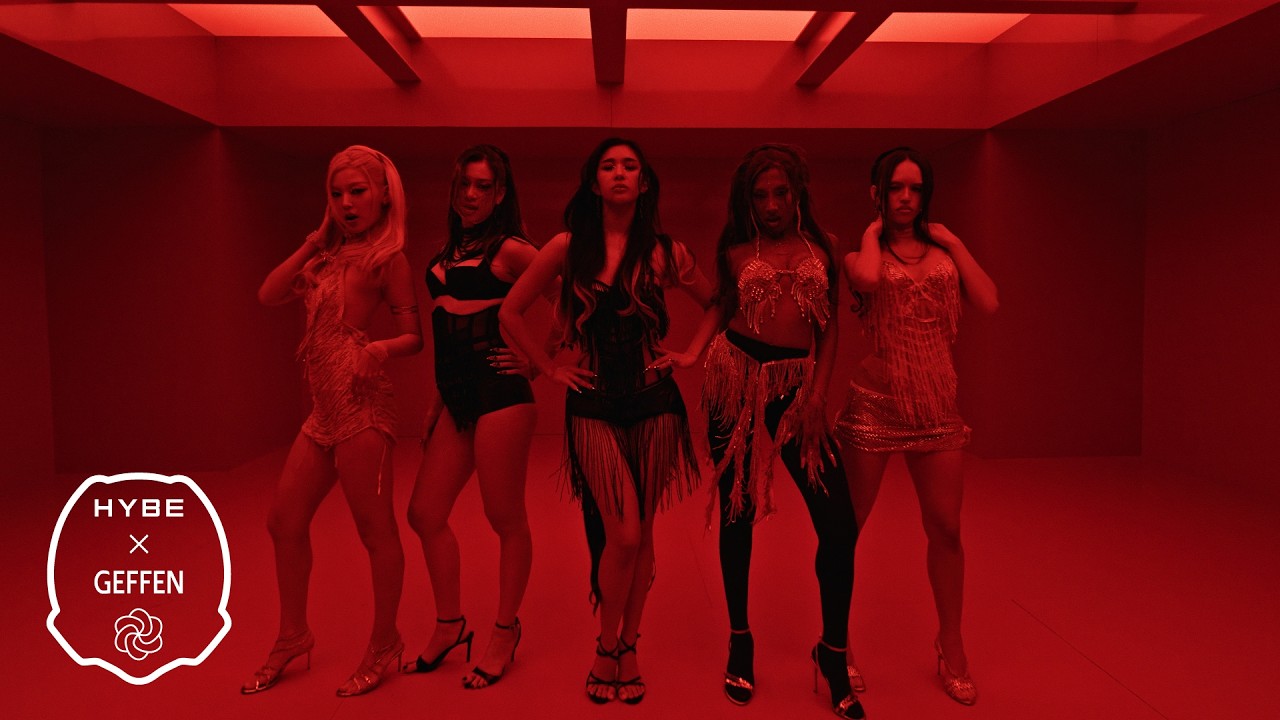
In the “Animal” music video, KATSEYE are simultaneously putting themselves on display and monitoring themselves. The members dance in front of what appears to be a mirror, but on the other side of the glass, alternate personas of the same members — dressed as men — watch, evaluate, and confer about them. The scene recreates the familiar dynamic of women dancing while men look on, yet both the watchers and the watched are played by the same women. It hardly seems coincidental that Demi Moore, who starred in “The Substance,” a film that lays bare society’s obsession with women’s appearance, appears in “Animal.” As she advises the members on what to wear, she tells them, “All right, let’s get wild.” Here is someone who has spent decades being judged by Hollywood for her body, age, and sexuality, ushering KATSEYE into their own “wild” transformation. In doing so, the video shifts the members from objects of judgment to agents of their own wildness.
A woman sipping tea with her pinky raised: “PINKY UP” turns a gesture that exaggerates the refined femininity of the upper class into a signature move in its choreography. Then, a dark room that had confined people transforms into a techno party. Particularly symbolic is the moment when the dolls in the parking lot trade “You” and “Me,” then turn “We, we?” into “Oui, oui?”. Those once divided into “you” and “me” become “we,” while the French oui — linked to “we” through sound — becomes an affirmation of the community they have formed. The “PINKY UP” lyric “I love you, you love me” recalls a song from the popular American children’s show “Barney & Friends,” where the next line is “We’re a happy family.” KATSEYE, however, replaces it with “We batshit, oui oui.” In place of the harmless, conventional “happy family” is a community of people who define their own identities, choose one another, and form a “we” of their own. When they open the trunk, Daniela — lying among plush toys and eating snacks — similarly subverts the crime-film cliché of a woman in the trunk of a car. Daniela, who also appears inside a claw machine earlier in the video, lies comfortably among the plush toys in the trunk before taking the dolls’ hands, stepping out, and launching into the performance. If “Animal” traces the members’ journey from internalizing others’ judgments and policing themselves more harshly to embracing every side of themselves and expressing it freely, “PINKY UP” blurs the boundaries between the artificial and the wild, the everyday and the transgressive, and gender itself through a celebration created by people who choose one another and become a “we.” In short, for KATSEYE, “WILD” does not simply mean instinct or the wild in its natural state. Rather, it is the energy of turning artificial, controlled environments into stages of their own — a wild attitude that transforms even the conditions of control into material for self-expression.
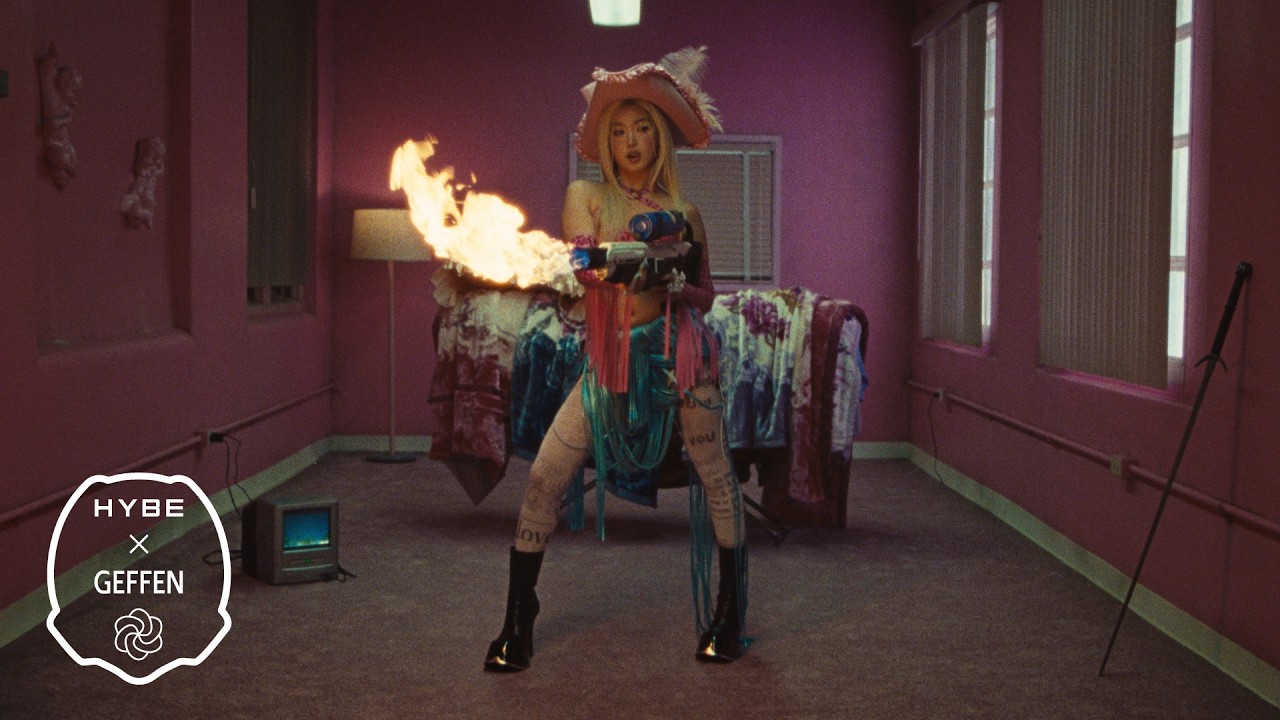
“Us against the world shaking ass in the parking lot.” The “PINKY UP” lyric carries over into the “Hootie Frutti” music video, where KATSEYE move their hips as the music begins. Sophia runs her hand over a fan, while Yoonchae fans herself with a newspaper, both gestures suggesting the heat. But rather than being somewhere in the tropics, they are inside a warehouse. As the members dance in this enclosed space, singing lyrics that compare themselves to sweet fruit as they entice someone, they recall a figure described in “Animal”: “Nobody knows you’re outta control / But I see a side behind the closed doors.” The person in the lyrics has painted nails and wears a crop top with loose-fitting jeans — signifiers traditionally read as feminine — while concealing wild instincts behind closed doors. In the “Hootie Frutti” music video, KATSEYE seem to translate those instincts into performance. Inside the warehouse, people worn out by the heat watch KATSEYE perform with vacant, largely disengaged expressions, or dance around them without paying the members much attention. Yet within this world, KATSEYE are both the force that sets a fading party back in motion and figures who dance regardless of who is watching. As in “Animal,” where the members tear through their suits and dance freely in the red room, KATSEYE embody their wildness by dancing without regard for the gaze of others, here in a warehouse where nature itself is nowhere to be found.
The bonus track “Unloveu,” which Lara co-wrote and co-produced, turns the language of a wedding vow into a declaration of walking away from a relationship. In the chorus, “I do” — the language of commitment — is repurposed to describe the state of no longer loving someone: “Unloveu.” The line “And I wore your words like a necklace” captures the moment when the speaker, who had taken her lover’s words and judgments on as part of herself, breaks free from their influence. That act of taking familiar language and remaking its meaning on her own terms echoes KATSEYE’s broader approach on “WILD”: disrupting familiar symbols and the spaces they are given, then recreating them in their own way. In this way, “WILD” brings together disparate layers within a single album: the techno-driven flamboyance of “PINKY UP,” the delicate sensibility of “Unloveu,” and the exuberance of Brazilian funk-inflected, repetitive percussion, alongside the remaking of the everyday, challenges to conventional norms, and sensuality. Across these contrasts, “WILD” emerges not as a state of nature, but as an attitude that disrupts artificial, controlled environments. There is no wilderness, but wildness is constantly being made. In that sense, “WILD” offers a glimpse of what wildness means to KATSEYE as they navigate the heart of the entertainment industry. For them, wildness is not something that can only be found by escaping the reality they have been given. As “PINKY UP” shows, a raised pinky — a symbol of refinement — can become the signature move of a freewheeling party. A cramped room can come alive when people come together in solidarity and revel on their own terms. Wildness, then, does not belong to any particular place. It is an attitude: taking the spaces and familiar symbols they are given, disrupting them, and remaking them in their own way. Perhaps this is the wildness “WILD” is trying to define.