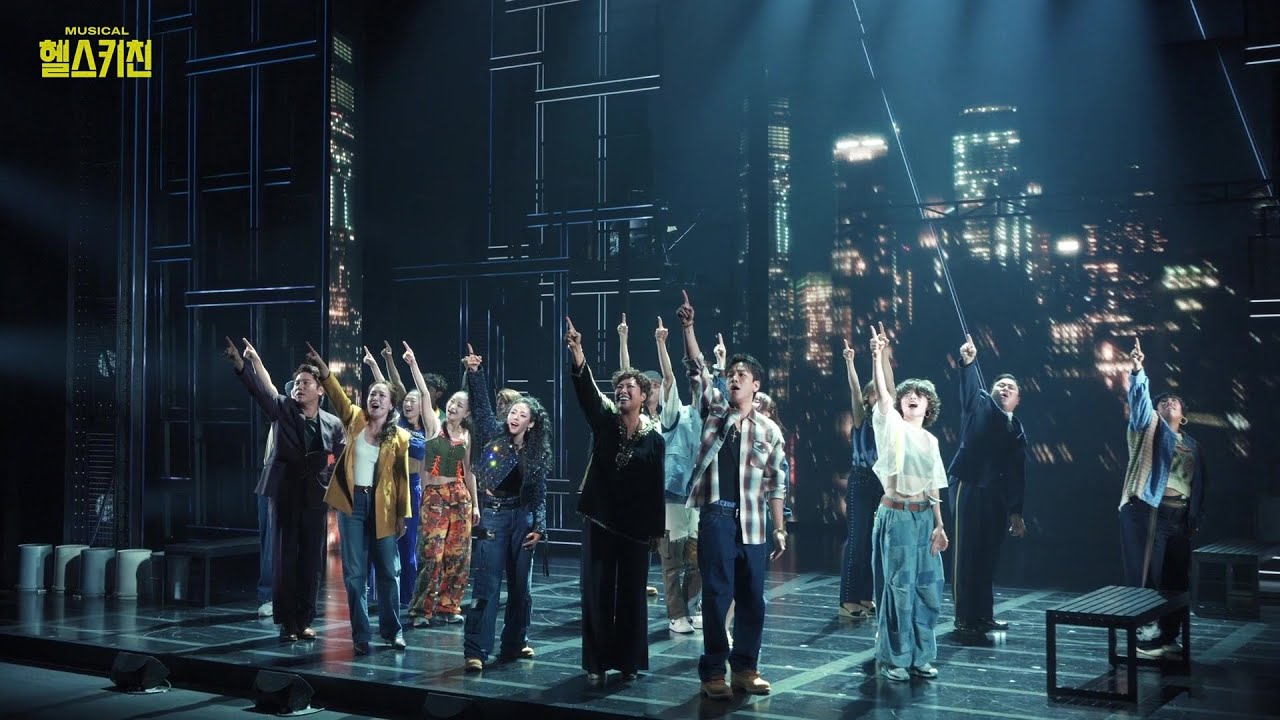
The moment the spotlight hits Sooha Kim, the audience feels an “explosion of mysterious power.” She captivates the audience instantly with the force of her voice and her overflowing energy, all while playing entirely different roles in every production she’s in. Now, she’s back as Ali in “Hell’s Kitchen,” the Alicia Keys jukebox musical inspired by the singer’s own coming-of-age story. Kim has always moved freely between genres and eras, making each song and character her own, and this time she portrays a young woman in 1990s New York, experiencing love and music, clashing with family, and finding her voice. What new colors and patterns will Ali contribute to the kaleidoscope that is Sooha Kim? We spoke to her to learn more about that spectacular transformation.
“Hell’s Kitchen” is a musical built on Alicia Keys’ music and her own experiences growing up, and it made quite a splash when it opened on Broadway in 2024, earning 13 Tony nominations. I’d love to hear how it feels to play Ali in this Korean production, and what drew you to the role when you were first offered it.
Sooha Kim: The thing that really drew me in was also the thing that gave me pause. The songs in “Hell’s Kitchen” are beautiful, but they demand a high level of skill in R&B and pop. At first, what I was mainly feeling was fear, but as I prepared for the audition and actually sang through the songs, that turned into a powerful conviction and desire to take it on. I decided I had to do this show.

Throughout the musical, well-known Alicia Keys songs like “Fallin’,” “No One,” and “Girl on Fire” become part of Ali’s story. Since the rhythm and groove of R&B and soul are so central to these songs, I imagine they called for a different approach than a typical musical number. What kind of training or research did you do to prepare?
Sooha Kim: I completely adopted the mindset that practice was the only way. I stayed behind to practice on my own after rehearsals wrapped at 6 p.m., and I asked both Lily Ling, the associate music director who came from the US, and Juin Yang, our domestic associate music director, for extra training, and they gave me detailed feedback. On the technical side, I focused on working on my head voice, rather than belting the songs out like I usually do, to bring out the details of Alicia Keys’ signature style and groove. I’d film myself, watch it back, and make adjustments to my singing, over and over. I even rented out a separate rehearsal room to practice with a mic in hand before I did a promotional shoot for a YouTube channel, just to check how the sound and tone I’d been working on actually came through on a proper microphone.
Is there a number you feel most attached to at the moment?
Sooha Kim: “Unthinkable” and “Like You’ll Never See Me Again,” the two Ali sings with Knuck, come to mind. With “Unthinkable,” I wanted to convey the feeling of a girl falling so instantly and deeply in love that it’s like the two of them are swimming in their own private underwater world. I had to bring out the rich R&B flavor of the song and make sure the lyrics still got across clearly, all while keeping my voice soft enough to embody Ali’s more delicate feelings, so I really practiced that one a lot. It’s a tough number, but such a beautiful and captivating one. “Like You’ll Never See Me Again,” on the other hand, has to capture the entirety of Ali and Knuck’s breakup in a short span of time. While I’m singing it, there’s this constant struggle inside me between the Ali who’s grown more mature and the Ali who can’t quite accept the fact that it’s over. It’s tricky to perform—I have to hold the emotion back and let it come out in this raw, whispery way—but that’s exactly why it means so much to me.
Ali is based on Alicia Keys’ real coming-of-age experience, but she’s an original character created for the show. What did you add to the role to make it your own?
Sooha Kim: First, I looked up old things featuring Alicia Keys and analyzed the potential feelings behind her music and her words, what she was trying to say. At the same time, I listened to ’90s R&B and jazz every day, trying to internalize that natural sense of rhythm. I felt like the key to this character wasn’t just the singing ability, but capturing the rhythm Ali seems to innately have, so I paid close attention to the routines and little details in how the dance ensemble actors moved to the rhythm and worked those in. Then, to really perfect the choreography, I even learned specifics of the moves from Jeong Minhee, one of the crossover swings.
When she’s in the height of her youth, Ali’s suddenly hit all at once with passion, anxiety, love, and conflict. How did you want to express that “beautiful chaos”?
Sooha Kim: Ever since I decided in fifth grade that I wanted to be a musical actor, I’ve had my eyes on nothing but that. Along the way, I always had a burning passion inside me, alongside this vague uncertainty about where I need to go, just like Ali. Looking back, it was the darkest, dreariest period of my life, but because I had a dream, it was also the most illuminating. I drew on a lot of my feelings from back then, when I was excitedly discovering musicals and music for the first time, while preparing for the show.
I paid special attention to where Ali’s emotions really come from so she wouldn’t come across as just a kid throwing a tantrum. Instead of starting with just that she’s mad at her mom, it was frustration from feeling unheard, and I let that build into hurt and deep aspiration. There’s something urgent crying out inside her, but even she doesn’t know where it’s taking her, and I wanted the audience to empathize with that youthful anxiety. I also changed the tone of my vocals as the story progressed so the audience could feel her growth as she moves past the breakup and finds herself.
Ali falls deeply in love for the first time when she meets Knuck. How was Ali’s first time falling in love different from the romances you’ve played in past roles?
Sooha Kim: A lot of the characters I’ve played before experienced love in big, tragic ways, tangled up with survival or fate, but love in Ali’s case feels much more young and raw—a true first love. What really felt different was that it’s a process of self-discovery, coming to understand who she is through that other person. What she gets by loving Knuck is a sense of being deeply connected to another person. If the piano is what helps her hear her inner voice, Knuck’s the one who brings that voice out into the open and lets Ali share and connect with someone else so passionately. But on the other hand, what she loses is her hazy fantasy version of the world. As she deals with the breakup, she realizes the world doesn’t always go the way she wants it to, but Ali comes out the other side of that shattered fantasy a stronger and more mature person.
Ali’s love with Knuck represents one part of her journey to self-discovery. Also influencing her growth in their own way are her mother, Jersey, and her teacher Miss Liza Jane. How did you play Ali differently in relation to those three characters?
Sooha Kim: To put it metaphorically, I’d say Jersey is Ali’s roots, Miss Liza Jane is her wings, and Knuck is the door that opened up an unknown world to her. Of the three, the one who had the most decisive influence on Ali’s process of self-discovery is Miss Liza Jane. She takes the sound and potential that’s been inside Ali all along and brings it out into the open. She’s both her teacher and her musical savior. When Ali’s with her mom, I show Ali at her most childlike and open, but also feeling frustrated from wanting to break free of what holds her back. When she’s with Miss Liza Jane, I emphasize her curiosity, respect, and the way she focuses to really absorb the music. When she’s with Knuck, I try to capture the thrill of stepping into an unknown world and the fact that she’s choosing that for herself. I think that experiencing all three relationships is ultimately what lets Ali grow beyond being someone’s daughter, student, or lover, into Ali, her own independent person.
Ali discovers her own potential for the first time thanks to Miss Liza Jane’s piano. What do the piano and the song “Kaleidoscope” mean to Ali? What were you mainly focused on for trying to portray that?
Sooha Kim: When Ali first hears the sound of the piano, she feels curious and irresistibly drawn in. As the title suggests, like all the different colors and shapes you get when you turn a kaleidoscope, it’s as if all the emotions and potential Ali had been pushing down inside her finally burst out into a beautiful light the moment she hears the piano. That’s why I think the piano is the closest thing out there to Ali’s own voice.
That said, this one song doesn’t suddenly change Ali’s whole life. You don’t notice how high you’re going each time you take a step going up a staircase, but eventually you look back and realize how high up you’ve come. It’s the same way with how Miss Liza Jane gradually becomes a part of Ali’s life, and Ali’s personal growth works the same way. To express that curiosity when she’s first faced with the piano, I start out singing very breathily. Lily Ling told me this was actually something Alicia Keys specifically asked for. As the song goes on, the actors who represent different aspects of Ali’s feelings start appearing one by one. I wanted to use falling into rhythm with them to convey the kaleidoscope that is Ali gradually becoming more and more colorful.
Even well-known love songs like “If I Ain’t Got You” and “No One” become stories about family in the show. After experiencing love in so many different forms, what do you think Ali comes to understand love to be?
Sooha Kim: “If I Ain’t Got You” is usually considered a love song between a couple, but in the show, it’s a song about the memories and connection Ali has with her dad. She sings through him being there and being gone, and that plus the musical thread that ties them together makes her feel longing, gratitude, happiness, sadness, and loneliness all at the same time. The audience really responds to it, too. I can feel the air in the room change as soon as the intro starts. “No One” is when Ali and her mom reaffirm their love for each other. It’s given new life as an intense love song between mother and daughter, where even if the whole world turns its back on them, they don’t have to be afraid, as long as they have each other. I think what Ali ultimately understands love to be, after experiencing it in so many different forms, is a feeling of absolute acceptance. It’s saying it’s okay not to be perfect, and accepting that.
New York is a major catalyst for personal growth for Ali. Similarly, you left for London at 21 and have lived and acted in many different cities since. Did your personal experience help you to better understand Ali?
Sooha Kim: Just like with Ali and New York, my time abroad starting with London was a major catalyst for me. When I first arrived in London when I was 21, I was surrounded by an unfamiliar language and culture, and the sheer overwhelming energy of the city, and the first thing I felt was fear and loneliness. Every day, I asked myself the same question: “Can I actually find my place in this new city, on this big a stage?” But over time, I realized that the strangeness of the city and all the different people in it weren’t causing me to shrink—they were filling me up. I didn’t even know it at the time, but being around different cultures, people from all different backgrounds, working alongside amazing actors, all helped broaden my horizons, both as an actor and just as a person. So when I’m up onstage, I can take that loneliness I felt when I was abroad and all the exhilarating energy that came after it and reflect it in Ali as she takes in New York.
The characters you’ve played seem to share one thing in common regardless of era or genre: They choose the lives they live. Is there something about that kind of character that draws you to them in particular?
Sooha Kim: Every character I’ve ever played has been important to me. They each carry in them a piece of my own life. Looking back, I think I’ve always been instinctively drawn to characters who choose and carve out their own path, rather than being passively swept along by circumstance or fate. I especially find myself drawn to characters who keep trying to live their lives, even when they’re hurt and thrown for a loop. When I meet a character like that, the passion inside me naturally starts to heat up too. I want to keep bringing strong, independent characters like that, characters who make their own decisions in life, to the stage.
Seeing Ali at the piano also brings Jenny from “Four Minutes” to mind, as the piano leads them both on their own individual journeys of self-discovery. Having portrayed both characters, what does music mean to you now?
Sooha Kim: In “Four Minutes,” the piano is a symbol of the brutal struggle for Jenny to prove her own genius and of her disconnection from the world, but since it’s the only chance she ever has to be free, she has a love–hate relationship with it. For Ali, though, the piano is more about hope and greater freedom, where she can discover things about herself she never knew and connect with the world. Jenny explodes with pent-up rage and pain and throws it all away—Ali unleashes all the light and potential she was inside her out into the world.
These days I see music as something that demands I throw myself into it each time, but in the end, it sets me free. There’s nothing like that sense of liberation that comes from making it through something challenging. I think it’s that duality that keeps pushing me to take on new challenges and lets me stand onstage as the most authentic version of myself.
Looking back, you’ve portrayed a string of roles you previously dreamed of playing—the lead in “Aida,” Mimi in “RENT,” Éponine in “Les Misérables.” If you from 10 years ago could see where you are now, what do you think she’d say? And finally, what are you dreaming of doing next?
Sooha Kim: It makes me think of me rehearsing for “Miss Saigon” in Japan 10 years ago. I can still picture how hot that summer was, the heat of the asphalt road and the air as I got off the subway and walked to the practice studio. I was in my 20s, full of dreams, in love with the stage but always a little anxious. If that version of me could see where I am now, I think she’d say, “You’re doing a great job. I’m so proud of you for making it so far and never giving up.” And I’d want to tell her to never forget the hard times because they’ll end up being exactly what keeps you going now.
I still have so much to learn, even now. Anytime I’m up onstage, I’m unsure and second-guessing everything. So my next dream isn’t anything big. It’s the same thing I’ve always done: giving my all to the role I’m given in a performance, and remaining a friendly face onstage for a long time to come—someone who can offer hope, simple as it is, to anyone out there feeling as anxious and full of dreams as I once did, by saying, “Even I’m still finding my footing, and still have a lot to work on, but I keep moving forward step by step.” If I can do that, that’ll be enough for me.
The Korean premiere of “Hell’s Kitchen” runs from July 24 through November 8 at the GS Arts Center.