
“The Apothecary Diaries”
Yoon Haein: Based on the light novel of the same name, the anime “The Apothecary Diaries” is set in the imperial palace of a fictional country from a bygone era. The protagonist, Maomao, is a 17-year-old apothecary who grew up learning the trade from Luomen, her adoptive father and the apothecary in the pleasure district. Maomao’s knowledge of ingredients that help and harm is matched only by her curiosity about them, and one glimpse of an herb is enough to make her eyes light up and become deeply engrossed. She’s small in stature, with a permanently blank expression and a low, disinterested voice. And when she opens her mouth, what comes out is usually sarcasm. Likened to a feral cat in the story, Maomao doesn’t care what anyone thinks of her. She’s portrayed as an eccentric genius, intensely drawn to whatever interests her and unconcerned with what doesn’t. Her talent, though, mirrors her views on herbal ingredients, where depending on how they’re used, they can become medicine or poison. In the first episode, Maomao is kidnapped while running an errand for her adoptive father and sold into the palace as a servant to do menial labor. In a country ruled by a strict social hierarchy, she keeps a low profile and spends each day just trying to make it through her years of service unscathed. But is that too much to ask of someone that hungry for knowledge? The inner palace has its share of incidents, and Maomao’s very slight sensitivity to justice calls her to help in her own way. Along the way, Jinshi, a eunuch who manages the palace’s servants and consorts and who’s as capable as he is beautiful, ends up discovering Maomao and the talent she possesses. It’s when she becomes a poison taster for Gyokuyou, one of four high-ranking consorts, that the story of “The Apothecary Diaries” truly begins.
In every episode, Jinshi asks Maomao to look into an incident, and she uses her trademark shrewdness and bold behavior to get to the bottom of it. And the more cases Maomao solves around the palace, the more people this feral cat finds herself progressively caring about. Take episode 39, when Xiaolan, a fellow servant Maomao befriends in the inner palace and who’s like a little sister to her, accidentally bumps into a eunuch carrying ice meant for Loulan, another high-ranking consort. Destroying ice worth as much as a person is a disaster no mere servant can ever make up for. Without a moment’s hesitation, Maomao finds a way to help Xiaolan out of the jam. Her timid excuse, that she’s “not obligated to help her” but “won’t be able to sleep at night” if she doesn’t, shows her innate kindness and sense of justice. Maomao’s deductions—more or less musings to herself—always begin with the caveat that it’s all just “conjecture.” It’s not so much a way of dodging responsibility as a sign that she understands the weight of the truth and the responsibility that accompanies it. Even when she sees through a case, if the realities of the era mean the truth would plunge someone into tragedy, she doesn’t lay out all the cards and instead opts to protect the vulnerable. Main-character buffs and genius stats aside, what really makes it impossible not to fall for Maomao is her tsundere personality.
Season by season, episode by episode, more and more’s been revealed about Jinshi (he’s a little too capable for a mere eunuch), as has the mysterious story of Maomao’s birth parents. Stranger and stranger things keep happening at the inner palace, tangled up with a mess of court politics. Maomao’s original plan of quietly serving out her years of servitude went out the window long ago, and she’s only getting dragged into a bigger and bigger swirl of chaos. Season three, streaming in select parts of Asia since October 3, is the perfect chance to sort through the conjecture and piece together the truth alongside her.
“Hayao Miyazaki and the Heron”
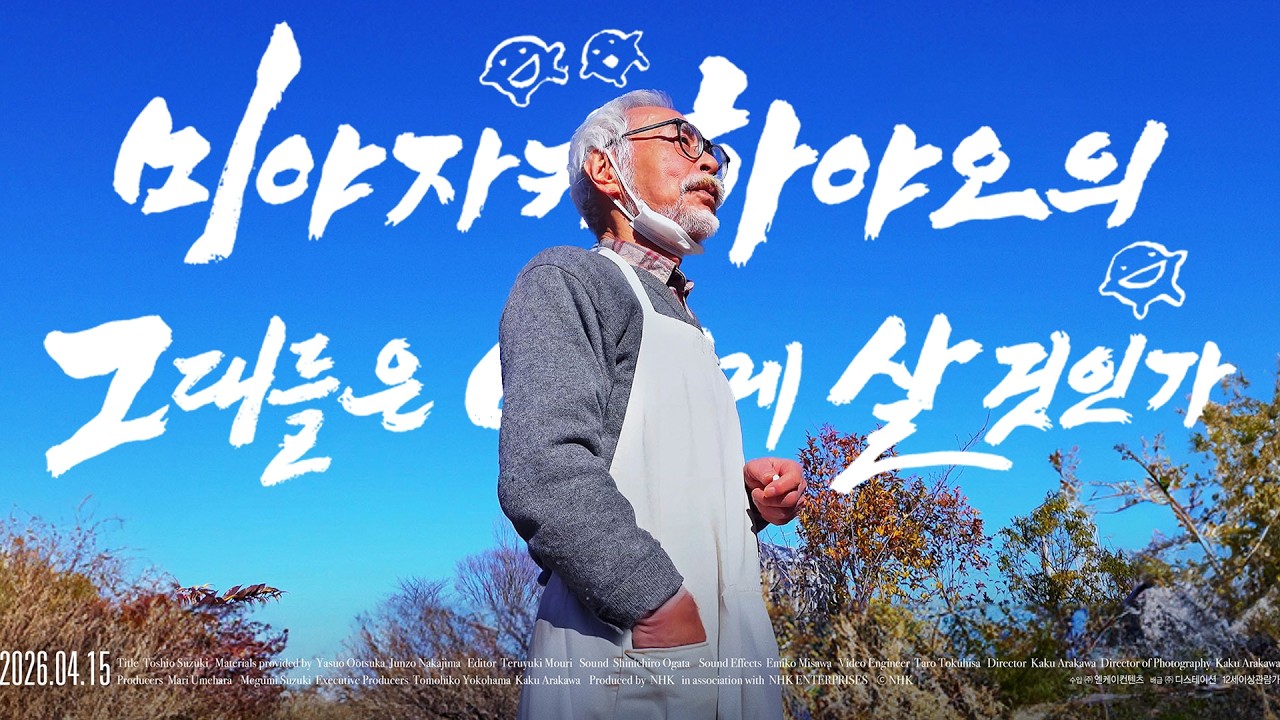
Baek Seolhui (writer, columnist): The documentary “Hayao Miyazaki and the Heron” is a 120-minute recut of an NHK broadcast that aired in December 2023. In Korea, it was screened exclusively at Megabox theaters from April 15, and now it’s available on streaming services like Netflix for the first time.
Some years ago, I suddenly found I was no longer able to read words on a page. What pulled me out of it was a line from the director’s film “Kiki’s Delivery Service,” spoken by the artist Ursula to Kiki when the protagonist can no longer fly. If the drawings won’t come, she says, you struggle through and draw and draw some more, and if you still can’t, you can just stop drawing. Miyazaki was closing in on 50 when he gave Ursula that line, one that comforted me—someone born the same year as the film came out. So where does the celebrated director—still wrestling with creative pains, having already said goodbye to so many colleagues, including his dear friend Isao Takahata (Paku-san)—find solace for himself now?
“He opened his brain more than ever before. This is his true life story.” To make “The Boy and the Heron,” which he declared his final feature, Miyazaki walks back his retirement plans yet again and works on the storyboards as though stepping inside the film. He draws the granduncle, a figure modeled on Takahata, noting they “had a love-hate relationship” and adding he “finally buried him in the storyboards.”
2,566 days to go. As the number shrinks, the director’s face grows gaunt and his tone rougher. More and more of the people around him disappear. Miyazaki’s shaken to his core. Even so, he grips the pencil with his hand and never stops. “The real world,” he laments, “coming back to it is a pain.” He’s so lost in his work that it seems like that’s where he feels most alive. After I saw “The Boy and the Heron” in 2023, I wrote, “It felt like an old man, still going strong, who’s always spoken to the preciousness of life, roaring, ‘Is that the way you’re gonna keep on living your life?’” Having since seen this documentary, though, I see that differently now—as something the director’s shouting at himself. And he’s already answered the question. Upon hearing news of a colleague’s death, he says, “Anyway, back to work.” Hayao Miyazaki will be drawing stories until his final breath.
“Theo of Golden” (Allen Levi)
Kim Boksung (Writer): Theo—last name conspicuously unknown—rolls into a town in the American South one day, but no one knows why. And when they ask him about it, he carefully avoids disclosing any information. Theo’s an old man, nearly 90, and his personal agenda is to buy up portraits of the townspeople—roughly as many as he is years old—and gift them to the person depicted in each drawing. The gift turns out to be much more than a picture, though. Theo is a talented listener with an unparalleled capacity for empathy, and each picture comes with an invitation to sit down and talk with the man for a while.
These conversations form the entire core of “Theo of Golden.” The debut novel of Allen Levi, it’s unabashedly a feel-good book for feels-bad times. It’s a cozy, heartwarming, escapist read, and there’s no shame in that. Theo’s true identity, carefully kept secret, does eventually pay off with its own emotional twist, but it’s the lessons about connecting with your neighbors that the reader walks away with.