*This article contains spoilers for the movie “Bugonia”.
Even though “Bugonia,” the new feature from Yorgos Lanthimos, openly draws its blueprint from Jang Joon-hwan’s “Save the Green Planet!” (2003), its impact doesn’t end with the familiarity of a remake. Yes, the film tracks the major beats of the original—from its opening premise to its finale—but the experience of watching it sparks a far wider constellation of associations. As I walked out of the theater—still buzzing with adrenaline—Hollywood films that catapult both characters and viewers into psychological free fall with breakneck velocity began surfacing in my mind: “The Substance” (2024), “Everything Everywhere All at Once” (2022), and “Babylon” (2022). These works share something crucial—not in plot or genre, but in the sensation they evoke. They feel like cinema’s convulsive reaction to the conditions of a “risk society,” films that hurl warning flares straight at a modern audience: Are you really okay living like this? Rather than offering solutions, these films press on the bruises. They layer conflict at dizzying speed, escalate tension, and leave the viewer caught in a kind of emotional vertigo. They jab at your side, telling you that an escape into another world might be the only option. In this sense, I’m inclined to think of them as a kind of “anxiety cinema”: movies born from the agitation, instability, and low-grade panic that define contemporary life.
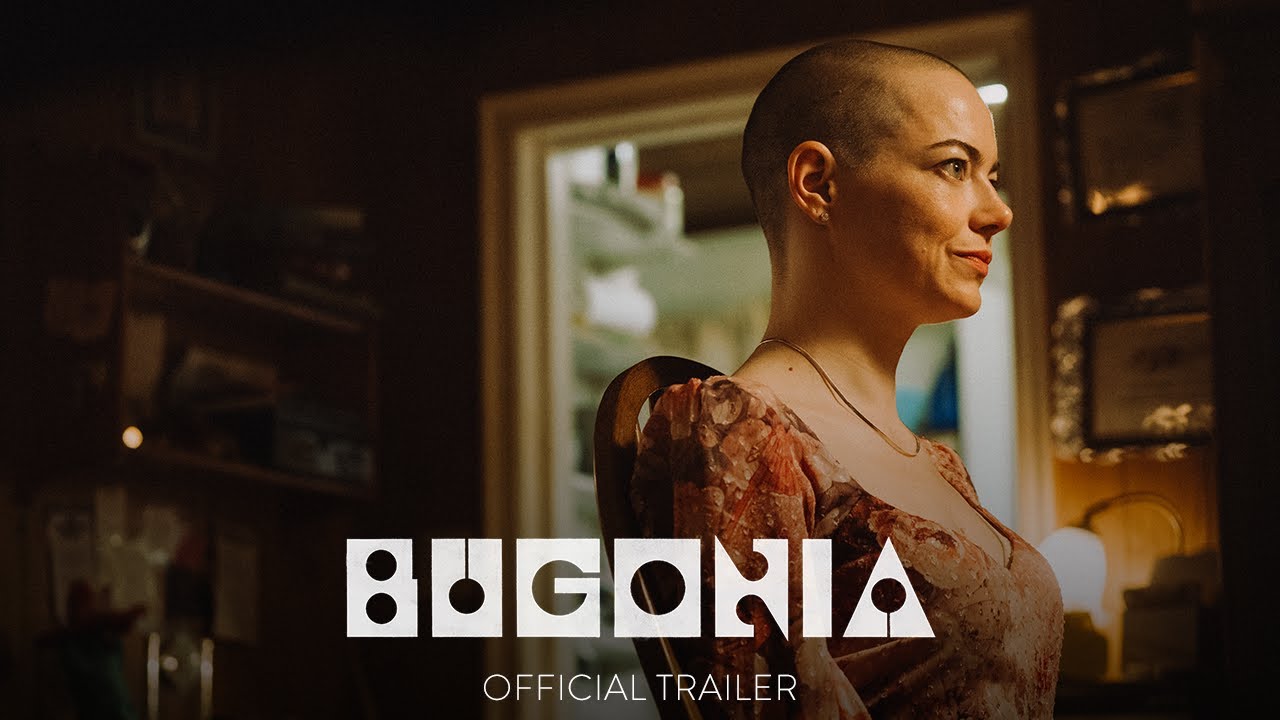
Teddy (Jesse Plemons), the impoverished laborer at the center of “Bugonia,” believes he is standing off against Michelle (Emma Stone)—the CEO of the chemical giant Auxolith. On the surface, it looks like a hostage situation. But in Teddy’s mind, he’s not a lone man confronting a corporate titan; he’s the commander of the “Human Resistance Headquarters,” defending Earth from extraterrestrials who have infiltrated society. Michelle, he insists, is one of them—an emissary from Andromeda—and he demands that she contact the mothership to negotiate their full withdrawal from the planet. The question of whether Michelle is actually an alien hangs in the air, but even if she were, nothing guarantees Teddy’s safe passage to the Andromedan emperor or that any negotiation would yield the future he imagines. The confrontation is fundamentally unwinnable: not simply a clash between two individuals, but an encounter between species, between beings who may not even share the same dimension of reality. Lanthimos frames the standoff so that its asymmetry becomes suffocating. The more Teddy pushes, the more the audience is left with growing unease, sensing that Teddy is trapped in a game whose rules he can’t comprehend—one in which he seems fated to lose before he even begins.
In a society saturated with danger, the source of that danger—and the price it demands—often becomes impossible to discern. The world is so tangled, so overcomplicated, that someone like Teddy can no longer rely on reasoned analysis. Instead, he turns inward, trusting instinct over logic. When his cousin Donnie (Aidan Delbis) asks how he can possibly distinguish Andromedans from ordinary people, Teddy answers with an unsettling certainty. The people he meets in a shabby supermarket parking lot, he says, are obviously not aliens; you can tell just by looking. They’re “harmless and hopeless,” unmistakably human. Michelle, by contrast, must be Andromedan—because, in his mind, her narrow feet, her impeccably clipped nails, her slightly protruding front teeth, her dense hairline, and her thick earlobes are giveaways. Teddy clings to these subjective impressions with unwavering faith, even though no one else could reasonably accept them as evidence of anything. Teddy has drifted beyond social norms. In his view, only his instincts remain reliable.
Teddy’s mistrust doesn’t emerge from nowhere. It grows out of a world where language itself has thinned into something hollow—especially the language of those who hold power. Audiences will likely remember the scene in which Michelle strolls into work and asks her assistant to send out a company-wide message: everyone should “feel free to leave at 5:30.” And then, almost in the same breath, she clarifies that no one actually has to go home early—employees should let their conscience guide them, so long as overall productivity remains unchanged. Michelle even cautions her assistant to be careful with the phrasing, a nod to the way language has become honed and weaponized, its surface polished while its meaning evaporates. And then she caps the exchange with a bright declaration—“New era!” But what exactly is this “new era” she claims to herald? An era in which employees are still tethered to their desks but encouraged to pretend they are free? A time when nothing is genuinely new, yet everyone is urged to believe they are voluntarily stepping into innovation? Leaders like Michelle don’t use language to inspire or reveal; they use it to disguise.
The contrast with the original film makes the erosion of language—and the hollowness of public speech—all the more striking. In “Save the Green Planet!”, director Jang Joon-hwan filled the story with press exposés detailing the corruption of CEO Kang Man-shik (Baek Yoon-sik). But in “Bugonia,” Michelle is presented solely as a promising female CEO. She hides her true intentions behind fluent, polished speech, highlighting only her supposed goodwill. When she promises to place the accident that ruined Sandy’s life—Sandy (Alicia Silverstone) being Teddy’s mother—at the very front of the company’s history, she turns even wrongdoing into a display of sincerity. And Teddy, positioned somewhere near the bottom edge of this society, reaches an extreme conclusion: that there is no negotiation, no judicial order, no Congress, no America, no global democratic system. He doesn’t mean that Congress literally doesn’t exist or that America has vanished from the planet. He means that the gap between what these grand terms are supposed to signify and how they actually function has grown so wide that they might as well not exist. From Teddy’s perspective, a system that no longer matches its own language is no different from a system that isn’t there at all. If “Bugonia” feels especially heavy with dialogue, that is precisely the point. The film is calling out the distance between modern people’s true feelings and the language they use—a kind of communication that remains as a shell, its meaning stripped away.
When Teddy and Michelle launch into their monologues on their respective thoughts, the camera avoids over-the-shoulder shots or reverse shots that would normally capture the listener’s reactions. Instead, it holds firmly on the speaker’s face, framing only the certainty—the insistence—of the person talking. The camera’s stance makes its point clear: each of them is interested only in expressing their own truth. With no one genuinely listening, their exchanges become one-way broadcasts, and the two characters fail to communicate in any meaningful way. And while they technically share the same language and live under the same sky, the space where workers and capitalists might once have crossed paths has all but disappeared in the neoliberal era. Teddy and Michelle live in different neighborhoods, move through the world in entirely different ways—she drives a car while he rides a bicycle—park in different places, and even enter their workplaces through separate doors. Each is sealed inside a private filter bubble, their worlds barely touching.
Teddy no longer takes pride in the culture of workers the way people once did, before neoliberalism carved society into its current shape. The present brings him little satisfaction, and the future offers no promise. For Teddy—or perhaps for the film itself—the search for safety leads not toward progress, but toward retreat and a kind of self-erasure. Just before the title “Bugonia” flashes on screen, Teddy persuades Donnie to undergo chemical castration. As they brace themselves for the procedure, the two share a brief exchange about freedom, hoping to ease the tension. Donnie describes it as something that belongs to childhood, a time that felt uncomplicated and filled with the people who mattered. His words suggest that freedom no longer belongs to the present, and certainly not to the future. Instead, it has become something imagined in retrospect, something we believe we once possessed. We are living in an era where freedom feels less like a horizon to move toward than a memory receding behind us.
Earlier Hollywood action films also swept audiences along at breakneck speed, yanking viewers by the collar as they raced toward a familiar promise: the villain is punished, humanity is saved, and peace returns to Earth. But the protagonists of “The Substance,” “Everything Everywhere All at Once,” “Babylon,” and “Bugonia”—all released in the 2020s—fight no such villains. They flail inside environments so profoundly broken that no single antagonist can be blamed. Their struggles end not in triumph but in collapse, exhaustion, or makeshift resolutions that never truly repair anything. The story concludes not because the problem is solved, but because the characters—and the films themselves—have pushed their frenzy to its furthest limit. Paradoxically, only then does the anxiety soften, allowing the film to close. “Bugonia” follows the narrative bones of its source, “Save the Green Planet!”, with meticulous faithfulness, holding fast to Teddy’s delusion that Michelle is an alien. Yet there is one crucial divergence: unlike Man-shik in the original, who destroys the planet, Michelle chooses to eliminate only the humans. She decides to spare the Earth itself and the nonhuman beings living on it. So where, then, does the human soul find rest? “Bugonia” answers: by returning to nothingness. In its final sequence—after humanity has been wiped out—the film lingers on the gestures of animals and the drift of a plastic bag rising through the air, as if relieved by the absence of people. And as the end credits roll, the film soothes us with peaceful sounds of nature. If “Save the Green Planet!” ends by showing a childhood image of Byeong-gu (Shin Ha-kyun) floating through space, “Bugonia” concludes with something starker: a black screen filled only with birdsong and rain. Teddy, who quivered with fear throughout the film’s world, is gone. The rest of humanity is gone. What remains to greet the audience is the sound of rain and the chirping of birds—nature carrying on, indifferent to our disappearance.