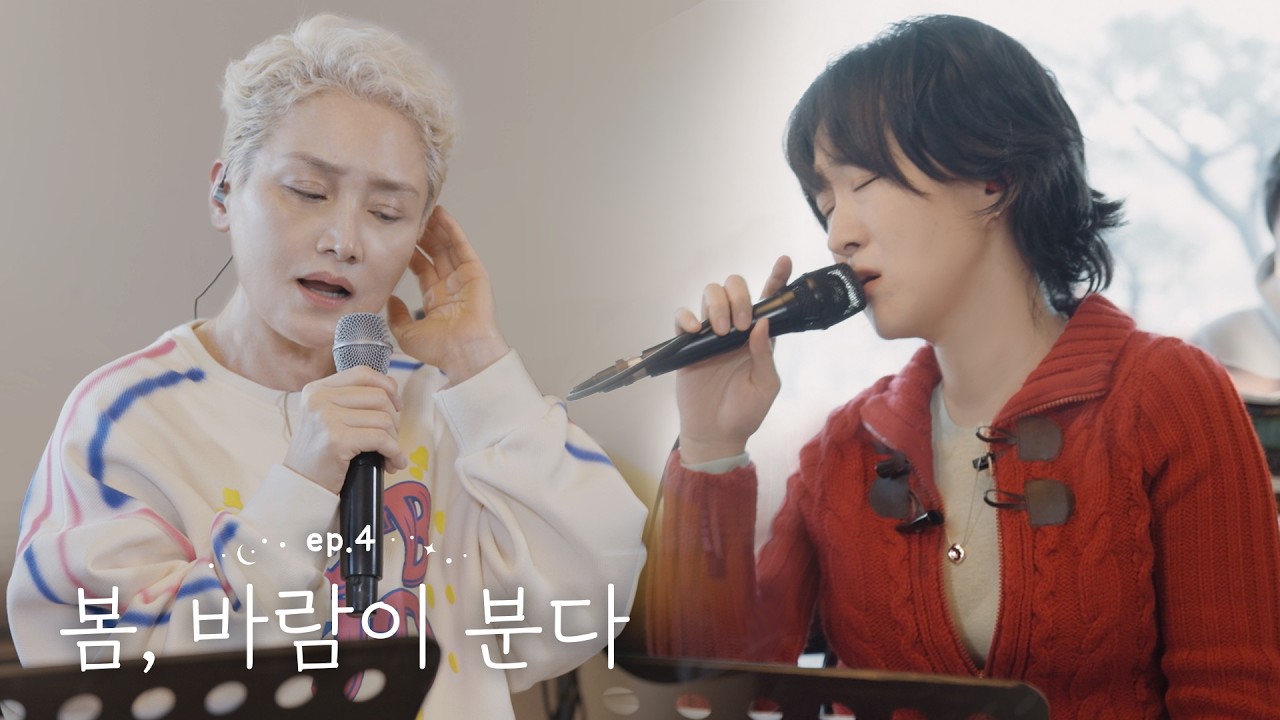
“Lee Sora’s First Spring” (YouTube)
Yoon Haein: “It shaped everything I love.” That’s how comedian Moon Sang-hoon—appearing as the first guest on singer Lee Sora’s YouTube channel—describes what her music has meant to him. He adds, “She introduced me to so many words I hadn’t known before.” There’s a particular sensitivity in her songwriting, a way of tracing the quiet, layered accumulations of feeling, and a voice that holds both sorrow and warmth at once. Over the years, through late-night music programs and radio, Lee has cultivated a distinctly intimate sensibility—one that has left a deep imprint on certain emotional worlds. This past March, she began encountering the world again through YouTube. In “Lee Sora’s First Spring,” conversations unfold in an unhurried, almost meandering rhythm, interwoven with song—moving gently against the grain of the dopamine-driven present and quietly reviving the atmosphere of late-night radio. Inviting listeners to send in what she calls “messy love stories, heart-aching love stories—those small feelings you’re not even sure you’re allowed to write down,” she responds to one such confession with a simple truth: “It’s sadder when you feel like you’re the only one going through it.” At times, she speaks with quiet stubbornness and devotion about music itself; at others, she turns to her guests with an almost unguarded sincerity, praising their strengths and charms. And then there are moments when she sits with someone like Kim Jang-hoon—an artist who shared a formative era with her—and, with gentle humor, revisits memories and behind-the-scenes stories from two or three decades ago in broadcasting. “Lee Sora’s First Spring” draws you into moments of quiet recognition, then, almost without notice, into a soft laugh.
“Aren’t there a lot of people like this? I’m like that too.” Lee Sora responds with quiet empathy to a listener who admits they’re afraid to grow closer to someone, worried it will only make the distance harder when they drift apart. “Worries you carry in advance only weigh on your heart,” she says, gently adding that while there’s no need to force anything, one shouldn’t hold back what might be good as it comes. It’s a moment of consolation rendered with a precision only she seems capable of. Speaking on “Fairy Jaehyung,” Lee also shared that she had stepped away from performing due to vocal cord nodules and, for a long stretch, rarely left her home. Describing her return, she put it simply: “Before, I lived in moonlight. Now, I live in sunlight.” As that image suggests, there’s a warmth in her language that can only come from someone who knows the cool stillness of moonlight. It may be why, even now, people continue to seek out her words and her songs.
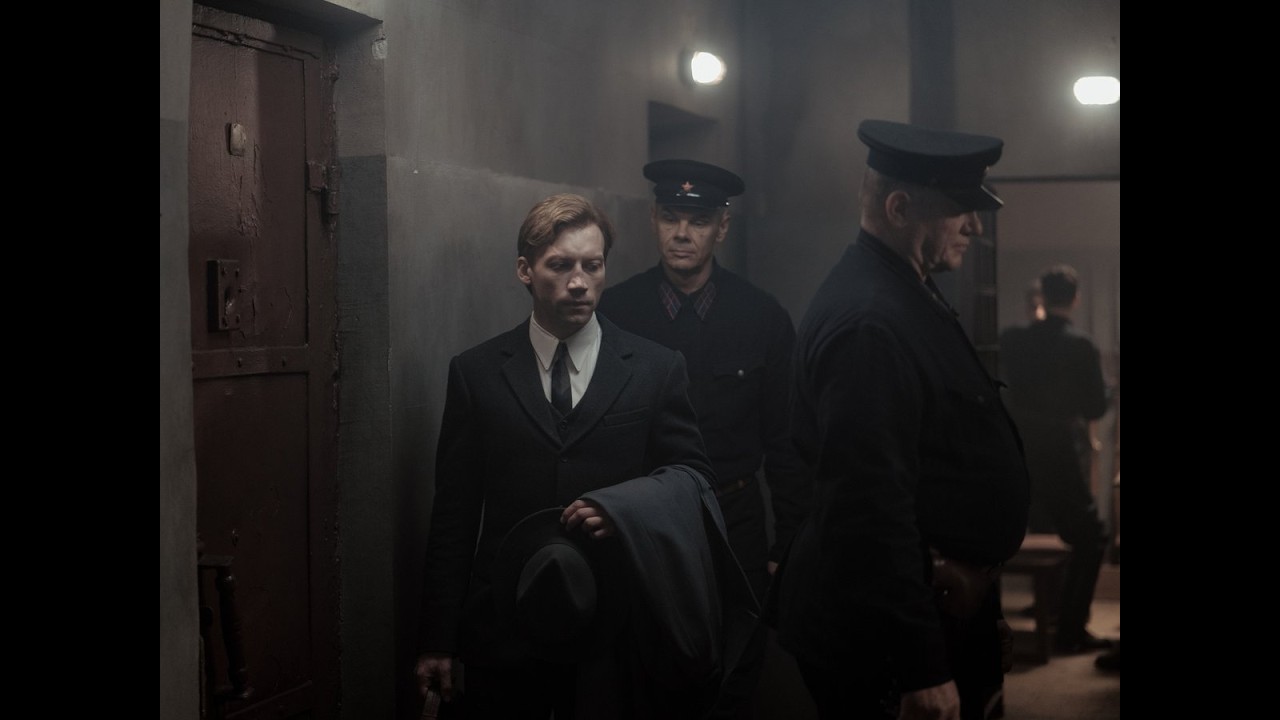
“Two Prosecutors”
Nam Sunwoo (CINE21 Reporter): At a time when everyone seems to be talking about AI, one filmmaker left that path early and turned instead to cinema: Sergei Loznitsa, born in Belarus and raised in Ukraine. After studying applied mathematics and working at the Institute of Cybernetics, he went on to attend the Gerasimov Institute of Cinematography in Russia, and since the late 1990s has made more than thirty short and feature-length films. Moving between documentary and fiction, he has chronicled the tragedies of modern Eastern European history, earning recognition at Cannes and leading a masterclass at the Busan International Film Festival. Yet until now, none of his films had received an official theatrical release in Korea.
“Two Prosecutors” marks Loznitsa’s first film to be released in Korea. Adapted from the novel of the same name, it is set in the Soviet Union during Stalin’s Great Purge in 1937. Kornev (Aleksandr Kuznetsov), a newly appointed prosecutor, comes into possession of a letter written in blood from a prison inmate. Evading strict surveillance, he meets its author face to face and is confronted with a testimony of state violence inscribed on the man’s body. Determined to bring the truth to light, Kornev sets out to reach the Prosecutor General. For a young man just beginning his career—one who has yet to grasp the system he is part of—the journey unfolds like a labyrinth whose nature he does not yet understand. Eyes follow him wherever he goes. When he returns their gaze, everything falls silent. The moment his guard slips, a trap is set.
In that sense, “Two Prosecutors” reads less as a period piece than as a fable that transcends its time. In a world where war and authoritarianism continue to expand the labyrinth, belief in good intentions can seem almost naïve. And yet, when Loznitsa visited Busan last year, he offered this: “There can be no hope within the films I make. When depicting something like the Holocaust, what kind of hope could one possibly speak of? If there is any hope, it exists outside the film—in the very possibility that such a film can be made.” As viewers, there may be little else we can do but bear witness to that hope.
underscores – “U”
Kim Doheon (Music Critic): “Goodbye hyperpop.” “The Lost Promises of Hyperpoptimism.” In the wake of the COVID-19 pandemic, hipster corners of the internet seemed intent on killing off hyperpop—the genre that once reveled in chaos and excess, pushing itself to the brink. Jane Remover’s “Revengeseekerz” felt like a kind of Frankenstein, stitched together from hyperpop’s slain body, while Charli xcx’s lime-green “brat” summer played like an offering, restoring its spirit to the mainstream. Now, hyperpop has become one with the very thing it once longed for and tried to emulate: pop. underscores’s “U” stands as the clearest proof.
Made alone in hotel rooms, airports, and car rides across cities like Chicago, Tokyo, Los Angeles, Barcelona, and New York, the album channels hyperpop’s most intimate processes into something unmistakably pop. From “Tell Me,” which reads like an unconscious confession of hyperpop’s drift toward pop, to “Music,” which transforms fan demand for dubstep and EDM into something closer to affection, to “Hollywood Forever,” a dreamy passage from bubblegum bass into Jersey club, the record keeps asking: how far have we come, and where do we go next? The answers are carried by a sequence of tracks—beginning with “The Peace,” which, through its densely layered vocoder textures, frames a sense of solitude within richness, consciously invoking a digital-age “Eleanor Rigby”; continuing with “Bodyfeeling,” built on a four-on-the-floor pulse; and extending to “Do It,” which explores points of contact with a distinct pop world in K-pop.
If “Wallsocket” once presented an unstable, imagined American small town, “U” refines that unease into something more controlled—hyperpop tools fully assimilated into the grammar of pop. “I'll wish you well forever, no, this ain't what I had imagined.” As the album closes with the quiet farewell of “Wish U Well,” the arbitrary boundaries of industry labels and genre classifications begin to dissolve. What we are witnessing is less a movement than a process of dissolution: a new generation’s rebellion melting into the vast sea of pop. And yet, in an era that resists complete unity, the question lingers—who, if anyone, will remain distinct?