Yeon Sang-ho is one of Korean cinema’s most prolific working filmmakers. He began in animation, then moved across graphic novels, live-action features, and television dramas; count the projects he has written or produced without directing, and the filmography expands further still. The scale and texture of those works vary widely, but genre is their shared terrain. Yeon moves readily between blockbusters and low-budget films, as his recent run of “Revelations,” “The Ugly,” and “COLONY” makes clear.
For all that range, one figure keeps returning: the zombie. Yeon has used it not only as a source of horror, but as a way of taking the temperature of the world around him. With “COLONY,” which opened on May 21 and has been holding its own at the box office, he continues to develop a distinct path for K-zombie cinema. The question is how that path began—and what his zombies have become along the way.

“Train to Busan” (2016): A fresh premise on familiar tracks
At its simplest, “Train to Busan” is a father’s fight to protect his daughter from zombies, staged as an ensemble drama aboard a speeding train. It is also Yeon Sang-ho’s first live-action feature, Korea’s first zombie blockbuster, and a box-office sensation that drew more than 10 million viewers—distinctions that register the scale of its achievement. In “The King of Pigs” (2011), Yeon brought an animator’s ferocity to the aftermath of school violence; in “The Fake” (2013), he examined the fraught relationship between faith and human nature. With “Train to Busan,” he took a genre still unfamiliar to much of the Korean audience and turned it into a record-breaking spectacle.
Until then, zombies had belonged largely to Hollywood and Western popular culture. The spectacle of bodies that refuse to stay dead was familiar territory for genre fans, but potentially disorienting for viewers with no such frame of reference. “Train to Busan” meets that gap with an assured sense of direction. Yeon folds the zombie premise into forms audiences already know: the disaster film, the family drama, and, above all, the crowd-pleasing thriller. Zombies become the disruptive ingredient, introduced at precisely the right moments to unsettle those familiar forms without abandoning them.
What role, then, do the zombies play in “Train to Busan”? Swift and relentless, they are less characters in their own right than the force bearing down on the protagonists. Their function is diagnostic: they expose the human cast, revealing who is decent and who is not. Yet moral character has no bearing on survival. The zombies know nothing of justice or retribution; they follow instinct, pursuing whoever becomes prey. That indifference is where the film finds its suspense. Yeon nevertheless gives the outbreak a social context, tracing it to a biotech company looking to profit from stock manipulation. The critique emerges in a rougher, more overt form in “Seoul Station,” the animated prequel to “Train to Busan.”
“Seoul Station” (2016): A city with nowhere to go
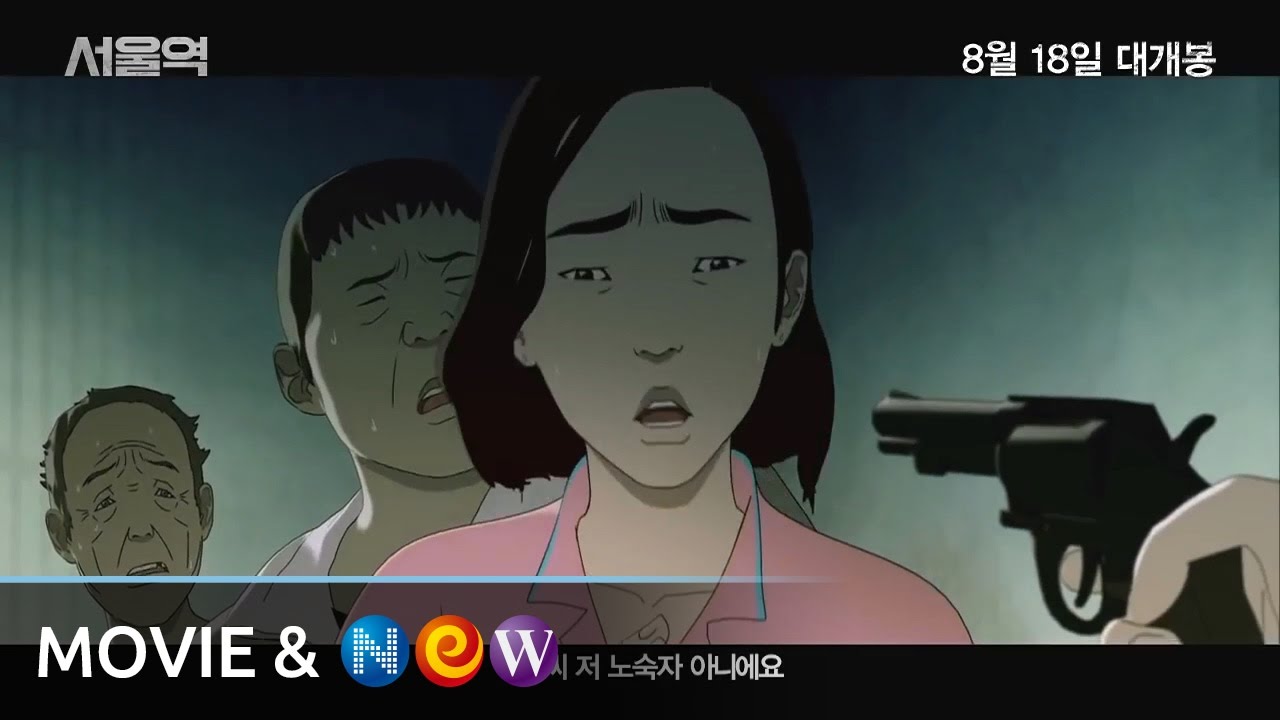
Released after “Train to Busan” but made first, the animated “Seoul Station” opens with two young men discussing the need for universal welfare. Nearby, an elderly man walks with one hand pressed to the back of his neck. One of the men moves to help, then recoils at the smell, covers his nose, and waves him away: the man is homeless, he says, and lives around Seoul Station. The scene is brief, but its irony is blunt. This is a city where people speak of equality while recoiling from what it demands of them. That contradiction is embedded in the very place that bears the name “Seoul Station.”
The old man’s staggering soon reveals itself as the onset of infection, and the streets around the station descend into chaos. “Seoul Station” thus establishes a loose connection to “Train to Busan” before returning to a familiar configuration: a daughter and a father at the center of the story. The daughter is a young woman who has left a brothel and now lives with her boyfriend. The man who sets out after hearing that she has been spotted in an online post is introduced as her father. As they flee the outbreak, the two eventually reunite at a model home. There, “Seoul Station” turns more cruel. What appears to be a family bond is revealed to be a transactional one: the man has been pursuing her not out of paternal love, but because of a debt-bound grudge. The revelation stands in stark contrast to the familial devotion at the heart of “Train to Busan.”
In “Seoul Station,” zombies begin to resemble an evolved form of the urban dispossessed. As the young woman escapes them and emerges from City Hall Station, she sighs that she wants to go home. Her homeless companion shares the feeling—then cries out that he has no home to return to. For people already living with nowhere to belong before the outbreak, the zombies merely sharpen an existing deprivation. Their eventual infection feels like a final capitulation to a misery they have long endured: better to become the zombie that chases than the human being chased, to forget home altogether than to keep longing for it. “Seoul Station” is saturated with that resignation.

“Peninsula” (2020): Into the zombie apocalypse
Four years later, “Peninsula” returns to the genre pleasures that propelled “Train to Busan.” Its most memorable set pieces are car chases that exploit the zombies’ sensitivity to light and sound, while the opening takes on the tense mechanics of a caper. The protagonist has fled a Korea laid waste by the outbreak and now lives in Hong Kong as a refugee. Treated as an outsider there, he carries the grief of losing his sister and nephew, as well as the guilt of having left a mother and daughter in similar danger in order to save his own family. An offer of a substantial payout brings him back to the Korean Peninsula.
The zombies in “Peninsula” are less frightening than those in “Train to Busan” and less resonant than those in “Seoul Station.” In the former, they are an unknowable menace; in the latter, an expression of social despair. Here, they have comparatively little force of their own, serving instead as part of the apocalyptic backdrop to a man’s reckoning with grief and guilt. That may be because the film’s villains treat them as playthings. Unit 631, a portrait of dehumanization, stages lethal games of hide-and-seek between the infected and human beings, releasing captive zombies onto people they deem easy prey. Zombies become neither the condition of life nor the environment enclosing it, but a tool. That is not an unfamiliar move in zombie cinema, and it might have given the creatures greater complexity. But “Peninsula” reprises the stark moral division of “Train to Busan” without its forward momentum. Its villains, who turn zombies into spectacle, register as more formidable than the zombies themselves; the film’s attention settles instead on its protagonist’s inner recovery. The result is that the outbreak becomes harder to read as anything more than a plot device.
“COLONY” (2026): Anxieties for the age of AI
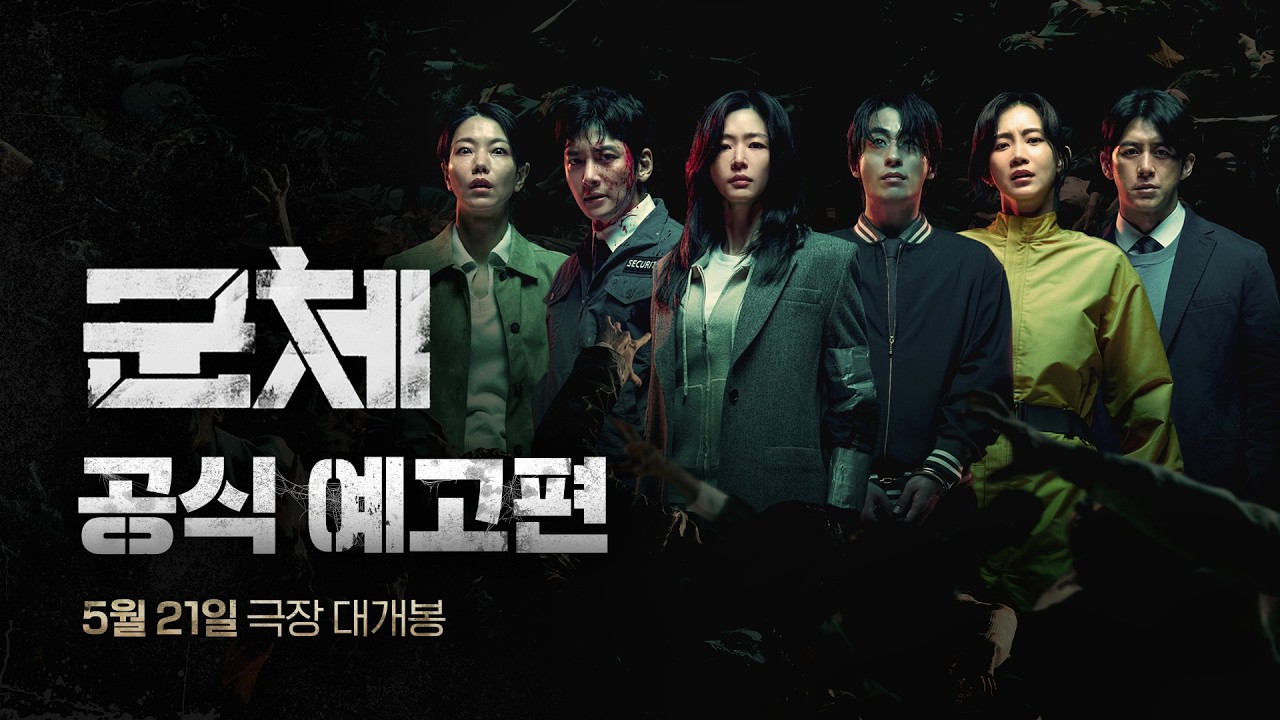
“COLONY” marks a departure from the moment of its title. For the first time in Yeon Sang-ho’s zombie universe, the title refers not to a place but to a collective. The film shifts its focus from the landscapes zombies have devastated and the people wandering through them to the zombies themselves. Yeon has previously sketched the origins and behavior of his zombies in spare, suggestive strokes. With “COLONY,” he fills in the picture: who released the virus, how, and why. A biotechnology Ph.D. takes on the task of solving the mystery, and as she deciphers the infected’s behavior, the purpose behind them—and the antagonist who controls them—gradually comes into view. Her task is to turn that knowledge into a means of escape. The film keeps the investigation moving at a brisk pace, delivering its pleasure as a thriller while bringing its larger concerns into focus.
Once again, the zombie carries the film’s argument. In “COLONY,” the infected move in lockstep with the first infected, seemingly linked by a collective intelligence. But the effect is closer to mindlessness than thought. Their uniformity is both their strength and their vulnerability. The villain develops the virus after being worn down by the tragedies of failed communication. The scientist, by contrast, confronts the crisis by forging solidarity again and again, even when communication remains imperfect. The conclusion is clear: individuality is what makes us human. Yeon has said that the screenplay grew out of his curiosity about AI—something akin to “the sum of universal thought.” Having established K-zombie cinema through a sure command of genre convention, then used it to register the anxieties of the present, Yeon has made his next move difficult not to anticipate.