In our new weekly feature “THE WEEKLY,” music critic Seo Seongdeok takes stock of the biggest developments in the music industry each week. Catch up on the latest stories in music, from major artist moves to notable new releases, Billboard chart highlights, and more.

Ariana Grande’s “petal” Debuts at No. 1 on the Billboard 200
Ariana Grande’s new album “petal” debuted at No. 1 on the Billboard 200 dated August 15. It is her seventh No. 1 album. She now has the fifth-most No. 1 albums among female solo artists. Taylor Swift leads with 15, followed by Barbra Streisand with 11, Madonna with 10, and Beyoncé with eight. Grande is tied with Janet Jackson and Lady Gaga.
The album earned 295,000 equivalent album units in its first week, Grande’s biggest week by units since “thank u, next” in 2019. Of that total, 168,000 came from album sales, marking the second-largest sales week of her career. Her 2014 album “My Everything” remains just ahead, with 169,000 copies sold. The album’s songs also generated 128.83 million streams. “petal” topped both the Top Album Sales and Top Streaming Albums charts.
All 12 tracks from “petal” charted in the top 40 of the Hot 100, ranging from “hate that i made you love me” at No. 2 to “nowhere, nobody” at No. 39. The new entries bring Grande’s career total to 110. She is the 23rd artist overall to chart at least 100 songs on the Hot 100 and the fourth woman to do so, following Taylor Swift with 277 entries, Nicki Minaj with 149, and Beyoncé with 107. The tracks from “petal” made an even stronger showing on the Billboard Global 200, occupying half of the chart’s top 10 spots, including “hate that i made you love me” at No. 1 and “petal” at No. 2. She also held the No. 2, No. 3, and No. 10 spots on the Billboard Global Excl. U.S. chart.
Ariana Grande has rarely been out of the spotlight over the past two years. Her projects spanned 2024 and 2025 with the release of “eternal sunshine” and the “Wicked” films, followed by “The Eternal Sunshine Tour” this year. “Petal” arrived at a time when public attention was firmly fixed on her, and it delivered chart results to match. After more than two years at this pace, her decision to take a break once the tour ends on September 1 is understandable.
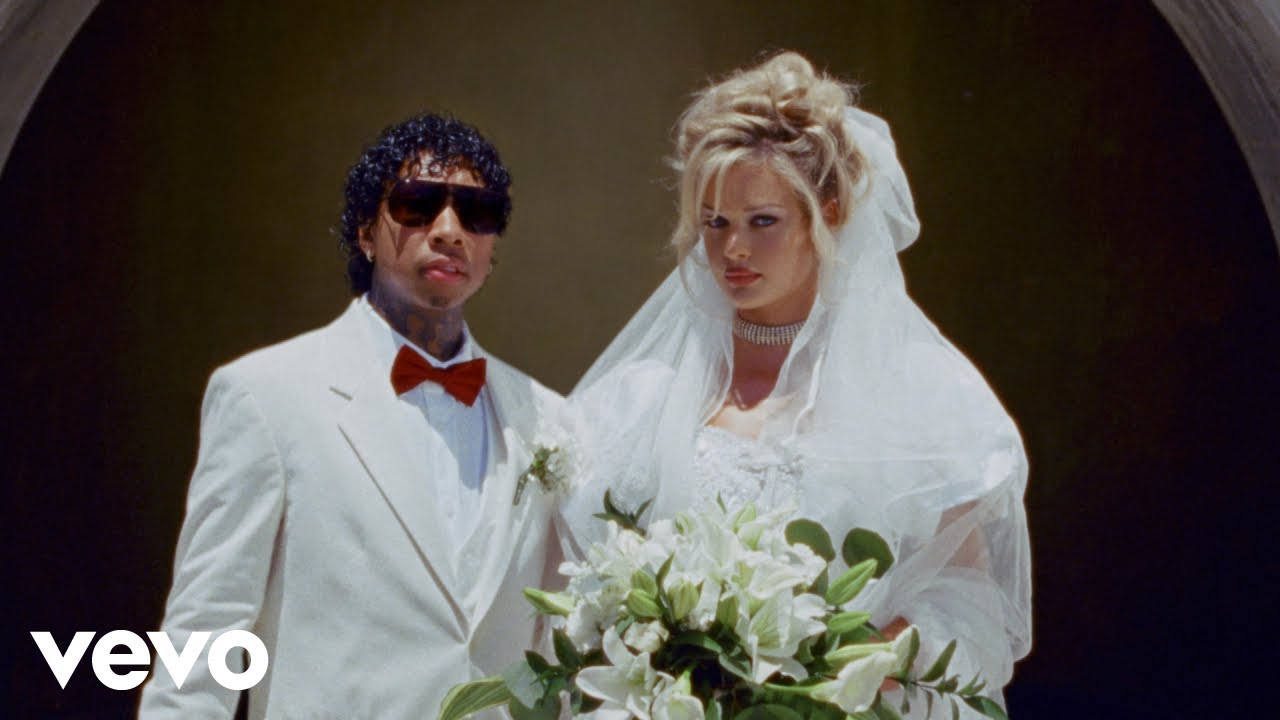
Tyga’s “$TARFACE” Sparks Controversy Over AI Music
Tyga’s new album “$TARFACE” puts a new persona inspired by the 1983 film “Scarface,” along with the era’s synth-pop and R&B sounds, front and center. The idea of a hip-hop artist venturing well beyond the genre is nothing new. What made “$TARFACE” controversial, however, was something else entirely.
When advance tracks such as “GAVE U RACKS” arrived in early July, some listeners reacted negatively, saying they sounded AI-generated. Those claims were unsubstantiated, but they did not emerge in a vacuum. Earlier, in early June, Fenix Flexin had released “RUBBERZ.” The two tracks had something in common: both featured rappers experimenting with 1980s new wave. “RUBBERZ” went viral and climbed to No. 58 on the Hot 100. The track's unusual vocal range and British accent, along with a live performance that appeared to be lip-synced, fueled suspicions that AI was involved. On July 30, producer Medasin published an analysis concluding that “RUBBERZ” had been made using the AI music generation site Treblo. Fenix Flexin subsequently acknowledged that AI had been used.
As it happened, “$TARFACE” was released the very next day. By then, listeners had already begun connecting three elements: rappers, 1980s sounds, and AI. The media response was unusually harsh. In a review published on August 12, Pitchfork gave the album a score of 0.0, its first zero rating in 19 years. Instead of giving it a numerical score, Anthony Fantano rated it “Not Music/10.” On Rate Your Music, where user ratings are aggregated, the album’s rating stood at 0.6 out of 5.
Critics have not claimed that everything on the album was generated by AI. Pitchfork, however, even provided an example of a prompt that could be entered into Treblo, arguing that anyone could produce similar results. The review also warned that AI could replace investment in the people and equipment needed to create new music, and ultimately creative labor itself. It effectively urged readers to boycott the album, warning them against listening even out of curiosity. This broadly aligns with Fantano’s argument that the people who benefit most from AI are those who have neither ideas of their own nor a work ethic.
Tyga eventually acknowledged using AI for the album’s 1980s-inspired synths and guitar solos. He compared the use of AI to the introduction of the auto-tune and maintained that he wrote and sang every song himself in the studio, effectively sidestepping the debate over “AI slops.” For its part, the market appears to have responded. “$TARFACE” earned fewer than 2,000 equivalent album units in its first week and failed to enter the Billboard 200.
Should AI Music Be Eligible for the Charts?
The controversy surrounding Tyga reveals an underlying belief that evident human effort contributes to a work’s quality. The music industry is now considering whether that belief should also determine chart eligibility. Recently, global music organizations, including the International Federation of the Phonographic Industry (IFPI) and the Grammys, have proposed labeling music on digital platforms as either “AI-generated” or “AI-assisted.” Major music companies, including Universal Music Group, Warner Music Group, and Sony Music Entertainment, have extended the proposal to chart eligibility.
Under the proposed framework, music would be classified as “AI-generated” if its lead vocals or key instrumental performances were generated by AI. “AI-assisted” would refer to music created substantially by humans, with generative AI used for some other expressive elements. Under the proposal, AI-generated music would be excluded from the charts altogether. Even AI-assisted music would have to meet several conditions to qualify for chart inclusion. The AI service used in its production would need to be properly authorized, and the music would have to comply with applicable copyright laws. The use of AI would also need to be properly disclosed and labeled.
While Tyga compares the use of AI to the introduction of Auto-Tune, the music industry likens the proposed framework to the Parental Advisory labeling system introduced in the 1980s. Musicians fiercely resisted the introduction of Parental Advisory labels on free-speech grounds. By contrast, few artists are likely to object to labeling AI music as such.
Some, however, oppose the proposed labeling system, viewing it as an inefficient administrative process. For one thing, “AI-assisted” is extremely difficult to define. AI is already routinely used in tasks large and small throughout the music production process. A single song may involve dozens of songwriters, producers, musicians, and engineers, all of whom use digital tools. Is it possible to draw a clear line between human creative labor and AI involvement?
Whether AI was used in a track may be impossible for third parties to determine, leaving creators to disclose it in good faith. As “$TARFACE” demonstrated, the market may still be able to apply its own standards. That does not mean no action is needed. We need to prevent unauthorized copying and impersonation and ensure that fully AI-generated music does not take away from the royalties available to human creators. This is an issue we will have to take more seriously in the years ahead.