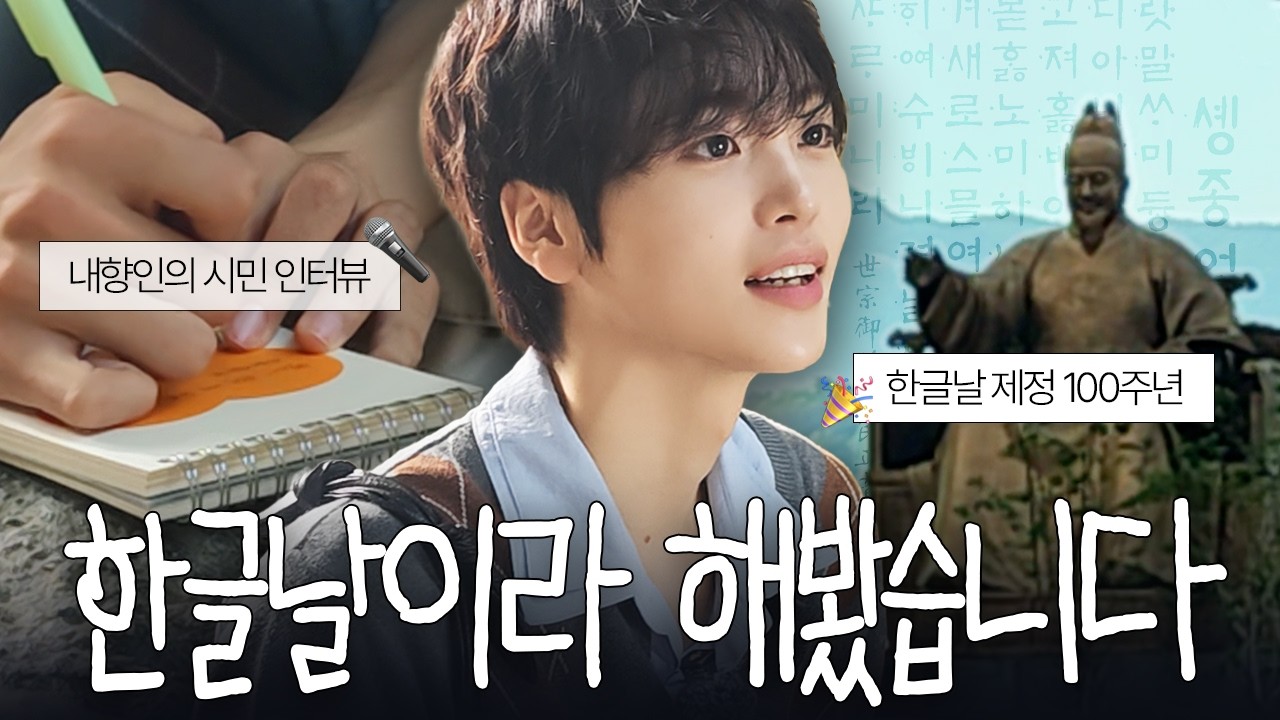
“Round HYEONGJUN”
Jeong Dana: There are countless shapes in the world. Of all of them, CRAVITY’s HYEONGJUN chose the circle. Asked why he named his YouTube channel “Round HYEONGJUN,” he replies, “My face is totally round! My eyes, nose, and mouth are all round!” But after watching a few videos, the circle behind the name seems to grow a little bigger. His first full-fledged episode, “The Obedient Youngest, HYEONGJUN,” takes him to his hometown of Tongyeong. Reuniting with his family and chatting in their local dialect, HYEONGJUN invites viewers into a world of familiar places and faces. He jokes to comedian Heo Kyung-hwan, a fellow Tongyeong native, “I’m the star of Tongyeong now.” During an appearance as a weathercaster, he delivers the weekend forecast for his hometown, adding, “Make sure to visit Tongyeong.” Watching him laugh with his family in the hometown he so often talks about, those earlier words take on a new resonance. In “Staying at a Stranger’s House for 2 Days and 1 Night,” he travels to Jeju Island to visit the aunt of a female staff member he once worked with, accompanied by his former manager. There, he asks about the meanings of expressions in the Jeju dialect, repeats them several times, and tries using them himself. Familiar words exchanged with family and unfamiliar ones learned in someone else’s home alike fill the moments captured on screen.
In “Collecting Words in the Heart of Seoul on Hangeul Day,” HYEONGJUN heads to Cheonggyecheon Book Street with a notebook in hand. He asks bookstore owners and passersby to write down their favorite sentences, reassuring those who hesitate that even a short one will do. At the end of a video filled with words from different people, HYEONGJUN contributes a poem of his own, titled “Round”: “The Earth I live on is round / The wheels passing by are round too / The ticking clock is round too / I look in the mirror, and my face is round too.” Moving from the world around him to his own reflection, the lines recall the innocent enthusiasm with which he explained his channel’s name. But when he writes, “The harsher the world gets, the rounder I’ve decided to become,” the focus shifts from the shape of things he can see to the kind of person he wants to be. Earlier, at a bookstore, HYEONGJUN had used stamps to form a six-character phrase on a sticky note. After “Round HYEONGJUN,” the next words he left behind were “The world is wide.” Read alongside the message on his channel banner, “Let’s stay round in a harsh world,” these words offer a glimpse of HYEONGJUN’s hopes for himself. Even if “No one can be completely free of rough edges,” he hopes to live by the words “Instead of answering sharp edges with sharp edges of my own / I’ll make sure those edges don’t point toward others.” In this light, his signature farewell, “Stay round!,” sounds as much like a reminder to himself as a message to his viewers. With “Round HYEONGJUN,” he continues to add to a name inspired by his face, a reflection of the person he hopes to become.
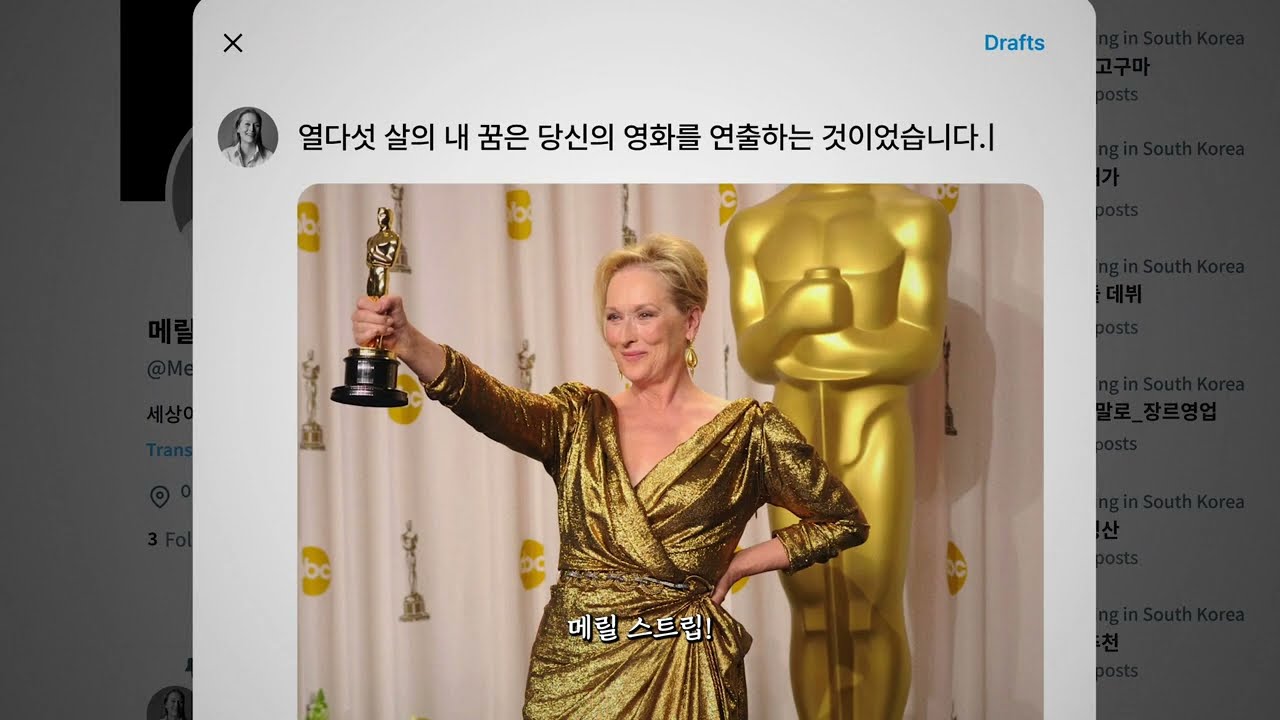
“The Meryl Streep Project”
Nam Sunwoo (“CINE21” Reporter): This may sound a little strange, but “The Meryl Streep Project,” a documentary ten years in the making by director Park Hyo-sun, is not a film about Meryl Streep. It may have started out that way, but the finished film subtly defies the premise suggested by its title. It is the story of a woman rebuilding her life with the strength she draws from another woman – or rather, from other women.
Turning the camera on herself, Park begins by tracing her long history of admiration for Streep. Watching “The Bridges of Madison County” (1995) helped shape her into a cinephile. She felt a sense of solidarity with a star who speaks out unequivocally for the rights of women and LGBTQ+ people, and went on to run a fan account on Twitter (now X). All the while, she dreamed of one day meeting Streep face-to-face, as one woman in film to another, one feminist to another.
As more friends come to share her dream, “The Meryl Streep Project” gradually gains momentum. Yet the signals she sends toward that shining star keep missing their mark. All she wanted was to reach someone she admired, a source of inspiration and almost a messenger of hope. So why does disillusionment keep mounting? The film ends as Park begins to turn her gaze away from the star in the sky and toward her own reflection in the mirror and the people around her. “From now on, I’ll write my own story.”
Sometimes, loving someone takes us on a long journey back to ourselves. But it’s the return, not the distance traveled, that I want to emphasize. Staying true to her feelings is what set Park on this journey, and she returns having learned from someone else how to live as herself. Perhaps, then, it’s too soon to label Park’s almost recklessly earnest quest to meet Meryl Streep a failure.
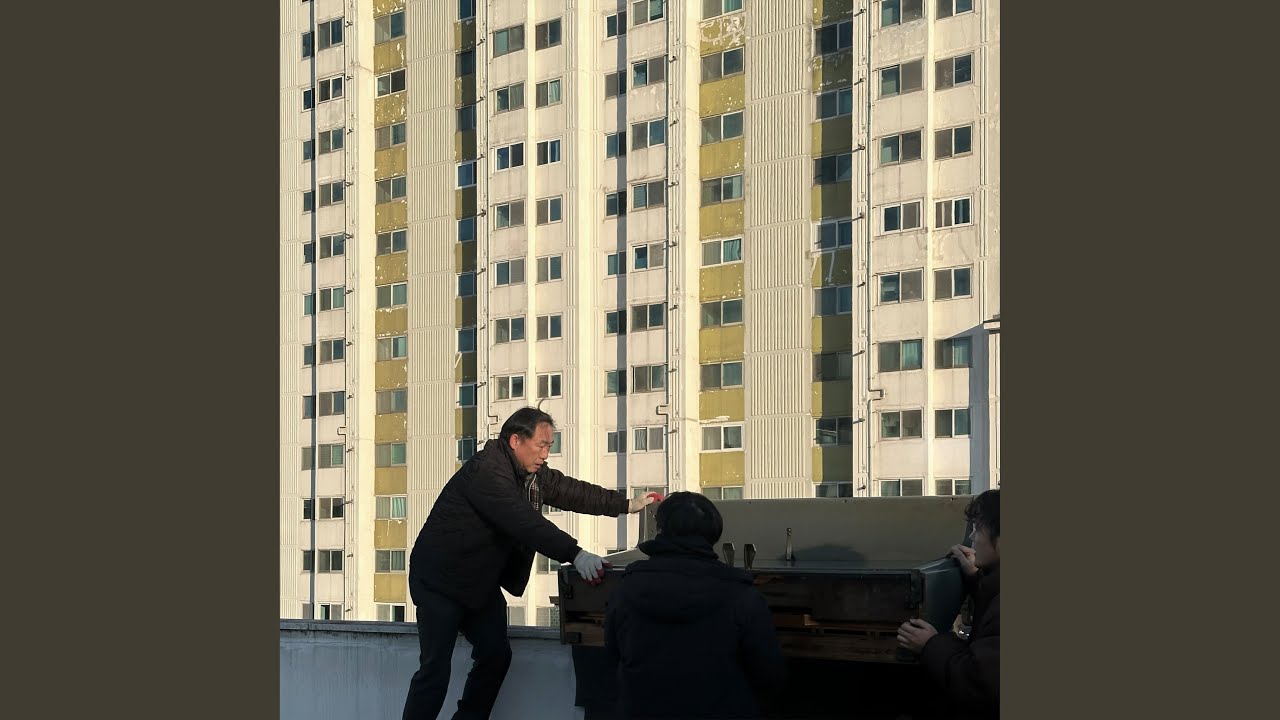
WOO JEE WON – “Home enough”
Kim Doheon (Music Critic): “It’s getting harder and harder to feel settled anywhere. No matter where I go, I feel like I’m floating, never quite able to adjust or tell dreams from reality. Sometimes I’ve even begged someone to be my home.” That’s how WOO JEE WON described her second full-length album, “Home enough,” to me. She ended with a question: “Have you found your home yet, Doheon?”
As I listened to the album, I took my hands off the keyboard for a moment and looked around the room. A jacket tossed aside, a few half-read books, a trash bag I still hadn’t taken out… How many places had I lived in Seoul by now? Owning a home feels like a distant dream, and I have nowhere to put down roots. Even on occasional visits to my hometown, I find myself searching for traces of fading memories in an unfamiliar landscape, struggling to feel that I still belong.
“Home enough” pries open the hollow spaces in familiar routines with eerie sounds that seep into everyday life. Every track title ends with a word that locates us somewhere. At the produce section of a supermarket she has wandered into on a whim, WOO pours out her loneliness to the vegetables. A man whistling on the subway as though he had a story to tell suddenly disappears. The anxiety and loneliness that permeate these ordinary places close in on me, as though I’m someone who doesn’t belong here. A fragile, wavering voice, scenes from everyday life, and surreal instrumentation make the familiar feel strange.
I want to leave this city, where survival means giving something up. On the album’s closing track, “In the Persimmon Orchard,” WOO has left Seoul behind. Picking persimmons with a friend in rural Sancheong, she bursts into tears. She takes a bite of a persimmon with no taste or scent and lays bare the sorry state of her heart. “My sorrow, my disappointment, my faith, my betrayal, my numbness, my ignorance.” Then she pulls away from the microphone and instruments and lets out a desperate scream: “My nothingness.” How much must we be shaken before we can believe there’s a place where our hearts can finally rest?