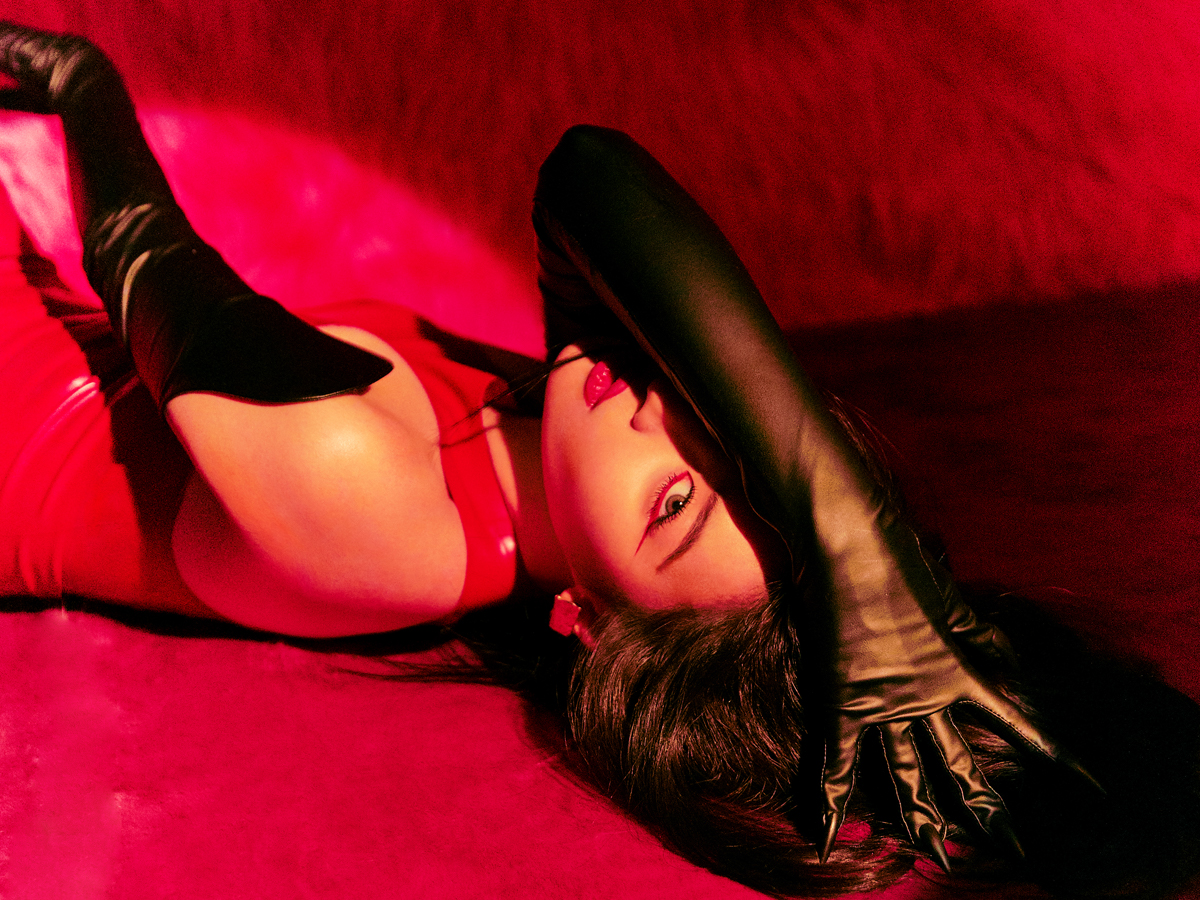
Eighteen years. The time an artist spent endlessly examining herself, then building herself back up again. Now, SUNMI speaks about a love that embraces who she once was.
Your first full-length album in 19 years, “HEART MAID,” has wrapped up its promotions. It must feel especially meaningful.
SUNMI: I have been doing this for 18 years, and at some point, I felt like I needed something that would let me take stock of who SUNMI is, both as a person and as an artist. That is how “HEART MAID” came to be. Now that the promotions are over, I feel completely worn down, in the best way (laughs). I love this feeling. It feels like everything has been stripped back, which means I can finally start building something new again.
It feels like artists eventually reach a moment when they have to clear things out and move forward.
SUNMI: There comes a point when you have to strip things away before you can move on. Looking back, there were three major phases for me. The music I made when I debuted as part of Wonder Girls, the music I showed as SUNMI, the solo artist and performer, and then another phase built around my personal taste, with songs like “Balloon in Love” and “BLUE!”, which felt different from what I had done before. When I released “Balloon in Love” and “BLUE!”, I finally felt like the picture of who I am was complete. With this album, I wanted to fold all three phases into a single continuous story.
In an interview with “ELLE Thailand,” you said that “HEART MAID” reflects how you learned to handle the anxiety you carried in your twenties, and how that process became a form of healing. How did that journey shape the album?
SUNMI: In my early twenties, there was a long stretch where I started to understand what kind of person I really was. It came late, almost like a second adolescence. Those emotions were pretty dark, and they might be hard for people to connect with. So even back then, I kept thinking I wanted to keep those feelings intact but find a brighter way to express them. Honestly, I would not say “HEART MAID” is perfectly balanced. But with this album, I wanted to let my personal taste lead a little more. I know I will keep accessibility in mind going forward, so this time, I allowed myself to lean into what I like.
What was it like to go through that process?
SUNMI: When I was writing “Balloon in Love” and “BLUE!”, I was in a really bright, positive place. But revisiting my early to mid twenties brought my darker side back to the surface. I found myself slipping into those emotions again, almost like I had been lightly tinted by them (laughs). But I loved that, too. Every song on this album came from a heartfelt place.
The title “HEART MAID” suggests caring for the listener’s heart. As you worked through so many emotions, do you feel you also gained more room to comfort others?
SUNMI: “Room” is exactly the right word. When I was younger, I did not really have the space to take care of myself. I had a lot of work, and I was young. But over time, I have picked up my own ways of getting through things, and that has given me more room. I can tell myself, “In moments like this, I know how to handle it.” I named the album “HEART MAID” because I wanted to take care of people’s hearts, but as I worked on it, I realized I also wanted to take better care of myself.
Your title track, “CYNICAL,” delivers a theme that could easily feel heavy, but does so with humor.
SUNMI: I really did not want this album to feel too serious, or to sink too deeply into itself. If I looked back on it later, it might feel a little embarrassing (laughs). That is why I always try to leave room for humor in my work. In “CYNICAL,” the device I used to keep things from getting too heavy was the lady ghost. In Korean folklore, she is a figure who dies carrying deep resentment, so in a way, she represents the ultimate form of cynicism. That is why I thought it would be funny and cute if someone like that suddenly said, “Why is everyone so cynical? Let’s laugh a little.” When I was filming the music video, I imagined her as a playful, almost adorable ghost, but some fans were genuinely scared (laughs).
Everyone has their own reading of it, of course (laughs). Your lyrics often leave room for multiple interpretations, with different perspectives crossing at once. Even in “Miniskirt,” lines like “Don’t judge me too harshly,” or “Why bother, why bother (no no) with misunderstanding? Let’s all get along,” invite more than one way of looking at the song.
SUNMI: I think “miniskirt” as a subject can be read in a lot of different directions. Just like with “TAIL,” there are words that carry certain assumptions the moment you hear them. A miniskirt is one of those. People might assume you are wearing it for someone else, or to be seen a certain way. But if you really look at the lyrics, it is simply about putting on a miniskirt, getting dressed up, and going out with friends. That is why I wrote the line, “Why bother, why bother (no no) with misunderstanding?”
From “Noir,” which looks at a moment when attention itself has turned into a kind of currency, to “LALALAY,” which reflects mass psychology, and now “CYNICAL,” which urges us not to take everything so seriously, your work consistently captures different facets of the society we live in.
SUNMI: Writing “CYNICAL” made me realize something about my lyrics. They often come from a slightly skewed angle. I always thought I was far from being a cynical person. In fact, I have been hurt a lot by people who are. I am warm by nature. But the more I thought about it, the more I realized that this side exists in me, too. I can be warm and sharp. Everyone carries both. Once I understood that, I stopped feeling the need to treat it so seriously. In everyday life, I am not cold toward the people around me. But expressing that sharper edge through music feels like what keeps me moving forward.
It may not be cynicism so much as sensitivity, the kind that makes you notice more than most people do. Songs like “BLUE!,” “Happy af,” and “A long long night” show many different textures of love.
SUNMI: My songs might sound like love stories, but I do not limit love to romantic relationships. It can be between partners, between parents and children, or even between an artist and their fans. When I write, I like to leave things open. Without realizing it, I want people to come at the songs from their own angle. For example, there is a track on this album called “Bath.” If you only read the lyrics, it might sound like a love song about wanting to break away from a stagnant relationship. But it is actually about not messaging me outside of work hours (laughs). When it comes to singing about love, the label of the relationship does not feel that important to me.
What does love mean to you?
SUNMI: To me, love comes down to devotion and sacrifice. The song that expresses my idea of love most clearly is the opening track, “MAID.” When you first hear it, it might leave you wondering what the story is. I left it open on purpose so people could interpret it freely, but I can share what was behind it. There are two characters. One is a maid, and the other is the house's owner. The owner does something cruel, something unforgivable. The maid says nothing and takes the blame as if it were her own. In the line “Just took my blade,” she hides the owner’s knife. She does this because she loves him. And then she leaves. If she stays and keeps covering for him, he will go on living the same way. Realizing this, the owner is shaken. He trashes the house because it was always the maid who cleaned up after him. That is when it finally hits him: the maid loved him. Overwhelmed with it, he laughs, calls after her, and says, “Now let me be your maid,” as he follows her out.
It almost feels like a short film. It is fascinating.
SUNMI: Really? (laughs) In a way, that story is also about me. The version of myself in my early twenties, anxious and unpredictable, and the version of me now, calmer, steadier, and more grounded. When that younger version of me sometimes follows me along, I should try to welcome her. Be patient with her, and care for her with devotion and sacrifice. Because she is also me. That is what love means to me.
Hearing that, I thought of “BLUE!” When I watched the music video, I read it as a song that gently reaches back toward youth.
SUNMI: I wrote “BLUE!” as a song about the love between my fans and me. When I look back on my youth, I remember how bright and beautiful it felt, and how anxious it was at the same time. I also remember struggling to break free from that restlessness. When I asked myself what my youth really meant to me, the answer came clearly. It was my fans. They have been with me since my third year of middle school, watching me grow all the way to now. They grew alongside me as I changed. This was never a passing connection. They stayed with me through every moment.
How does it feel to be where you are now, after living through all of that?
SUNMI: It feels really good. In my twenties, I struggled to steady myself. But now, I have learned, at least a little, how to handle myself. I still don’t feel fully grown up, but the biggest thing I gained in my thirties is the ability not to be shaken so easily. It feels like my roots have grown deeper and stronger. When a boat drops anchor, waves can crash, and the wind can blow, but it does not drift far. That is what my thirties feel like. Like I have finally set my anchor.
You seem to have a very clear understanding of yourself. Looking inward like that is not easy. Is there a habit or approach that helps you do it?
SUNMI: I actually do not have hobbies, and unless I am working, I spend most of my time at home (laughs). But I genuinely enjoy being alone with my thoughts. I like to trace things back, why I felt a certain way in a particular moment, what expression I had on my face, what I said, and why. When I do that, the next day, and even the day after that, I start to feel clearer. If you move through time without ever defining what you like or who you are, a moment eventually comes when you are forced to confront it. A lot of idols ask me how I manage to come up with something new each time, and I always say the same thing. Even taking a moment to look inward makes a difference. It keeps things from building up later.
You have often talked about the importance of paying close attention to yourself, and you have said that what you have built so far came largely from effort.
SUNMI: Looking back, one of my strengths is that I tend to notice things. Even when I first debuted with Wonder Girls, I kept asking myself what I was actually good at. I did not excel at singing, dancing, visuals, or even presence. I felt like nothing about me was clearly defined yet. So, I started closely observing the things I liked, and I kept digging into them. Over time, I learned how to express those things in my own way.
You have many different kinds of talent, but personally, I have always liked the idea that effort itself can be a form of talent.
SUNMI: That really means a lot to me (laughs). Park Jin-young saw that side of me early on. When I was training to debut with Wonder Girls, I used to get scolded by him almost every day. After that, I would slip into the practice room quietly and stay until the very end, practicing over and over again. I honestly thought he hadn't noticed. But later, I realized he had been watching all along, and that surprised me. I genuinely believe that the SUNMI, I am today, was built through effort. Not something I was born with, but something I shaped over time.
Now that you have brought such an intense chapter to a close with “HEART MAID,” what kind of music do you want to make next?
SUNMI: Making “HEART MAID” meant stripping things back once. At some point, I will have to gather those pieces and shape something new out of them, but for now, I want to sit with this in-between state a little longer. I have already done everything I wanted to do, so oddly enough, I do not feel a strong urge toward anything specific yet. The one thought that does keep coming back is this: next time, I want to try something brighter. I have never fully shown the gentler, warmer side of myself through music. That is a version of SUNMI I would like to explore next.
- The genesis of SUNMI’s journey2025.12.08
- SUNMI’s Playlist2025.12.01
- The language of SUNMI2021.03.29