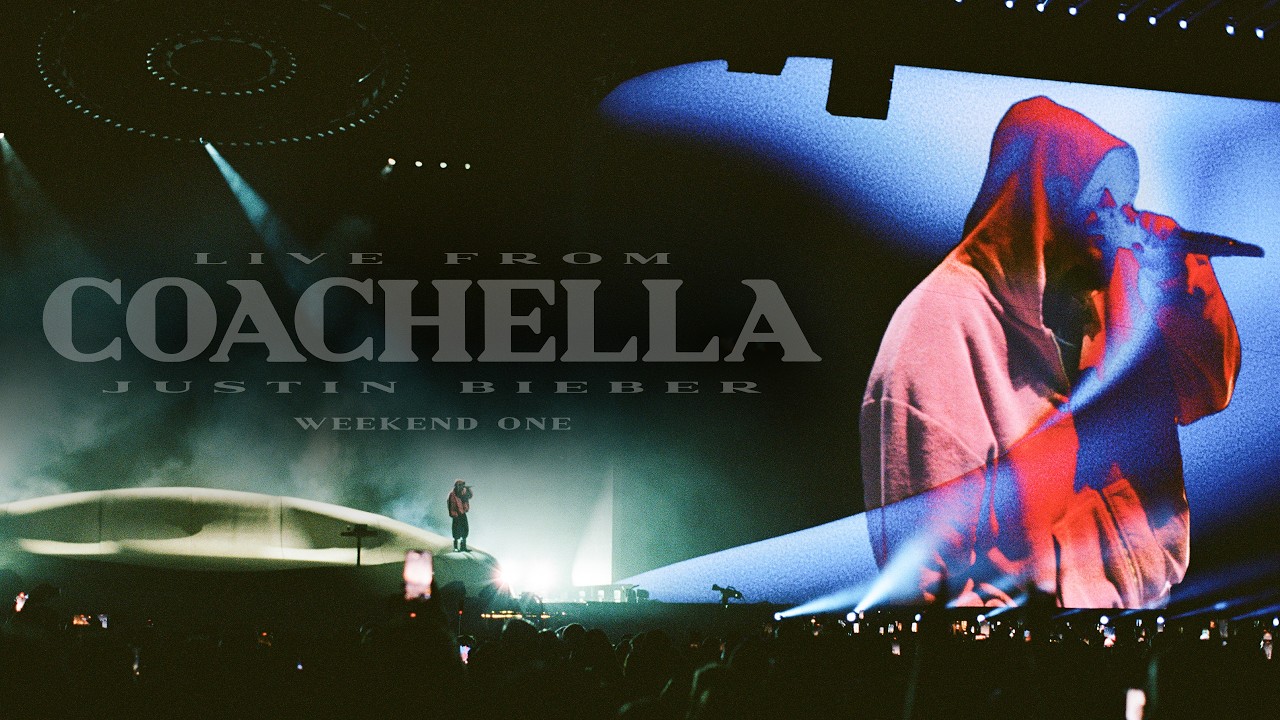
Seo Seongdeok (music critic): There’s two common criticisms of Justin Bieber’s set at Coachella this year: that the performance felt phoned in, and that he didn’t give justice to his older hits because he sold the rights to them in 2023.
First, the copyright sale has nothing to do with performing songs live. Geese even covered Bieber’s song “Baby” right there at Coachella. The only thing that’s changed is that licensing fees from live performances no longer go to Bieber. It was always safe to assume that the singer would lean heavily into newer material for his set. Prior to Coachella, he played two private shows in LA where he performed over 20 tracks off “SWAG.” Folding his older songs into that sonic framework would’ve created a disconnect that was even more jarring. Instead, Bieber emphasized how his “life has been on full display” and sang in harmony along with video of his past self that’s been permanently preserved on YouTube. With moments like the “One Less Lonely Girl” event during Weekend 2, he proved nobody knows his songs the way he does.
Just because a show diverges from the theatrical spectacle that’s become the Coachella headliner standard doesn’t mean it’s phoned in. Coachella is more than simply an event to be livestreamed—it’s to be experienced as a work of art in itself. It’s a unique experience where stage design, lighting, giant screens, and camerawork all work together to form a single unified experience that could only happen there. And you can be sure it’s true because every last part of the show was executed flawlessly: The opener “ALL I CAN TAKE” shot low to the ground, emphasizing the overhead lighting and topped off with vignette. When those lights become a halo during “Everything Hallelujah.” “DAISIES” during Weekend 1, with Mk.gee on a hill at the back of the stage, lit and framed with such careful depth that he looked like something out of a dream. The closing fireworks with Bieber’s name blazing across the screen. The word “lazy” never entered into it.
“Departure(s)” (Julian Barnes)
Kim Boksung (writer): Julian Barnes is an aging writer, living in London with blood cancer and without his deceased wife. This describes both the author of “Departure(s)” and its narrator. The novel—or book, anyway—was released to coincide with the author’s 80th birthday, and he’s long written in a way that blends fact with fiction, but his latest (and what he says will be his last) takes it a step further. A blend of fiction, autobiography, and essay, it’s impossible to say which parts are real and which are imagination, but in this genre-bending book, the narrator (author?) says that part isn’t really important.
Bookending the short read are pieces that feel like essays, sometimes touching on how hazy memories can be, at other times working through the realities of death. These parts can feel a bit tangential at times, but readers will forgive Barnes as he directly thanks them for a lifetime of readership and support—sort of the analog equivalent of a social media shoutout to fans. The middle section is more of a proper story, detailing a love story in two parts separated by decades of lost time. The narrator at once rages against the unfair complexities of love while also extolling its virtues.
Whether fiction or fact, the book certainly leans into the sadness the title suggests, but it’s ultimately hopeful and thankful. Barnes touches on his own literary backlog along the way, so take note as you go along if you’re looking to dive in deeper.