Christopher Nolan’s “The Odyssey” has continued its remarkable box-office run, surpassing 10 million admissions in Korea on September 6, just over a month after its release. It is only the second Nolan film to cross the 10-million mark in the country, following “Interstellar.” The film ranks No. 2 at the worldwide box office among this year’s releases, while Korea has emerged as its fifth-largest market, behind the United States, the United Kingdom, China, and France. And with “The Odyssey” still in theaters, Korea may soon overtake France. What is it about a heroic epic drawn from Greco-Roman mythology — the foundation of the Western literary and intellectual tradition — that has resonated so powerfully with Korean audiences in 2026?
On paper, the reasons for its success are easy enough to identify: a star-studded ensemble, a master filmmaker at the helm, and the scale and resources of a major blockbuster. But the film’s box-office achievement is particularly significant for another reason. At a time when theaters have been losing ground in a media landscape increasingly dominated by streaming, YouTube, and social media, “The Odyssey” has reaffirmed the value of the theatrical experience itself.
Four factors in particular help explain the film’s success. Together, they offer a window into how Korean audiences engage with screen entertainment today — and what their response might tell us about the future of movie theaters.
Brand power: Nolan as a genre unto himself
The term may have fallen somewhat out of fashion, but there was a time when a star’s name alone could sell a movie — a phenomenon often described as “ticket power.” In Korea as elsewhere, a major star was once considered essential to box-office success. Even the phrase “silver-screen star” grew out of this culture. Moviegoing, in those days, revolved around stars.
Young moviegoers today are less inclined to head to a theater on the strength of an actor’s or director’s name alone. Genre, subject matter, style — the calculus of what makes a movie worth seeing has become far more complex. Consider the superhero films that have dominated theaters since the 2000s. How often do we remember the director before the character or the actor? Rarely does a filmmaker’s name become a genre unto itself. Yet the “Dark Knight” trilogy remains so closely identified with Christopher Nolan that audiences may well think of its director before its stars, Christian Bale and Heath Ledger. Why?
The answer lies in Nolan’s approach to filmmaking. He reimagined comic-book superheroes as human beings capable of anguish, vulnerability, and pain, inviting modern audiences to look past the tights and empathize with the person underneath. His restless experimentation with cinematic technique and unfamiliar subject matter may not appeal equally to every viewer, but the craftsmanship of the films themselves is rarely in question. The name “Christopher Nolan” has become a brand unto itself — a promise of blockbuster filmmaking executed at the highest level. That brand power is the first key to the box-office success of “The Odyssey.”
Reimagining the classical hero: A father burdened by modern anguish
In “Interstellar,” Cooper (Matthew McConaughey) leaves for space after promising his daughter, “I’m coming back,” only to face the prospect of not having enough fuel to return to Earth. Odysseus (Matt Damon) in “The Odyssey” finds himself in much the same predicament: both men are driven by a desperate need to make it home to their families. But where Homer’s Odysseus is a cunning hero who savors hospitality and adventure even in the face of danger, Nolan’s is a more vulnerable figure, a man who only belatedly comes to recognize his own wrongdoing. Nolan makes the bold choice to recast the Homeric hero’s journey as a grueling path to atonement. His interpretation has drawn criticism for imposing a distinctly modern moral conflict on Odysseus, but it also reflects Nolan’s enduring preoccupation with fatherhood. Having defied the divine order embodied in the law of Zeus and slaughtered the Trojans, Odysseus confronts the tormented souls of the dead at the threshold of Hades and willingly subjects himself to the Sirens’ song, which he must never hear — forcing him into a painful reckoning with the consequences of his past.
Since the film’s release, audiences and critics alike have parsed the meaning of Odysseus’s anguish and atonement. Yet the tormented hero is hardly new territory for Nolan. Cooper crosses time and space in “Interstellar,” propelled by an urgent love for his daughter; Oppenheimer in “Oppenheimer” is consumed by moral guilt after helping create an atomic bomb of terrifying destructive power; and Bruce Wayne in “The Dark Knight” is haunted by the possibility that his own brand of vigilante justice gave rise to another monster in the Joker. Each is propelled by a sense of absence — and a debt that demands to be repaid.
What is striking, then, is that Nolan finds the makings of a harrowing family drama in the story of a mythic hero from 3,000 years ago. Telemachus (Tom Holland), desperate to protect his mother, Penelope (Anne Hathaway), from the suitors who threaten them during his father’s long absence, mirrors Murphy (Jessica Chastain) in “Interstellar,” whose lifelong longing for her father endures even as she goes on to save humanity. In reframing a story from Greco-Roman mythology familiar to Korean audiences around the modern moral questions and the universal pull of familial love, Nolan finds the second key to the film’s box-office success.
Reviving the fundamental appeal of storytelling through the visual
In an age saturated with short-form content, every filmmaker faces the same imperative: hold an audience’s attention for more than two hours. Nolan has long pushed cinematic form beyond the conventions of linear storytelling, with its clearly defined beginning, middle, and end — and modern audiences have proved remarkably receptive to his experiments. Consider “Memento,” which runs two timelines in opposite directions until they converge in a startling final twist; “Inception,” where dreams within dreams and stories within stories overlap to give visual form to the unconscious; “Dunkirk,” which interweaves the crises of soldiers across different timelines as though they were unfolding simultaneously; and “Tenet,” which brings opposing movements through time together within a single frame. Each exemplifies the distinctive mode of visual storytelling that Nolan has made his own.
“The Odyssey” is that visual storytelling in its most distilled form. Homer’s original, after all, is credited with one of the earliest uses of flashback in Western literature — a narrative innovation that makes it easy to see why Nolan was drawn to this foundational myth. The film begins with Odysseus, who has lost seven years of his memory under Calypso’s spell, then plunges into his recollections: the triumph of the Trojan Horse and the perilous, life-or-death adventures he endured alongside his men. The past unfolds with such immediacy that memory takes on the force of the present. Gradually, these recollections are intercut with events in Ithaca, his homeland now on the brink of collapse in its king’s absence, keeping viewers riveted as they follow Odysseus’s next move.
As these timelines converge, a striking structural symmetry comes into view: the Trojan Horse operation unfolding within the walls of Troy in the past and the bloody slaughter of the suitors within the walls of Ithaca in the present become mirror images of one another. The effect goes beyond visual shock. Through that symmetry, viewers viscerally experience both the ordeal of Odysseus’s atonement and the psychological transformation it brings about. Rather than simply following him through an epic 20-year journey, they must actively trace the story across shifting points in time and space, piecing it together like a puzzle. By turning the act of watching into a form of intellectual play, Nolan transforms the audience from passive spectators into active participants — and therein lies another key to his hold on modern moviegoers.
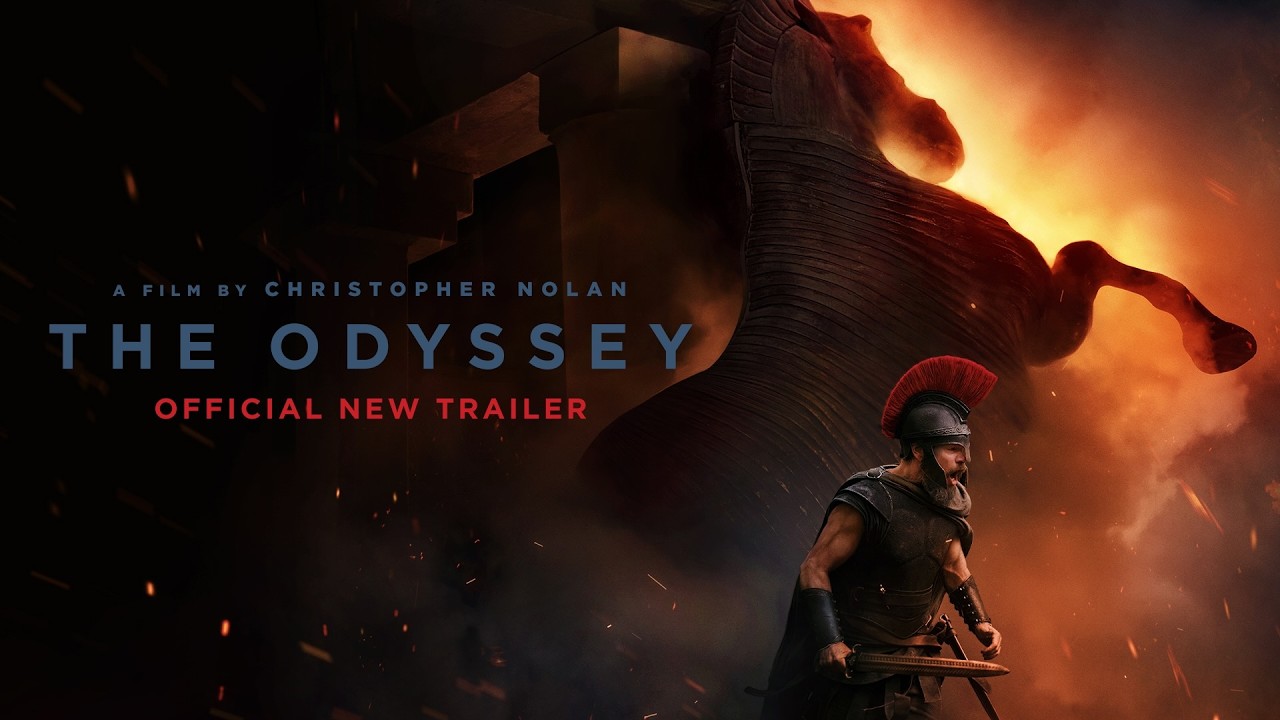
70mm IMAX and the future of the big screen
A film that demands to be seen in a theater. Even before its release, “The Odyssey” drew attention as the first feature ever shot entirely with 70mm IMAX cameras. IMAX cameras offer as much as ten times the resolution of conventional 35mm film cameras, and Nolan has long embraced these massive IMAX cameras — once used primarily for documentaries — as tools of narrative filmmaking. During the production of “The Dark Knight,” one of what were then only four IMAX cameras in the world was destroyed; across Nolan’s productions, three are said to have been damaged in total. The payoff is an experience built for the big screen, one that harnesses the overwhelming scale and resolution of large-format film in ways no home theater or smartphone could hope to replicate.
Nolan is among the filmmakers most firmly convinced that the art of cinema is inseparable from the technology that makes it possible. From silent film to sound, from analog film to digital, and onward to the immersive possibilities of computer-generated imagery and 3D, cinema has never stopped evolving. Nolan has made himself part of that continuum, cultivating a particular expectation among audiences: when he tries something new, they want to experience it in a theater.
One more factor should not be overlooked: the rapid development of Korea’s theatrical infrastructure. The trust Korean audiences have placed in Nolan since “The Dark Knight” has grown in tandem with the country’s multiplexes, which over the past decade have expanded premium formats including Dolby Atmos, IMAX, 4DX, SUPER LED to a level that ranks among the world’s best. That convergence of technological progress and faith in the cinematic experience has helped lay the groundwork for “The Odyssey” to take its place among the masterpieces of modern filmmaking. Whatever form Nolan’s next film may take, the bond of trust connecting filmmaker, theater, and audience is unlikely to be broken anytime soon.
- The reassuring lightness of Tom Holland2026.08.19
- How Yeon Sang-ho’s zombies have evolved2026.06.26
- Playing together in “Toy Story 5”2026.07.21