
“Hello, Twenty - Wonhee” (Coupang Play)
Catherine Choi: When asked whether she thinks of herself as “the nation’s little sister,” WONHEE said she “can be the nation’s ant, the nation’s weed, or the nation’s sprout,” even. Whatever else she might be, the irresistible idol is now unmistakably 20 in Korean age. “Hello, Twenty - Wonhee” follows the ILLIT member as she works through her bucket list with a rotating cast of older “girlies” to celebrate her officially becoming an adult. Throughout the series, these special guests—each standing in for all the adoring girlie fans nationwide—shower WONHEE with affection. First up is comedian Lee Eun-ji, who checks out how much WONHEE can drink. She’s coy at first when Eun-ji suggests they keep things going and move onto the next place for another round, but the young idol soon lights up as they get ready to go. “Of course, I’ll have to get my ID!”
On another episode, WONHEE tries to wow ITZY members YEJI and CHAERYEONG with what she promises will be a bit of magic. She then mimes skimming a bit of grease off the top of each of their heads to execute her “trick”: bringing her fists to her cheeks and scrunching up her face. “Cuties run the world!” YEJI exclaims. “Being cute is a superpower.” The source of that magic, it turns out, is how utterly genuine WONHEE is, whether she’s flustered by her own inexperience hosting the show or by her displays of cuteness. On a camping trip with Kim Sihyeon (aka chef Little Tiger), WONHEE doesn’t hesitate when her guest tears up mid-conversation, immediately taking off her blanket and wrapping it around Sihyeon instead. That unfettered sincerity is exactly why girlies are so instantly and deeply drawn to the idol—the magic of WONHEE at 20.

“Marty Supreme”
Nam Sunwoo (“CINE21” reporter): New York, 1952. Marty Mauser (Timothée Chalamet), a young Jewish man, excels at table tennis. But being good at something, earning good money, and having a good life are all different issues. He’s too proud to stay an amateur, but he can’t call himself a pro given he’s still working for a living. And table tennis being a minor sport in the US means Marty’s talent is more a burden than an asset. For better or for worse, it never occurs to him to see himself through other people’s eyes. With reflexes that are second to none, he just reaches out and grabs whatever opportunities flash past him. “Marty Supreme” sprints to keep up with its hungry, hotheaded protagonist, and doesn’t shy away from treating the audience like a ping pong ball.
After catching my breath, I checked out what director Josh Safdie had to say. “The people who excelled at table tennis were often people who didn’t fit anywhere else,” Safdie notes. “It wasn’t respected, so naturally it attracted weirdos, purists, obsessives.” What Marty is really fighting, it seems, is the feeling that the world has no use for what he has to offer. Something that never stops being humiliating no matter how used to it you might become. A fury that builds and builds until it consumes you whole. When that’s your situation, calm is hard to come by. Staying quiet feels too much like losing.
Life can hand out gifts that seem to say, “It’s time to stop.” In the final scene, Marty opens one such package and breaks down crying. Why does something he never wanted, something he’d gone out of his way to avoid, move him to tears? Does he catch a glimpse of himself in someone who’s been treated the same way by the world? Maybe it finally hits him, with all its painful implications, that a mismatch between reality and desire doesn’t always have to end in the worst way possible. The film ends abruptly as if too embarrassed to admit that fact, and as the credits roll, “Everybody Wants To Rule The World” by Tears For Fears plays, the opening lines speaking directly to a protagonist who has, in the end, shed the tears that accompany personal growth: “Welcome to your life / There’s no turning back.”
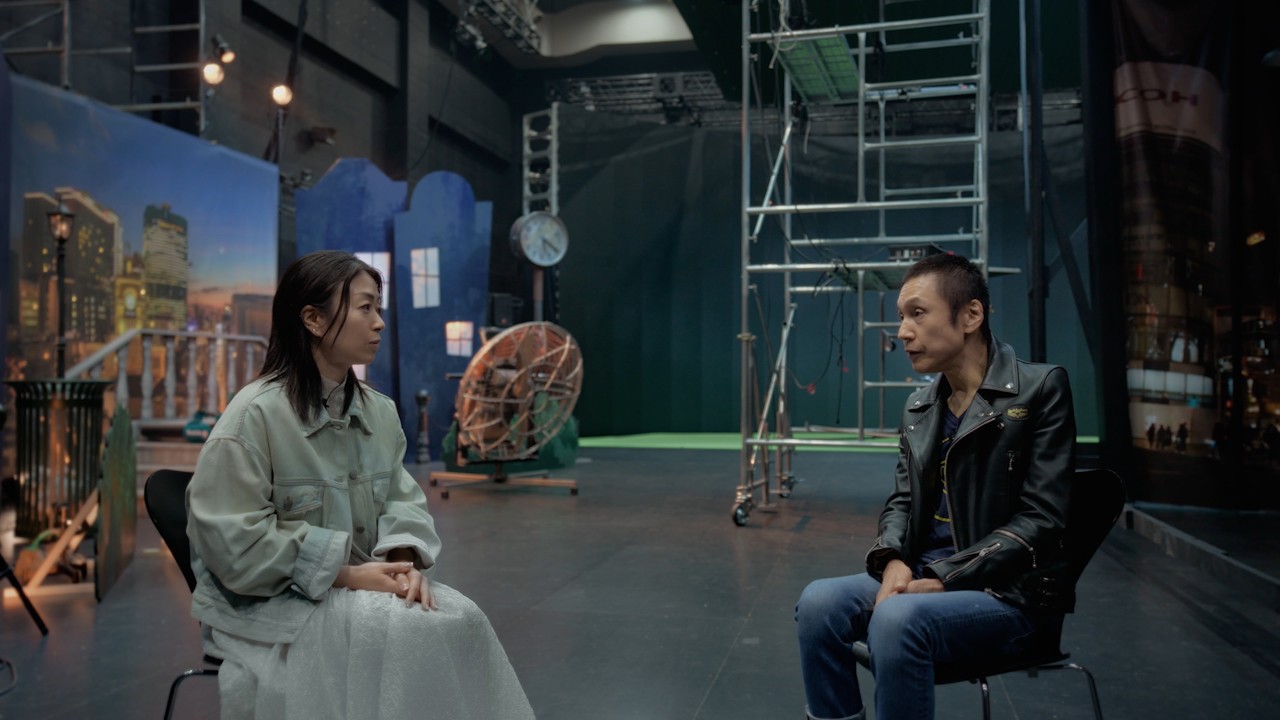
“PAPPAPARADISE” feat. Hiroto Komoto (Hikaru Utada)
Hwang Sunup (music critic): “I always run away. The second something gets to be a hassle, I’m out. But that gives me breathing room. Free time, too. And that’s where I get to do what I love.”
A day after releasing a music video together, its two artists put out another video, this time a conversation, and that bit of dialog from Hiroto Komoto goes straight to the heart of their song, which opens with the lines, “I want to keep doing what I love / There’s nothing wrong with being a fool.” Komoto’s been active since the 1980s, a hero of the Japanese punk scene with bands from the Blue Hearts to the Cro-Magnons. Those four decades spent moving ever forward on the simple conviction that “I don’t think I can do anything other than rock ’n’ roll” gives full meaning to the message Hikaru Utada wanted to convey through this song: Be yourself. Maybe that’s why, with each listen, what felt like a puzzling collaboration when first announced eventually feels like it couldn’t have been any other way. Whatever you make of the song itself, the harmonious reflection of how these two people live their lives is surprisingly moving.
The song now serves as the ending theme for “Chibi Maruko Chan,” a long-running anime that’s become something of a national institution in Japan. The song’s biggest selling point is how seamlessly it weaves a warm, undeniably catchy melody into sleek musical stylings borrowing from Black music. Add to that the strangely pleasant discord of Komoto’s one-of-a-kind guileless vocals, and Utada’s spot-on use of a multifaceted chorus to keep the music perfectly on track, and the result’s a song that’s as meaningful as it is expertly crafted. “I didn’t do this because I expected it to work out,” Komoto says, “I did it because I wanted to give it a try. And that’s how I found out that there’s meaning in that, too.” A life spent chasing what you love, it seems, is also a journey of endless discovery. I couldn’t be happier that we got to see these two sing together.